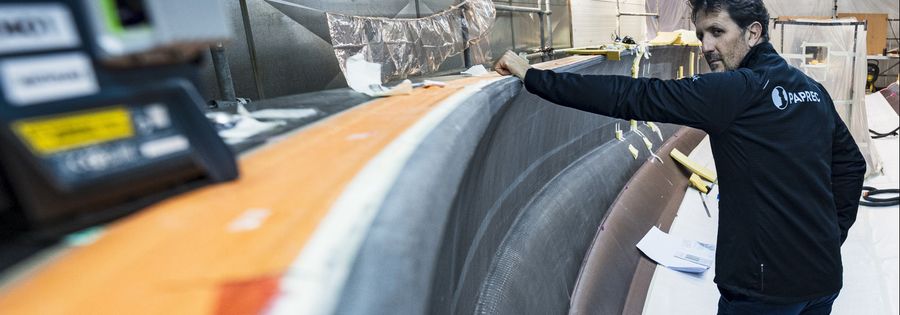
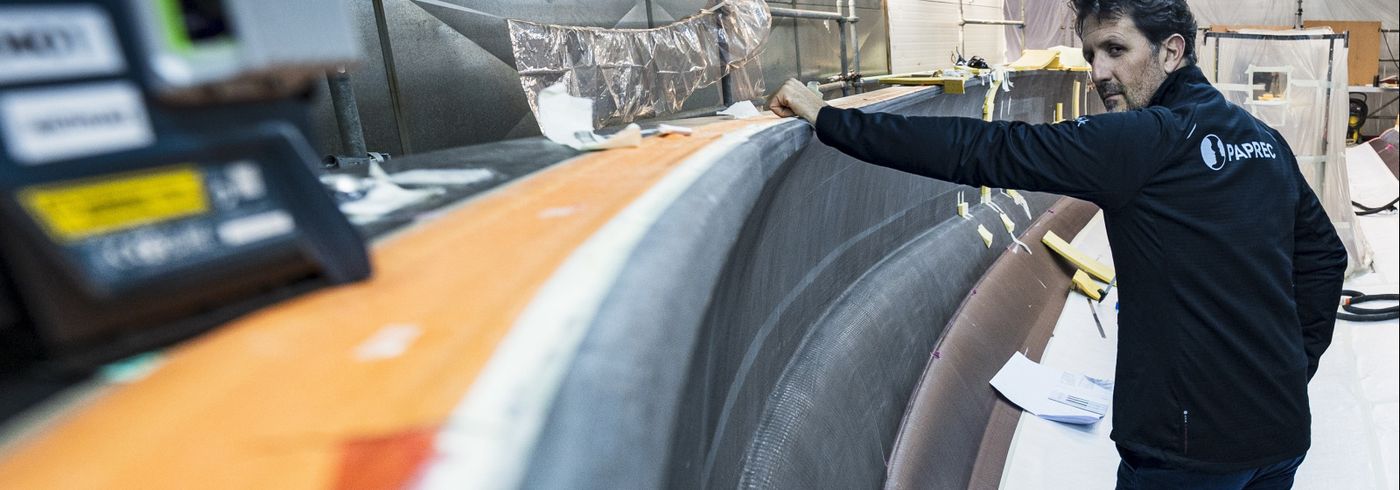
The new IMOCA Paprec will look slim, narrower than almost anything the class has launched in recent years, and the design team made that choice on purpose.
For a while now, successive generations of IMOCA 60s have crept towards the maximum hull width allowed under class rules. Yoann Richomme's new boat breaks that trend outright. To understand why, you have to go back to how these boats actually generate their power.
"Before, boats were wide because power came from the width of the hull," Richomme explains. That assumption no longer holds. Foil technology has matured to the point where, in his words, "it's the foils that generate power" now, not the hull shape.
The shift is playing out well beyond IMOCA racing. "Experienced wingfoil riders have a tiny board because they know that once you're airborne, it works really well," Richomme says. Gautier Levisse, who heads Team Paprec's design office, puts the history in context: foils were originally paired with big hulls and large sails, but "once you're flying, the hull doesn't serve much purpose". The result, he says, is that designers have tended to "reduce hull width as mastery of the foils develops".
Naval architect Antoine Koch frames it slightly differently. "Because we understand the behaviour of foils better and better, and trust them more, we can reduce the width of the boat."
A second factor behind the narrow hull is drag. To get the most out of the foils, you need to minimise contact with the water and the waves, and therefore minimise friction. "We're fighting hull drag," says Levisse. "By definition, being narrower creates less drag. We didn't need to run a lot of CFD studies to know that the slimmest object slices through water best. There's nothing better than making the hull as fine as possible."
That matters in rough, built-up seas too. "The key is being able to move quickly through the waves, without slamming to a stop and without losing time," Richomme says.
But narrower is not automatically better. "We still wanted to make sure the boat had enough power to get going," Levisse adds. A hull that handles waves well is no use if it cannot accelerate up onto the foils in the first place. Three chines were added to the design, their weight judged acceptable against the hull's overall mass, to help bridge that gap.
The upshot: the new Paprec IMOCA will reportedly be narrow enough to fit inside a Class40.
Not every team has reached the same conclusion. DMG-Mori Sailing Team and Groupe Dubreuil, both working with architect Guillaume Verdier, have gone the other way. Their new boats, unveiled this northern summer, feature a "converging" hull shape borrowed from trimaran central hulls, with a pronounced stern section designed to stay in constant contact with the water.
"It's very interesting," says Richomme. "Usually IMOCA designs converge, and that's not the case here. These will be boats with quite different strengths and weaknesses."
Two philosophies, one class, and no clear answer yet. That will only come once the new Paprec boat hits the water, due next northern spring, and lines up against its wider rivals for the first time.