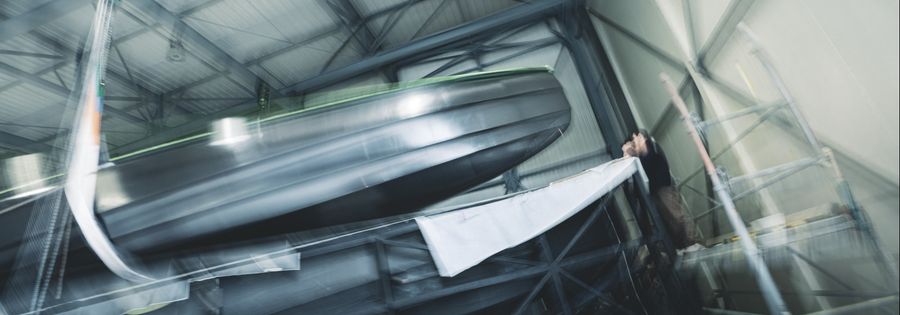
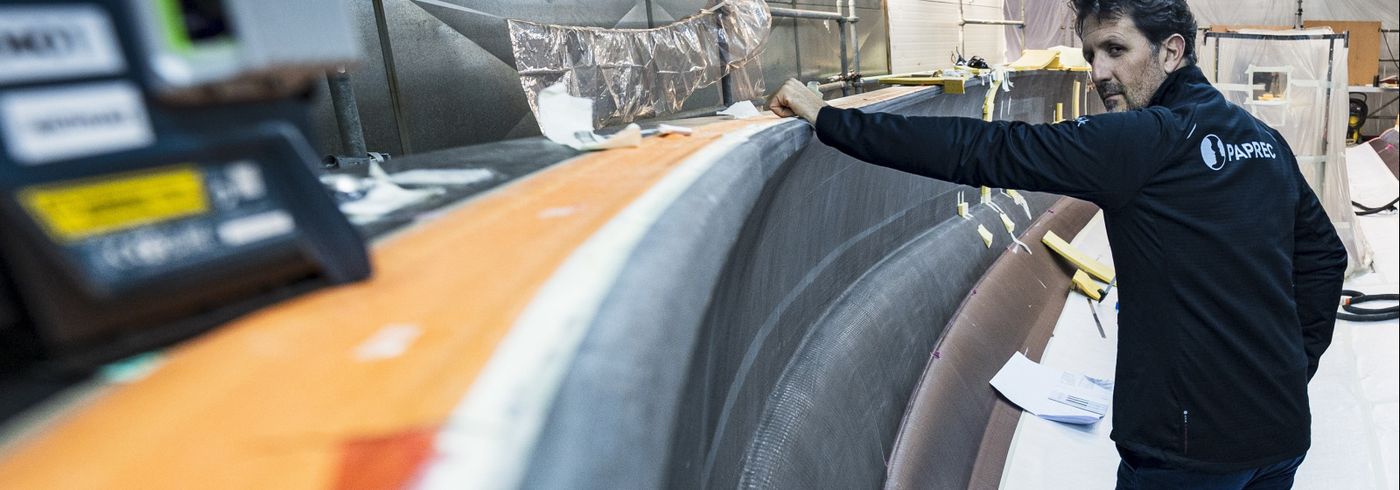
The next IMOCA Paprec is going to be narrow. Properly narrow, the slimmest hull the team has launched in years, and that is no accident.
It runs against the grain of what offshore sailing fans have come to expect. For years, IMOCA designers pushed hull width to the maximum the class rules would allow. Yoann Richomme's new boat is going the other way entirely.
The reasoning comes down to where the power now comes from. "Before, boats were wide because the power came from the width of the hull," Richomme explains. That has changed. Foils now generate the power that hull shape used to provide, and the design logic has flipped with it.
It is not an IMOCA-only phenomenon, either. "Experienced wingfoil riders have a tiny board because they know that once you're airborne, it works really well," Richomme says. Gautier Levisse, who heads up Team Paprec's design office, traces the same pattern back through foiling's history: "Originally, foils were paired with big hulls and big sails. But once you're flying, the hull isn't much use any more." As confidence in foil performance has grown, engineers have progressively narrowed hulls to match.
Naval architect Antoine Koch puts it simply: "Since we understand the action of foils better and better, and trust them more, we can reduce the width of the boat."
A narrower hull also cuts drag, less wetted surface, less friction against water and waves, and more of the foils' potential actually realised. "We're fighting against hull drag," says Levisse. "By definition, being narrower creates less drag. We didn't need to run a lot of CFD studies to know that the slimmest shape slices through water best. There's nothing better than making the hull as fine as possible."
That matters most in rough, built-up seas, where the goal is simply to keep moving. "The important thing is to get through the waves fast, without stalling and without losing time," Richomme adds.
Speed off the mark still matters, though. "We wanted to make sure the boat had enough power to get going," Levisse says. "Because even if the boat handles the sea better, the hull still needs to let it accelerate before the foils take over." Three chines were added to help, their weight judged acceptable against the hull's overall mass.
The result is a boat so fine it could, in theory, fit inside a Class40.
Not every team has gone this route. DMG-Mori Sailing Team and Groupe Dubreuil, working with architect Guillaume Verdier, have taken a different path with their new boats, unveiled this northern summer. Their hulls converge towards the stern, inspired by a trimaran's central hull, with a pronounced aft shape that stays in constant contact with the water.
"It's very interesting," Richomme says. "Usually IMOCA designs converge on similar solutions, and that's not happening here. These are going to be boats with quite different strengths and weaknesses."
What unites the fleet is simple curiosity. Everyone wants to see how it all plays out once IMOCA Paprec hits the water, with launch pencilled in for next spring.