Damien Guillou on Solarem still leads the Golden Globe Race 2026 on Day 77, with 16,234 nautical miles to go at the 20:00 UTC tracker update on 21 November (9am Sunday NZDT). That puts him 1,293 miles ahead of Ertan Beskardes on Miss Beagle. Henry Wootton on Privateer holds third, but the latest tracker figures put Etienne Messikommer on Bernard fourth, just 16.5 miles behind him.
Further back, Gunnar Christensen spent the night on Pompoen counting squalls, eight of them by morning. Somewhere in the middle of it all he saw a single white light where no light should have been.
Golden Globe Race 2026: distance sailed
Tracker snapshots, start to Day 77
Source: Golden Globe Race live tracker (Yellow Brick)
Golden Globe Race Day 77 standings
Here is the order at the 20:00 UTC tracker update on 21 November, with nautical miles to go and the miles each boat sailed since our Day 76 snapshot, worked out from the tracker's distance-sailed totals.
Damien Guillou, Solarem: 16,234 to go, 157 miles sailed
Ertan Beskardes, Miss Beagle: 17,527 to go, 125 miles sailed
Henry Wootton, Privateer: 17,832 to go, 146 miles sailed
Etienne Messikommer, Bernard: 17,849 to go, 104 miles sailed
Daniel Pinsky, Exodus: 17,906 to go, 109 miles sailed
Pär Nyman, Lazy Otter: 18,329 to go, 157 miles sailed
Guido Cantini, Hannah of Cowes: 18,571 to go, 108 miles sailed
Isa Rosli, Olleanna: 18,877 to go, 123 miles sailed
Gunnar Christensen, Pompoen: 18,891 to go, 101 miles sailed
Matt Woodside, Tipi Haere: 19,092 to go (last position 12:00 UTC)
Ten skippers are still racing, spread over about 2,858 miles from front to back. The tracker now lists Andrea Lodolo on BiBi as retired. The race office did some sums on Saturday: 16 starters and 10 still going, against one finisher from nine in 1968, five from 18 in 2018 and three from 16 in 2022. Ten sailors all reasonably content in the Southern Ocean at the same time struck the race office as almost suspicious.
Who is third in the Golden Globe Race now?
Wootton is still third, but the gap behind him has all but closed. Yesterday Messikommer was fifth and 375 miles behind Wootton. Since then his distance to go has dropped by 474 miles while the tracker shows him sailing only about 104, so something has changed in how his distance to finish is being calculated. What caused it is not clear, and his fourth place is worth watching over the next few updates. Either way, Wootton, Messikommer and Pinsky are now within about 73 miles of each other, and the race office has noted that Messikommer's southern position could pay off when the next weather systems arrive. Our Day 76 report had Wootton 53 miles clear of Pinsky, and these three have traded places all the way from Cape Town.
Pär Nyman logged the best 24-hour run on the board at 148 miles, leaving aside Messikommer's suspect figure, and is now 424 miles behind Pinsky. Further back, Isa Rosli has slipped past Christensen into eighth. A day ago he trailed by 1.1 miles; now he is 14 miles ahead on the leaderboard.
Where is the weather risk for the fleet?
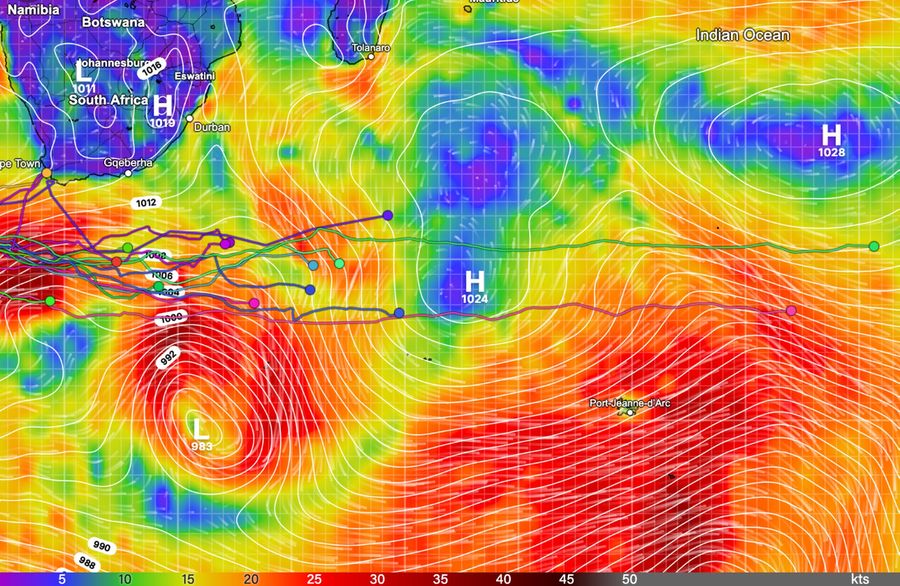
This is our own read of the PredictWind ECMWF and GFS wind maps, with times as shown on the maps. The data covers the sea from west of South Africa to roughly the longitude of Mauritius, so it misses Guillou far to the east. Forecasts change, so treat this as a guide for awareness only.
Right now a deep low sits south of South Africa, ringed by 30 to 40 knots, and it is parked among the back half of the fleet.
By Sunday evening the maps show two systems, a broad area of 30 to 40 knots in the west and a tighter low further east with a 35 to 45 knot ring, a little stronger on the GFS. On Monday they merge into one big circulation with 30 to 40 knots across its northern side, which looks like the roughest day for the middle and back of the fleet. Tuesday eases to 25 to 35 knots as the system moves east. By Wednesday the models split: the GFS spins up a new compact low just south-west of South Africa with 30 to 40 knots, while the ECMWF keeps it closer to 20 to 25.
Eight squalls and a mystery light aboard Pompoen
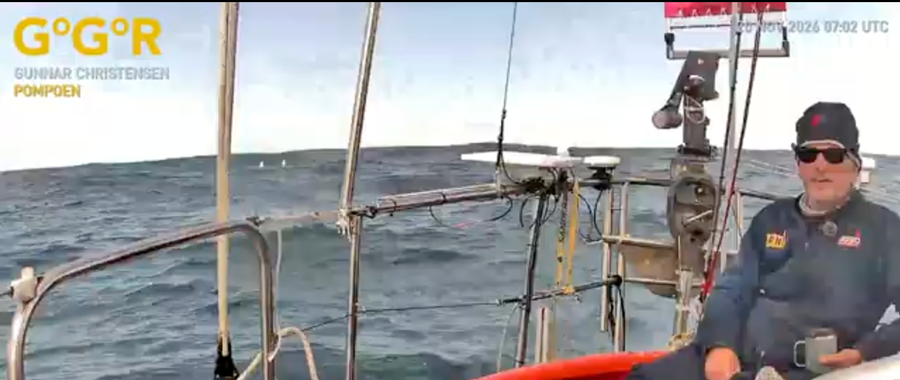
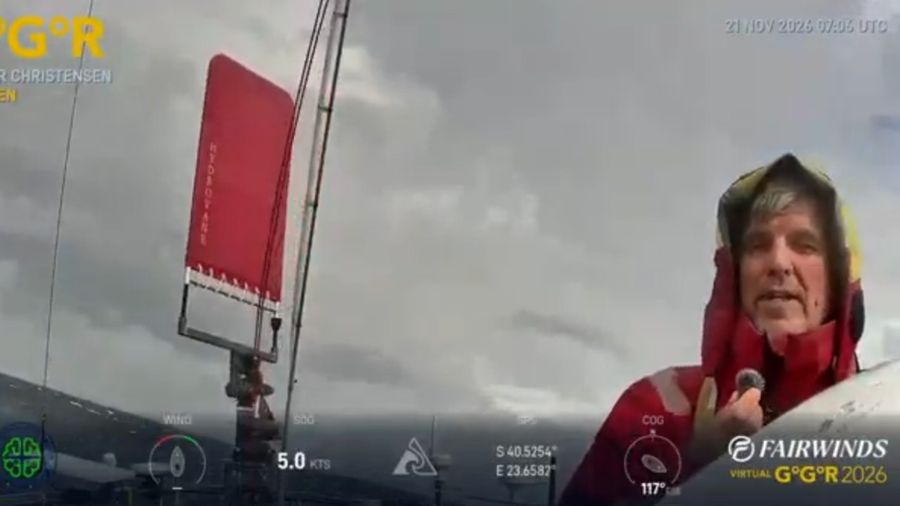
Christensen opened his Saturday morning broadcast at about 40.5 degrees south and 23.7 degrees east by announcing the eighth squall of the night, each one blowing 40 knots or more before dropping back to 20 and leaving him to wallow until the next. He had been pulling the jib out to keep the boat moving and then wrestling it back in every time a squall hit, which he called mayhem and hard on the sails and rig. He settled on a triple-reefed main and a reefed staysail, and admitted he was very, very tired.
Some squalls came with no cloud at all, he said, just a white wall of wind that laid the boat on her side. The wind had swung to the north-east overnight, an odd direction in the westerlies, and his starboard spinnaker pole had worked loose, chafed through the cover of a sheet and jammed, so he cannot pole out a headsail until he sorts it. He called the area the Cape of Storms living up to its name.
Then there was the light. During the night he saw a single white light ahead of a squall cloud, which he took for a yacht's masthead light. He was sure it was not a star and did not look like a ship, and he wondered whether it might be Rosli on Olleanna, whose VHF radio only works on low power. The two are 14 miles apart on the leaderboard, though that is a gap in distance to finish rather than a measure of how close they are on the water, so for now the light stays a mystery.
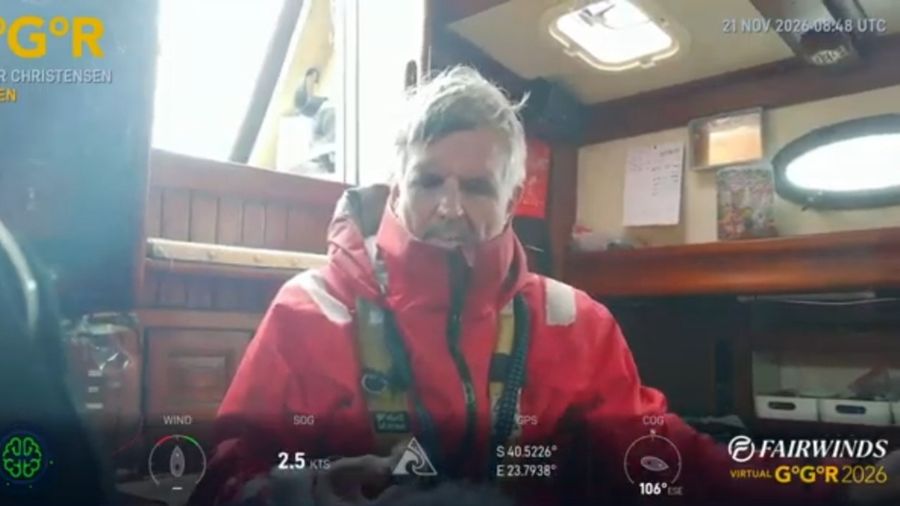
There was plenty to smile about between squalls. He complained that his camera was meant to be a follow-me camera but refused to follow him, then watched it wander off on its own. He keeps a weekly barograph sheet and numbers every low on it, each with a nickname we cannot print; this one is number five.
Breakfast was porridge with blueberries, though his glasses were too wet to read how much water to add, and everything in the galley had gone flying overnight, so his utensils were living in the rubbish bin. He promised viewers a coffee later, and swore he meant it. He also noted that sunshine down here is deceptive, because all it does is let you see the next squall coming. Our earlier piece on Christensen letting viewers pick dinner shows he rarely lets a bad night spoil the show.
Beskardes takes a sun sight and dreams of sandwiches
A long way east, at about 43.4 degrees south and 48 degrees east, Beskardes had his own rough night. The waves were three or four metres and the wind about 25 knots, but the gusts of 40-plus kept him busy adjusting the Hydrovane all night. Miss Beagle carries a mast about one and a half metres shorter than the rest of the fleet, so his first reef is really two and his second is more like three. He ran two of them on the main alone and still averaged six and a half to seven knots.
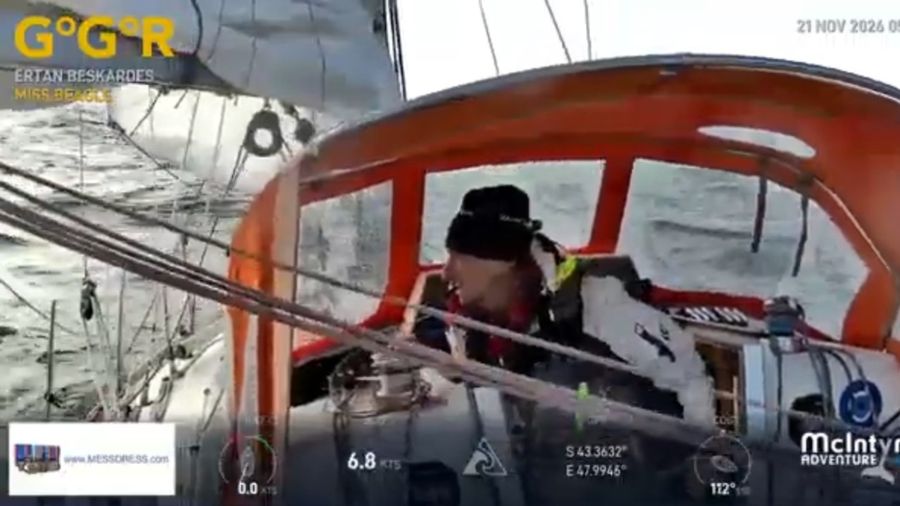
By 05:16 UTC on Saturday the sun was out and he was grinning under the spray hood. He called the view very pretty, then corrected himself to a little bit terrifying. He is counting down to 65 degrees east, when he can pull out the next paper chart, the one that finally shows Hobart, and he reckons that will feel much better psychologically. Then came the morning sun sight in the cockpit. He pleaded with the waves that it was not fair when they knocked him about, shouted a happy "opa" when he caught a good one, and went below to work through the sums.
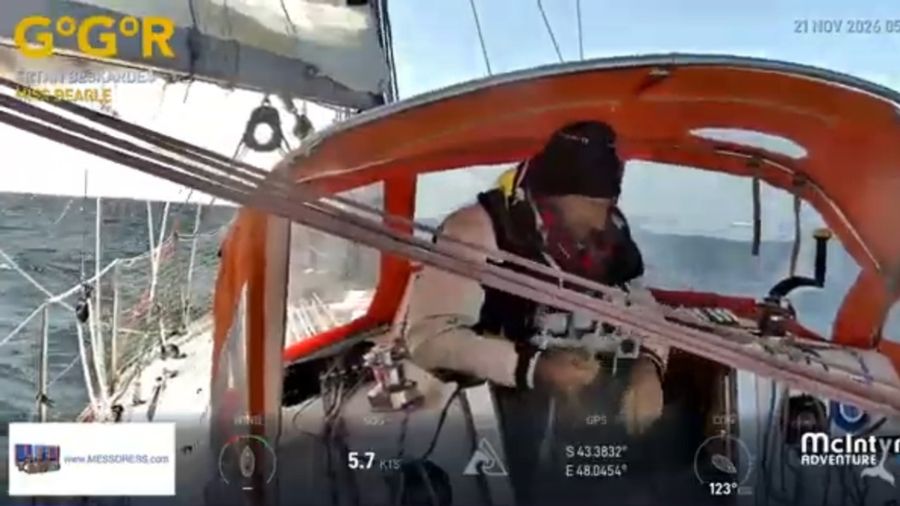
His cockpit hatch keeps sticking, and he has weighed up WD-40, hand cream and sunscreen as possible cures. The YB tracker beeps every so often and he keeps wondering what the noise is until he remembers. Lunch was a cup of soup: he has worked through the mushroom packets and moved on to something tomato-ish, served in the same cup he used for coffee, while dreaming aloud of proper bread, a cheese sandwich, a banana or a pastrami sandwich. By Saturday night the wind had dropped to 8 to 10 knots under a sky full of stars, and he said you do not get better night sailing than that, before asking the wind, very politely, for a little more. He also noted that everyone seems to be in completely different weather, with Christensen in the rough stuff and Messikommer enjoying plenty of breeze. His earlier plea to his compass for 100 shows he talks to his boat as much as to his viewers.
Across the fleet
The race office's Saturday morning update had Guillou heading steadily east and being nudged a little south-east, and it reckons he is one to one and a half weather systems ahead of his nearest challengers, which is a big part of why the gap keeps growing. It had Wootton making good speed in the right direction, Pinsky slowed by his patch of weather, Nyman enjoying the chase, Cantini being pushed north by uncooperative winds and Rosli possibly escaping the adverse current that has held him back. Woodside, at the back, was getting a lift from a stronger breeze and had been warned the system was coming. The race office cheekily called him a potential race winner, because in the Golden Globe Race finishing is everything. Our earlier report on rig failure, knockdowns and lies about westerlies explains why every skipper is still sailing one system at a time.
What to watch
Whether Wootton can hold third once Messikommer's tracker figures settle, and whether Pinsky can stay in touch. How the back markers, Christensen, Rosli and Woodside in particular, cope with Monday's strong westerly flow, and whether the GFS low near South Africa on Wednesday turns out to be real. And whether anyone can explain the light Christensen saw in the night.
Follow the whole race on our dedicated Golden Globe Race 2026 page.