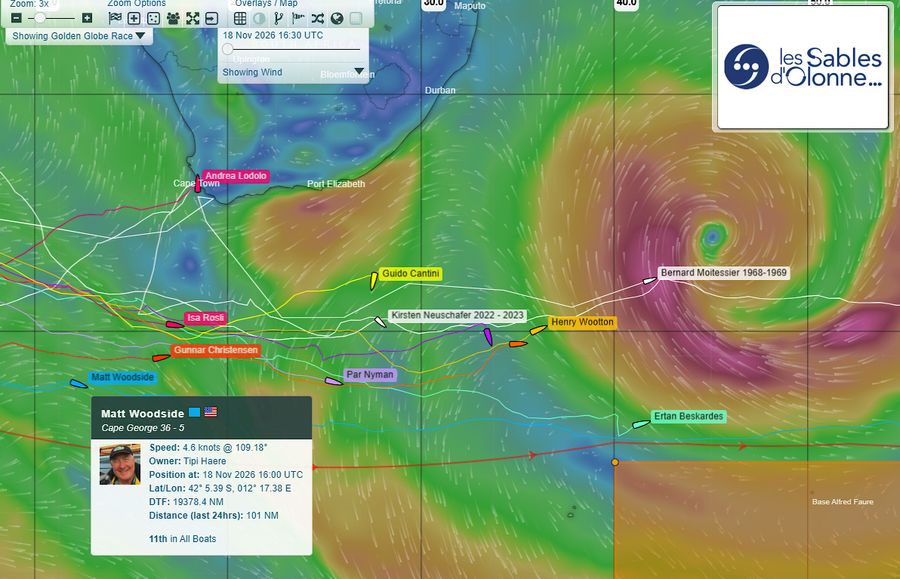
Damien Guillou on Solarem still leads the Golden Globe Race 2026 on Day 74, with 16,665 nautical miles to go at the 20:00 UTC tracker update on 18 November. Daniel Pinsky on Exodus has moved into third place, about four miles ahead of Henry Wootton on Privateer, while Guido Cantini on Hannah of Cowes has a sagging forestay and is leaning towards Cape Town. Further back, Isa Rosli on Olleanna and Gunnar Christensen on Pompoen are less than a mile apart in distance to go, and Ertan Beskardes on Miss Beagle spent the day bargaining with his compass and a stubborn potato gratin.
Golden Globe Race Day 74 standings
Here is the order at 20:00 UTC on 18 November, with nautical miles to go and the tracker's run for the previous 24 hours.
1. Damien Guillou, Solarem: 16,665 to go, 122 miles
2. Ertan Beskardes, Miss Beagle: 17,788 to go, 419 miles on the tracker (see below)
3. Daniel Pinsky, Exodus: 18,471 to go, 41 miles
4. Henry Wootton, Privateer: 18,475 to go, 23 miles
5. Etienne Messikommer, Bernard: 18,522 to go, 72 miles
6. Pär Nyman, Lazy Otter: 18,783 to go, 174 miles
7. Guido Cantini, Hannah of Cowes: 18,823 to go, 37 miles
8. Isa Rosli, Olleanna: 19,195 to go, 140 miles
9. Gunnar Christensen, Pompoen: 19,196 to go, 128 miles
10. Matt Woodside, Tipi Haere: 19,359 to go, 97 miles
Ten skippers are still racing. Andrea Lodolo is in Cape Town and is not in this order, even though the tracker still lists his boat.
Golden Globe Race 2026: distance sailed
Tracker snapshots, start to Day 74
Source: Golden Globe Race live tracker (Yellow Brick)
Who is third in the Golden Globe Race now?
Pinsky, by about four miles. At the Day 73 update Wootton led him by 21 miles, so the tracker has swung 25 miles Pinsky's way in a day: Pinsky cut his distance to go by 48 miles to Wootton's 23. These gaps are measured in distance to go, not the distance between the boats. Messikommer is fifth, 47 miles behind Wootton. Our earlier pieces on Pinsky closing to two miles and Wootton edging into third show how long this pair has been trading the place.
There was also a swap behind them. Nyman's 174 miles took him past Cantini into sixth, and he now leads him by 40 miles after trailing him by 97 a day earlier. At the back, Rosli's lead over Christensen has shrunk from 17 miles to under one, and Christensen is 164 miles clear of Woodside.
At the front, the tracker shows Guillou's lead over Beskardes at 1,123 miles, down from 1,420 in our report on the milk pond and the clean shave. That is not a real gain for Beskardes. His 24-hour run shows as 419 miles, but his distance sailed rose by only 104 miles, against 141 for Guillou. The race office has said the tracker is measuring some boats against different waypoints, so read the run figures with care.
Cantini's forestay sags
The day's biggest news came from the race office. At about 23:00 UTC on 17 November Cantini rang race control to say his forestay may have broken at the masthead. He had stopped for the night in about 20 knots with an acceptable sea, was about 450 miles south-east of Cape Town, said he was fine and asked for no help. He planned to climb the mast in the morning, and if the stay could not be repaired Cape Town was the only option.
The forestay supports the mast and carries the headsails, so a failure there limits how much sail he can set safely. By Wednesday the race report had it sagging, with Hannah of Cowes making under a knot with her headsail furled. A sea of about 2.5 metres was too rough to climb the mast, and stronger weather was coming, so Cape Town looked the likely stop. A stop there would move him into the Chichester Class under the race rules. He has not retired, and race management has talked the rules through with him. The tracker agrees that he slowed, with a run of just 37 miles.
Beskardes begs his compass for 100
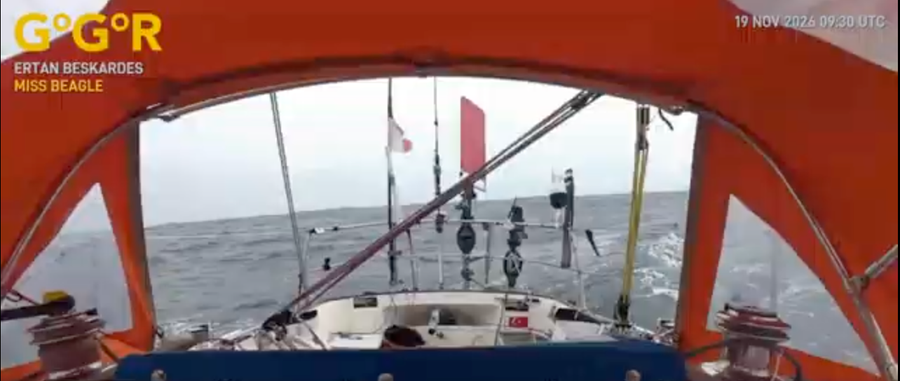
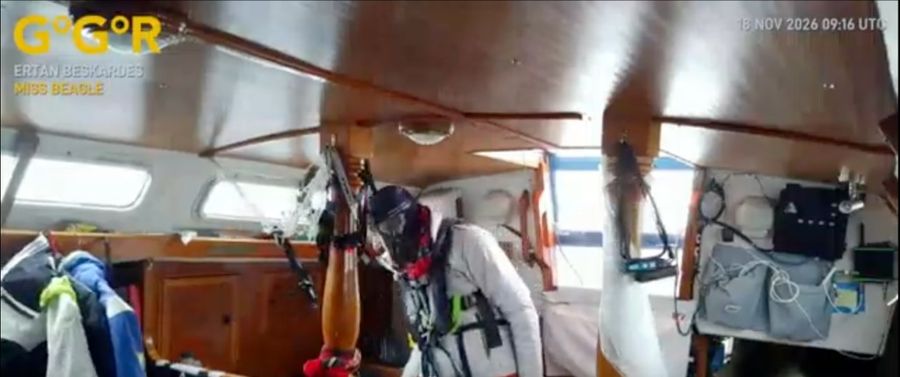
Ertan Beskardes spent Wednesday 18 November UTC on Miss Beagle at about 43.8 to 44 degrees south. At 05:45 UTC he was out under the red spray hood, making 4.3 knots and putting a little extra tension on the backstay. He had slept in full wet-weather gear under three layers of blankets, and he followed it with his first cup of tea since the day before, then a cup of soup, holding the mug to warm his hands.
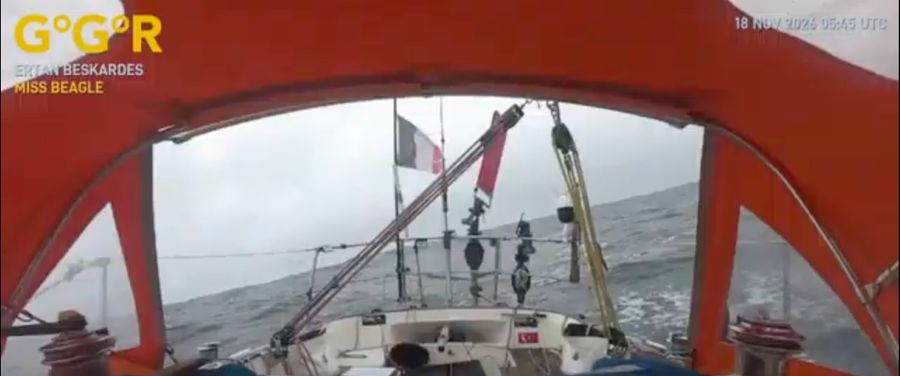
Later he shook the reef out of the mainsail and spent a good while coaxing the halyards up one colour at a time. He gave each line a pep talk, assuring the green one in particular that it was very important.
Soon after 08:00 UTC the wind was close to dead east with hardly any south in it, and his compass kept wandering between 90 and 100 degrees. He asked it politely to hold above 100, begged it, then turned away on the theory that it might behave if nobody was looking. The wind vane was doing the steering, so all he could do was watch the wind. His plan was to give up a little latitude, from about 44 to 43 degrees south, to make easting, then come back down when the wind turned. He likes to sit near 43.5 to 44.5 degrees south for the long run.
A potato gratin, a text to the chairman and a torch with no switch
A recording that starts at 08:34 UTC has Beskardes switching on the satellite phone and texting race chairman Don McIntyre to ask for a bit of affection, by which he meant a bit of information about how he was doing. No reply came, and he left the phone on in case.
By 09:01 UTC Miss Beagle was at 43.82 degrees south doing 5 knots, and Beskardes was making a freeze-dried potato gratin that McIntyre had given him. The first batch stuck and popped out of the saucepan, and the tin foil lid he built for the second fared no better, which he put down to being rubbish at it. He scored the result very highly anyway, and by the third go he said the burnt bits were the best part.
Around 09:40 UTC he sorted through the supplies box and found a diving torch with no button, which left him wondering how anything could work if nothing on it turned. He also found two disposable cameras, a single sock and a spare chocolate bar. The cabin thermometer read 12 degrees, which he called tropical. The VHF radio would not even crackle, so he announced to an empty ocean that this was Miss Beagle and asked if anyone was around, then gave up.
Christensen calls his boat Pumpkin
Further north, at about 41.1 degrees south, Gunnar Christensen had a day of dead microphones and radio calls. Around 10:00 UTC he was making 5.3 knots and admitted he is a news junkie, working through last year's copies of a weekly magazine and catching the BBC pips to set his watch. He calls Pompoen, the Afrikaans word for pumpkin, Pumpkin, and said she was in her stride, with a second reef in overnight when the barometer sagged and a reef out again at three in the morning.
At about 12:10 UTC he was fighting the batteries on a pair of wireless microphones and announcing that he was sailing like it was 1968. He fixed lunch from his freeze-dried stash, decided chicken korma needed no explanation, and measured the water in the only cup aboard with millilitres on it.
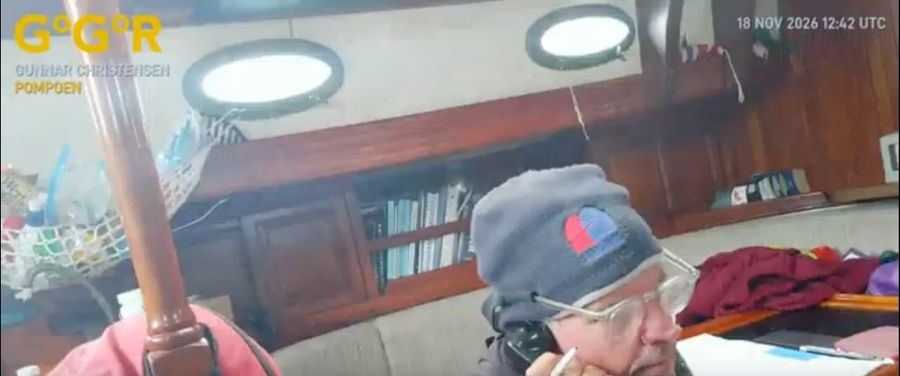
From about 12:15 UTC he spent most of an hour on the HF radio to Rosli, swapping positions and barometer readings, which were both falling. At one point there was a joke about ordering a bird book on Amazon and having it delivered by drone. On the radio the two sounded like neighbours, but the tracker figure is distance to go, so they are not necessarily within a mile of each other on the water.
Across the fleet
In the race office's daily messages from the boats this week, Pinsky wondered where the promised westerlies had got to, and Messikommer reported whale spray. On the tracker, Rosli's 140 miles and Christensen's 128 were the next best runs after Nyman's 174, leaving aside Beskardes's tracker quirk, while Woodside managed 97 at the tail of the order.
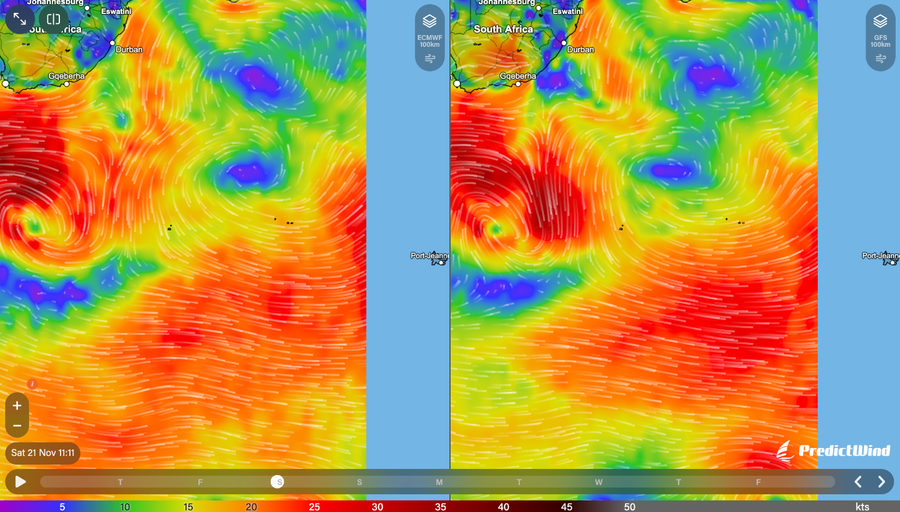
Golden Globe Race weather outlook for the fleet
This is our own read of the PredictWind ECMWF and GFS wind maps, with times as shown on the maps, so treat it as a rough guide for awareness only.
Wednesday 18 November, 16:35: a low east of Durban with about 35 knots, a strong low and cold front far to the south-west, a 25 to 35 knot band south of the fleet, and light air near the Cape.
Thursday 19 November, 10:11: the low east of Durban is deep, with 35 to 40 knots and the GFS stronger, and a 30 to 35 knot band arcs round the south.
Friday 20 November, 10:34: winds ease mostly to 15 to 25 knots, with a 30 to 35 knot patch in the middle and 35 knots or more in the far south-east.
Saturday 21 November, 11:11: a new low south-west of Cape Town has 35 to 40 knots at its core, with 15 to 25 knots elsewhere and light patches east of the Cape.
Sunday 22 November, 11:34: a large, deep low sits over the sailing area with 35 to 45 knots, the ECMWF showing the darkest colours.
What each skipper meets will depend on where they are and how the systems move.
What to watch next
The big question is whether Cantini can inspect and repair his forestay at sea or has to turn for Cape Town. Pinsky must now defend a narrow third place over Wootton, Rosli and Christensen remain virtually level on the tracker, and the weekend lows will test everyone. Beskardes, for his part, would like the wind to be anything but east. For another day aboard Miss Beagle, see our piece on his damaged companionway.
Follow the whole race on our dedicated Golden Globe Race 2026 page.