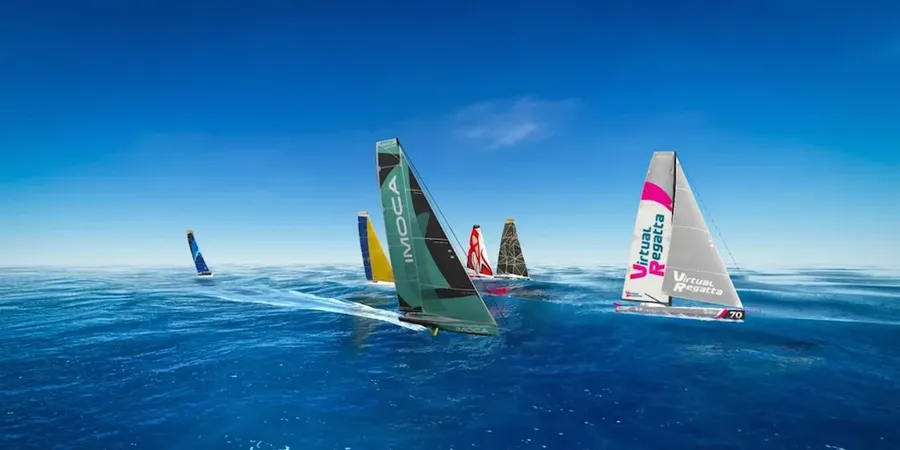
Virtual Regatta players will tackle a genuine piece of high-latitude sailing this Sunday, racing over the exact same course as the nine IMOCA skippers competing in the Vendée Arctique. The start is Les Sables-d'Olonne, the objective is the Arctic Circle, and the only obligation is to touch that polar boundary somewhere along the way before heading back south. No marks, no prescribed routing, no waypoints to follow in sequence. Just open ocean, a finish line, and every strategic decision in between left entirely to the skipper.
That freedom is precisely what makes the format so unusual for Virtual Regatta's community. The platform's players are largely accustomed to ocean courses with defined marks and established tactical orthodoxies, routes where the strategic questions narrow quickly and the faster boat tends to win. This event strips all of that away. Whether to pass through the Iceland channel, hug Norway's coastline, or make a sweeping arc deep into the North Atlantic, these are live questions each competitor must resolve independently, guided by their own reading of the weather.
The virtual race mirrors the real one in more than just geography. Players must also navigate ice exclusion zones and observe the marine protection areas that race officials have established to protect whales and other Arctic wildlife. Study of weather systems rolling across the upper latitudes is not optional. Ice reports matter. A longer routing that delivers stronger pressure may well outpace a shorter line sailed in disappointing breeze, but nobody will know until the race plays out.
For those stepping into Sunday's start, the experience is closer to a high-latitude chess match than a conventional offshore passage. Some players will push hard and north, betting on bold routing. Others will stay lower and more conservative, trusting predictability over distance gains. Both approaches carry risk. The Arctic Circle does not offer obvious answers, and the absence of any prescribed path means every competitor's trajectory amounts to an individual wager against the weather.
The real Vendée Arctique unfolds across roughly ten days of some of the most demanding ocean on earth, and the virtual edition carries the same sense of sustained pressure. Weather systems at these latitudes are volatile. Poor decision-making bleeds miles quietly and persistently. There is a stark difference between steering toward a charted buoy and navigating a course that is entirely self-determined, one where nature sets the only constraints that matter. What genuine ocean racers already understand, that the Arctic does not follow a script, is about to become apparent to the online fleet venturing into it for the first time.