
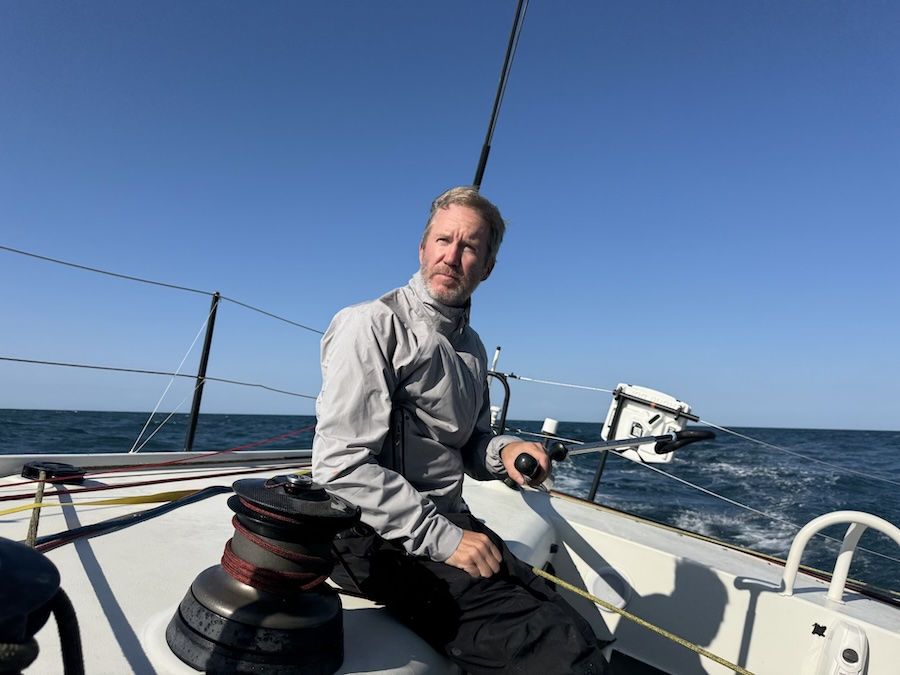
Forty years after his father Loïc Caradec vanished during the 1986 Route du Rhum, Tanguy Caradec will line up at the start of this year's race, carrying both a family story and a boat he has spent two years preparing.
Tanguy is 46. He will race a 50-foot monohull named Eurvad in the Vintage Mono class, a 13-boat fleet that trades optimised ratings for adventure, heritage and a proper mix of generations and amateur-pro sailors.
Loïc Caradec was one of the handful of sailors in the 1980s capable of handling the giant multihulls of that era, a sailor who pushed limits and captured the imagination of a generation. He disappeared on 13 November 1986 during that year's race. Tanguy was six at the time, and still remembers the trampoline of the catamaran Royal, his father's boat.
The idea of entering himself took hold two years ago. "A friend said to me, why don't you do it? It started to germinate and quickly I realised it wasn't so far-fetched. I'm capable of doing it, and if I don't do it now, I'll never do it," Tanguy says.
He is clear the project carries two threads, one sporting, one personal. "It's obvious that the Route du Rhum is inseparable from the story with my father. It's been forty years now and I want to pay him a fitting tribute. I'm doing it for him, of course, but not only that. It's also because the race makes me dream."
Preparation has been relentless. He bought the boat, changed the keel, found sponsors, and juggled training with communications and a life split between Paris and La Trinité-sur-Mer most weekends. "It touches on every string in my bow, but very intensely, and above all with a deadline, 1 November," he says, referring to the start date.

This will be his first solo race. He expects it could take anywhere from 16 to 21 days, navigating multiple weather systems and at least one depression. "You have to think of everything: not break anything, keep moving, eat well, manage to rest. It's quite an adventure where you have to push yourself to the limit."
Of his father, he says he was "a great sailor, very complete and mischievous," an engineer who loved technique and navigation and was among the pioneers of the big multihulls. By several accounts, Loïc Caradec had said before that fatal start that he no longer had "the sacred fire" for ocean racing, and Tanguy's mother always maintained it was meant to be his last.
The family kept an old boat, the Kervilen, on which Loïc learned to sail. It remains the oldest boat in La Trinité-sur-Mer, banned from carrying an engine, with every arrival and departure made under sail alone.
Tanguy has two daughters, aged 4 and 7, close in age to what he was when his father died. The elder, he says, is "a little proud but also afraid," and has told him she doesn't want him to leave and die like his father did.
He doesn't dwell on the goodbyes at the pontoon. "I hope I'll manage my emotions without holding them in completely. Even though there's a tribute to my father in this, I don't want my participation to tip into something maudlin. Quite the opposite, I want this to be a happy moment, and to enjoy it."