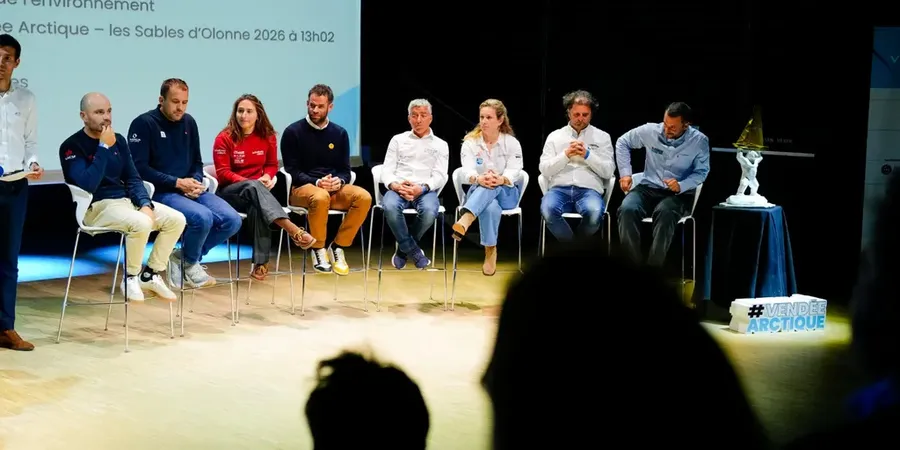
Nine IMOCA skippers slipped out of Les Sables-d'Olonne on Tuesday morning to contest a race with no precedent. The Vendée Arctique sets a deceptively clean objective: push north, cross the Arctic Circle at a latitude of your choosing, and get home faster than everyone else. There are no fixed waypoints, no mandated corridor, nothing between the fleet and the North Pole except each skipper's own judgement. What that boundless freedom means in practice, every one of them is about to find out.
Going into the race, Sam Goodchild carries the weight of expectation. The Macif skipper has been in outstanding form, collecting the Cape Race, The Ocean Race Europe, and the 1000 Race within a single month. Before the start he was characteristically measured. "I'm fortunate to be well supported," he said. "That lets me approach every race with confidence and actually enjoy it." His recent run of results suggests a sailor who has grasped what this kind of racing demands, something closer in spirit to mountain climbing than to conventional offshore sailing, where strategic patience and raw speed must constantly be balanced.
The group pursuing him is a varied and compelling mix. Ambrogio Beccaria spent months stripping and rebuilding the boat he acquired from Thomas Ruyant, the former Vulnérable, a preparation that was thorough but far from straightforward. The Italian made his reputation in Class40 racing and chooses his words carefully when discussing his reconfigured foiler. "We've fundamentally overhauled the boat," he said. "The goal is to finish without damaging it." A second place at The Ocean Race Europe and a fourth at the Transat Café L'Or suggest the composure to handle whatever the Arctic throws at him, even if his caution is entirely reasonable.
Three of the nine starters are women. Élodie Bonafous campaigns a sister-ship to Goodchild's Macif and has already banked a Rolex Fastnet win and a Cape Race podium since joining the class. She has no illusions about what the coming days will demand. "It's learning at full throttle," she said. "This will be a long race, about managing endurance and rhythm. It's going to be intense." Corentin Horeau's MACSF placed second at the 1000 Race just three weeks ago, and the 34-year-old is building deliberately toward the Vendée Globe 2028. Violette Dorange, who finished third in the 1000 Race, has been sharpening her preparation alongside Sam Davies. Francesca Clapcich, the Italian-American driving 11th Hour Racing, announced herself at the Transat Café L'Or with a second-place finish and arrives eager for the strategic complexity this route offers.
Arnaud Boissières, a five-time Vendée Globe veteran, has taken over the former Guyot Environnement boat and regards this campaign as a genuine new beginning. "We're launching a new cycle with a brand new challenge," he said. Manuel Cousin, another Vendée Globe campaigner, is contesting his first foiling programme on a hull that has been extensively rebuilt. Nico d'Estais takes the start as the only skipper aboard a non-foiling boat, yet he declines to let his equipment set a ceiling on his ambitions. "I'd like to cross the line with one or two boats behind me," he said with a grin. "I don't set boundaries."
The weather will write the race. Skippers can round Iceland from either side, chase a high-pressure system or push through lows, aim for 70 degrees north or hold back near the 66-degree threshold. The race organisation has offered no steer on any of it. Corentin Horeau captured the shared reality in plain terms: "You've got to sail well and try to be faster than everyone else." There is nothing more complicated than that.