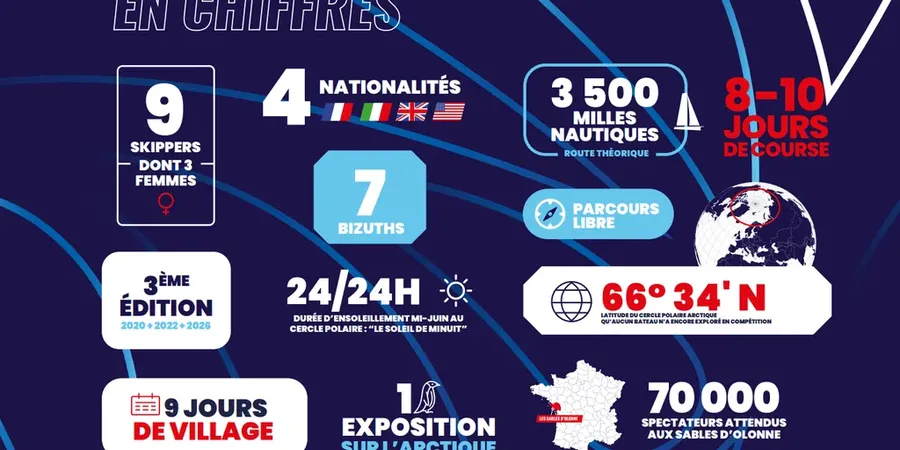
Nine IMOCA monohulls will line up on 7 June when the Vendée Arctique 2026 sends its skippers northward into territory solo offshore racing has never reached. When they cross 66°34' and pass through the Arctic Circle, each of them will become the first solitaire sailor ever to do so in competition. That is not a marketing claim. It is a straightforward geographic fact, and it gives this edition of the race a weight its predecessors could not carry.
The Vendée Arctique itself is still a young event. It was conceived in 2020 as a response to the disruption of that year, returned in 2022 with broader ambitions, and has now reached a third edition that pushes the concept somewhere genuinely new. What distinguishes this edition from both earlier races is not just the latitude. It is the complete absence of a prescribed route. There are no mandatory waypoints, no fixed corridor, no course laid out in advance for skippers to follow. Navigational freedom is total, which means every strategic decision, from the first hour to the last, belongs to the sailor alone.
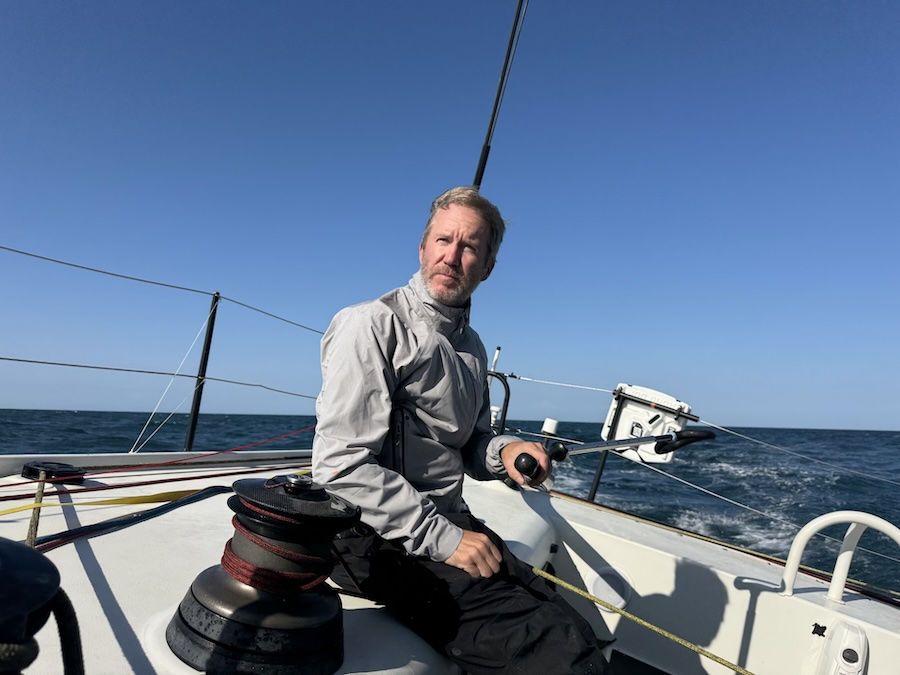
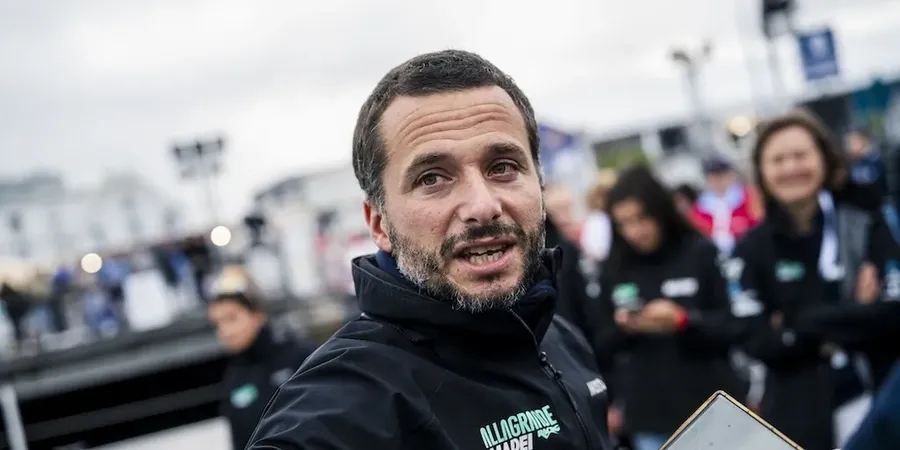
The fleet numbers nine boats, compact by some standards but carrying real depth. Italy's Ambrogio Beccaria will race Allagrande Mapei. The French contingent accounts for the majority of the field: Arnaud Boissières on April Marine, Manuel Cousin aboard Coup de Pouce, Nicolas d'Estais steering Café Joyeux, Corentin Horeau at the helm of Macsf, and Violette Dorange carrying the colours of Initiatives-Cœur. Sam Goodchild, who holds both British and French nationality, will race Macif Santé Prévoyance. Italy's Francesca Clapcich lines up under American registry in 11th Hour Racing. Élodie Bonafous completes the nine aboard Association Petits Princes–Quéguiner.
Seven of those nine have never started the Vendée Arctique before, a number that speaks plainly to the pace at which the post-Vendée Globe generation has moved through the IMOCA fleet and made it their own. Three of the nine are women. Bonafous, Clapcich and Dorange each arrive with different backgrounds and different histories, but their near-term goals align closely: cross the Arctic Circle, accumulate high-latitude solo miles, and build their standing within the 2028 Vendée Globe qualification cycle. That women account for a third of the field is not a point requiring emphasis. It reflects, simply, how the discipline now operates, with identical boats, identical conditions, and identical demands placed on every skipper at the start.
The course spans roughly 3,500 nautical miles, though that figure functions more as an approximation than a fixed distance. Because no route is imposed, the actual miles each boat covers will depend entirely on the weather systems each skipper chooses to engage with or avoid, on ice zones, on exclusion areas, and on sea state. Some will drive hard and direct toward the Arctic Circle; others will seek out more favourable conditions or safer passages through cold, unstable water. The result is likely to be the most strategically open race on the IMOCA calendar, one in which two boats starting side by side could end up sailing very different races across very different water.
High-latitude conditions in June offer little of the stability that offshore sailors can usually rely on to structure their thinking. Depressions form and chain together across cold, restless seas. The weather can shift quickly, demanding repeated sail changes and course corrections. Cold works its way into everything, and sleep, always a scarce resource in solo sailing, will suffer further.
Racing is expected to last between eight and ten days. That is brief by offshore standards, but the relentlessness of the environment makes duration something of a secondary concern. June at those latitudes brings permanent daylight. There is no dusk, no dawn, no darkening sky to give the body a natural signal toward rest. The physiological effects of racing without that daily rhythm have no real precedent in solo offshore sailing, and no one who has competed in solitaire events has been to these waters before to gather any experience worth passing on. Around the Arctic Circle, these nine skippers will be operating in a space the sport has simply never entered. No established tactics exist, no template from a previous campaign to consult. Just nine monohulls, open water, and a line that has never been crossed alone.