A ketch ashore at dawn, a fuel-less tinny reported in the wrong place and a jet ski taking on water off Te Puru kept the Thames volunteers busy across two Sundays, on top of training trips to Raglan and Auckland.
Thames Coastguard opened its mid-September update on Facebook with a line plenty of volunteer crews would recognise: "It's been a quiet month for Thames Coastguard, and we were itching for some action."
Four weeks later the unit had trained in Raglan and Auckland, answered three callouts across two Sundays and helped get a jet ski rider with mild hypothermia ashore at Te Puru and on to hospital.
It's a big patch for one volunteer crew. Its area of operation covers the entire Firth of Thames across to Kawakawa Bay and north to the Colville Channel, a coast scattered with islands, harbours and marine farms.
Training on the west coast
With a quiet period at home, nine crew packed up their rescue boat, Richardsons Rescue, and headed across to Raglan for bar crossing and jet ski training with the local unit, whose Gallagher Rescue was ready to go as well. Raglan has run personal watercraft as rescue craft since 2003. The west coast didn't co-operate. With 30 knot winds and choppy seas, the boats never reached the bar, though the crew reckoned the conditions were challenging enough without it.
In the afternoon, the session moved to jet skis. Raglan volunteers rode with the Thames crew, and the group spent a few hours practising patient transfers from jet ski to boat, an exercise the unit described as "incredibly enlightening". Thames volunteer Roco was, by the unit's account, hard to get off the ski.
The first weekend of October brought a second trip, this time to Auckland, where the crew spent 10 hours on the water working through multi-vessel scenarios. Bruce passed his SAR practical obs that day, a milestone the unit said he'd been working towards for months, and Roco moved closer to having several of his own requirements signed off.
The crew were hoping for a quiet Sunday. The first callout came at 8am.
Woolshed Bay at low water
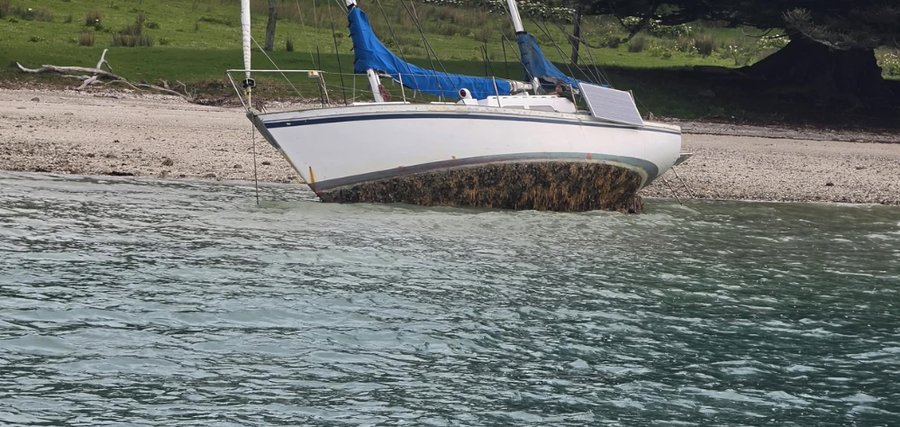
A 32-foot ketch had dragged its anchor at around 3am and gone ashore in Woolshed Bay. When the crew arrived they recognised the skipper as a repeat customer, though this time he had a Coastguard membership.
The tide was still dropping, so rather than risk putting their own boat on the mud, the crew anchored and waited. After about an hour and a half the yacht was starting to lift and didn't look to be damaged beyond repair. With their anchor set, they backed Richardsons Rescue down as close as they could, hooked on and towed the ketch off the beach without fuss.
Before he sailed off, the skipper got two pieces of advice: keep a lifejacket on board whatever the size of the boat, and "maybe think about taking a day skipper's course and understanding how to anchor your vessel better". Coastguard Boating Education runs the Day Skipper course the crew had in mind.
That membership is worth a note for anyone weighing it up. Coastguard's membership page lists an individual membership at $150 a year, covering free non-urgent on-water assistance around the clock. Non-members are charged $400 an hour for non-urgent help, for the full duration of the job, and salvage work is excluded. In a marine emergency, Coastguard says it is there for all Kiwis.
The boat that wasn't there
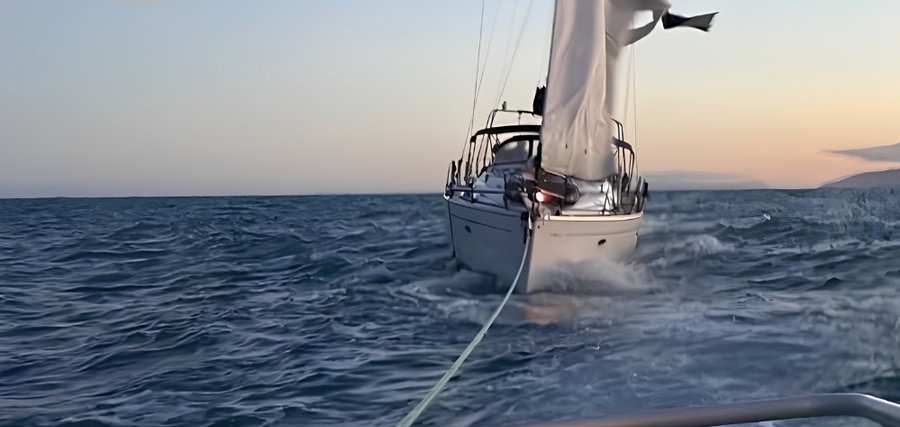
On the way home the crew were tasked to a 4.5m tinny that had run out of fuel, which its occupants put down to a faulty gauge. The reported position was about a nautical mile west of the Waikawau ramp. There was no boat there.
A call to Coastguard Radio sorted it out. The tinny was actually at the northern end of the farms, and the wrong coordinates had been passed on. The unit shrugged it off as something that happens now and then, and it does. In January 2023 the same crew went looking for two kayakers reported 500m off Tapu who turned out to be two nautical miles off the coast, as skipper Steve Mansell explained in a Coastguard release on that rescue.
Once they found the tinny, the crew moved two children and one adult across to Richardsons Rescue, partly for the thrill and partly to make the tow back to Waikawau easier for everyone. Stephen, Bruce, Jimmy and new recruit Dave were aboard. It was Dave's first callout, and when they got back he went straight out again on a fire brigade callout. The crew didn't get home until around 4pm.
Te Puru: a jet ski taking on water
The third callout came a week later. At 9.54am on Sunday 11 October, the unit was alerted to a jet ski taking on water about 2km off Te Puru, with two people needing help.
Richardsons Rescue and the police launch Deodar III both responded, arriving just before 11am. Deodar III is an 18.5m waterjet patrol vessel, built by Q-West in 2007 for New Zealand Police.
One rider was unhurt and came aboard Richardsons Rescue. The other had mild hypothermia and was transferred to Deodar III, where police and Coastguard crew treated them before landing them at the Te Puru boat ramp. A police car took them on to hospital. The uninjured rider was then moved across to Deodar III, and both they and the jet ski were dropped at the ramp. Wayne, Steve M, Bruce, Jimmy and Matt crewed the Coastguard boat, with Heath helping police at the ramp.
The incident came two days after New Zealand's new lifejacket rule took effect. Since 9 October, everyone on board a recreational craft of 6 metres or under must wear a lifejacket while it is underway, apart from a short list of exemptions such as surfboards and supervised sporting events. Coastguard spells out that the rule includes jet skis. "Underway" covers any time the craft isn't anchored, aground or tied up, so a ski drifting with its engine off still counts.
For Coromandel boaties, the wearing part isn't new. Waikato Regional Council's navigation safety bylaw has required lifejackets to be worn on vessels 6m and under while underway since 2013, and the council's lifejacket page says breaches may attract a $200 fine. Coastguard notes that specific national penalties for the new requirement are still to be created.
Thames Coastguard closed its account of the Te Puru job with a seasonal nudge: summer is close, so it's time to get the maintenance done and check the safety gear. Boaties needing a new lifejacket can trade in an old one through Coastguard's Old4New programme, running at Hunting & Fishing stores from 16 November to 31 January.