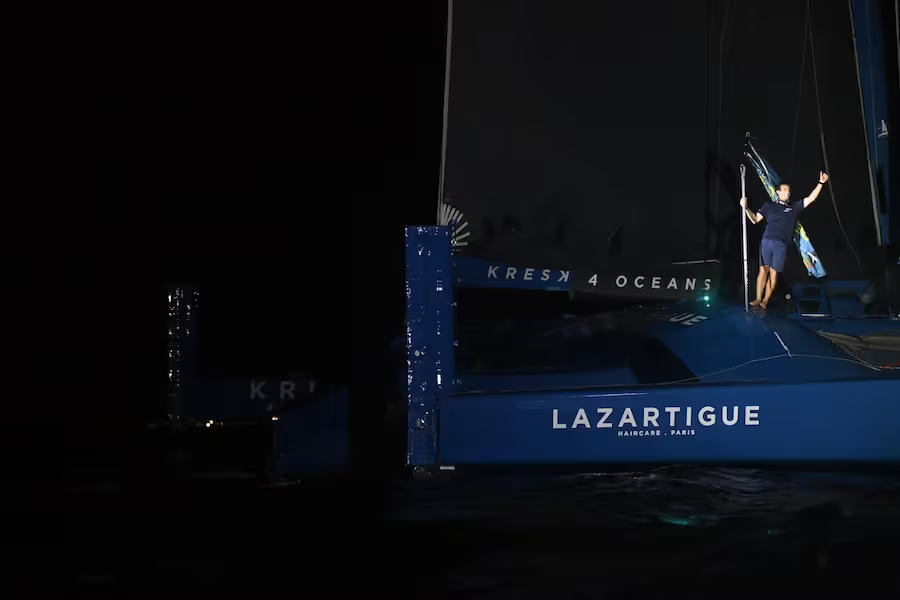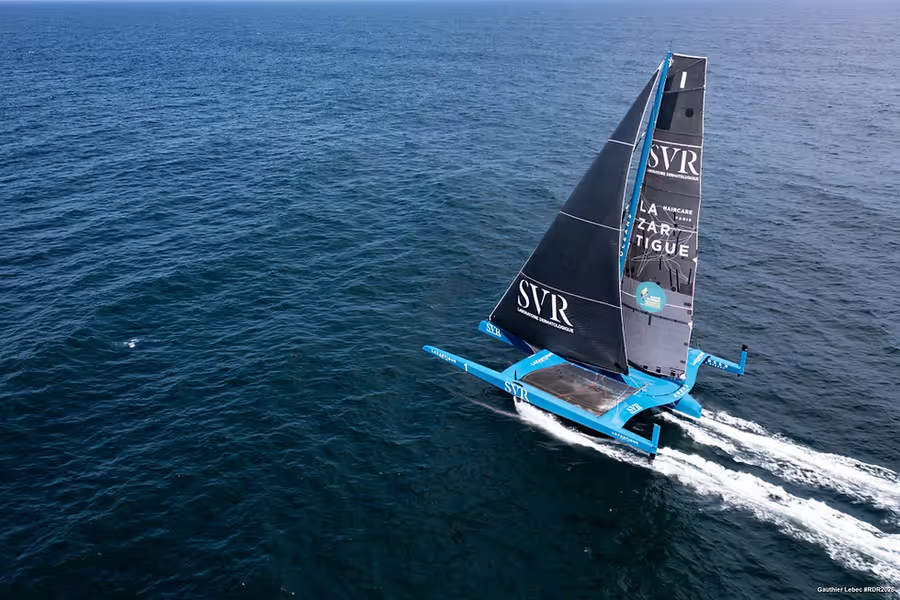

Tom Laperche arrived in Guadeloupe like a man stepping out of a dream: clean-shaven, blue eyes steady, white polo shirt barely creased after six days at sea. The Mémorial Act was packed, the official pontoon groaning under the weight of well-wishers, all wanting a piece of the moment as the new prince of the oceans talked at length about his victorious Route du Rhum-Destination Guadeloupe campaign aboard the Ultim trimaran SVR Lazartigue.
After the pontoon came the stage, and the trophy held high.
Asked about his emotions at the finish, Laperche didn't hold back. "It's my whole story since childhood in La Trinité-sur-Mer. I always saw incredible images of finishes here, of great champions over the decades. My dream was first to sail these boats one day, maybe race them solo, and why not race the Route du Rhum. So winning it at the helm of the most beautiful boat of the 2026 edition makes me very, very happy."
He knew the race wouldn't be easy. No Route du Rhum winner gets there with their hands in their pockets, he said. But he loved every minute of it, rediscovering on the SVR Lazartigue everything he'd hoped to find: full speed, and the sense that everything was unfolding fluidly, almost unbelievably so.
"At every gust, every sail change, I was in complete fusion with the boat," he said. "I wanted that boat to fly, to go as fast as possible. At certain moments it demands nothing less, and it's a pleasure trying to match it. I was in a state of grace. In my life I've had two or three moments where everything went right and nothing could touch me: the Solitaire du Figaro in 2022, and the start of the Arkéa Ultim Challenge Brest in 2024."
He was quick to credit his shore team. "I had an extraordinary technical team who worked incredibly hard. They've done everything these past five years to get us to the best possible level. You can see today how much we've progressed. I was alone at sea but I can tell you that on land they did an extraordinary job."
The weather made for an unusual race, he explained. There was no trade wind, forcing the fleet onto distinctly northern routes. He'd exchanged quick messages with Charles Caudrelier, who agreed it wasn't an easy edition. Plenty of sail changes, transitions, adjustments, long manoeuvres: energy-sapping work that demanded constant remobilisation.
"I loved being in that difficulty, in pushing myself, finding limits you didn't know you had," he said. "I'm very happy to have climbed every little step without thinking too much about winning."
News of Armel Le Cléac'h's dismasting, alone in the middle of the ocean, hit him hard. "It chilled my blood. I didn't really know what to do and I was genuinely nervous before setting off again. Big thoughts for them, for Team Banque Populaire. That accident reminds us this is an extraordinary sport, but we're always right on the edge. These boats are exceptional but we're always on a knife edge. The emotions are almost indescribable. It's a total commitment you find nowhere else, and that's what makes it beautiful."
Family mattered too. His father raced the Route du Rhum and finished fourth in Multi50 back in 2010. Laperche later sailed that same boat alongside him, nights and days at sea together, learning to read nature, machine and the elements all at once.
On mentors, he singled out François Gabart. "I don't think I'll ever thank him enough for believing in me. He was convinced I was capable of handling these big boats before I knew it myself." Pascal Bidégorry and Franck Cammas also shaped him, he said, with Cammas part of the routing team throughout the six days of racing.
Asked if he already had his next goal in mind, Laperche laughed. "I haven't won the Route du Rhum a second time yet! Offshore racing has changed enormously and there are still plenty of great challenges out there. What I haven't managed yet is a full round-the-world race on these boats. In our sport, that's still a very important challenge."