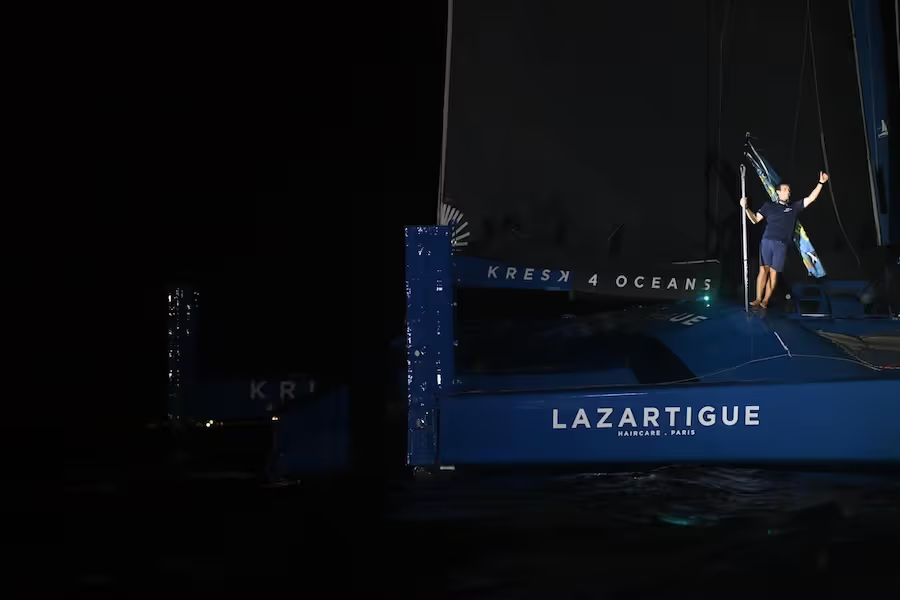
Tom Laperche has won the Route du Rhum Destination Guadeloupe in the Ultim class, crossing from Saint-Malo to Pointe-à-Pitre in 6 days, 13 hours, 27 minutes and 40 seconds. He led from almost the first manoeuvre and never looked back.
His dominance showed within half an hour of the start gun last Sunday. Starting just behind Armel Le Cléac'h on Maxi Banque Populaire XI under a big gennaker, the SVR Lazartigue skipper worked out early that the leg after Cap Fréhel, rounding Bréhat, would need a J2. Rather than wait for the gate to change sail, he combined the manoeuvre with his first gybe, pushed deep on that tack, then popped out with a foot already in the gate and the right angle from the get-go. He came in ahead of Le Cléac'h, who'd sequenced his own manoeuvres later. Among elite sailors, that's one way of saying: I'm here, I'm sharp, I'm fast, come and get me.
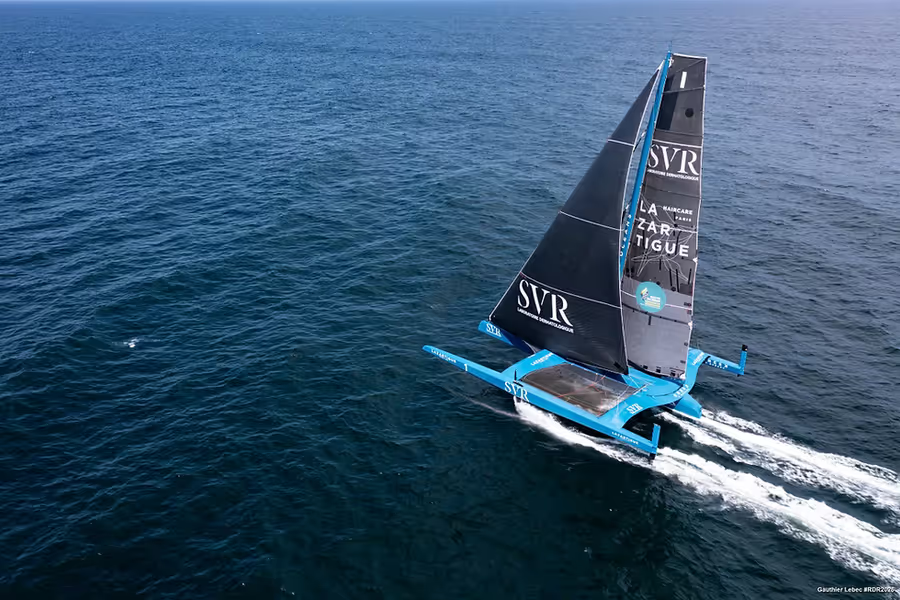
Conditions were kind early on. Flat seas and a medium downwind breeze aren't strictly the VPLP design's best point of sail, but the new foils fitted this year were built to cover exactly that weakness, the one that had cost Laperche and Gabart the Transat Jacques Vabre back in 2023.

The starboard foil had actually broken in training six weeks before the race and been swapped for the older version. Luck held anyway. The run towards Ireland, crucial for the rest of the race, was sailed on the new foil, and the boat looked completely at home. Laperche's shore team recorded a top speed of 48.9 knots off Ouessant, against a crewed boat record that's never topped 51 knots.
By the Irish gybe, 15 hours in, he already had a 28-mile lead. He held a leeward position through the Channel exit, free to manoeuvre as he pleased, and SVR Lazartigue was first to gybe.
The lead crept out steadily. Through the thalweg, that windless corridor where the breeze reverses 180 degrees between entry and exit, Laperche picked up more miles to stretch it to 55. In rougher seas and unstable wind he kept working the boat hard, changing sails repeatedly, refining settings, digging deeper. His lead peaked at 82 miles exactly 48 hours in, on the Tuesday at 1pm. The fleet was passing the Azores at a pace never seen before in this race. The easy miles were over.
From there, the direct route to Pointe-à-Pitre became something of a dead end. Laperche kept setting the pace while Thomas Coville, on Sodebo Ultim 3, broke away on a more direct line. The ideal routing ran through a ridge off the Bermuda high, needed to connect with a small front to the west. SVR Lazartigue luffed up first towards the north-west on the evening of 3 November, with Maxi Banque Populaire XI just behind in his wind shadow. Le Cléac'h lost less speed than expected and the gap shrank to 20 miles coming out of the ridge.
Then everything changed. Maxi Banque Populaire XI capsized, removing Laperche's strongest rival from the equation, with no disrespect intended to Coville or Louis Burton on Armand Thiéry. Burton was on the same route as Laperche but 100 miles back with a less potent trimaran. Coville tried his luck cutting across the ridge to go straight on, but he'd already lost his big gennaker by that point and was carrying a 45-minute penalty for a broken engine seal at the start.
Setting a pace that forces rivals into mistakes, whether lapses of judgement, botched manoeuvres or poor routing calls, that's the short version of how Laperche sailed the first three days.
The rest of the race was no easy cruise. Nearly 2,000 miles remained to Pointe-à-Pitre, with several transitions and a tropical depression to navigate. That depression was new territory for Laperche, but he's a curious sailor, and he had total trust in his routing team: Franck Cammas, with whom he won the Transat Café l'Or in 2025, and Jean-Yves Bernot, still the benchmark in the field, who invented offshore routing exactly forty years ago guiding Philippe Poupon to victory in the 1986 Route du Rhum.
That pairing steered Tom all the way to Guadeloupe on a route that ended up the furthest north ever sailed in the race's history, further north even than the early editions when monohulls tried their luck on the great circle route.
In his last video message, as he prepared for one of his final tacks past Antigua, the SVR Lazartigue skipper said: "I'm taking things one at a time. I'm being careful with every manoeuvre. We've got a plan that's not simple but it's exciting, doing a nice loop round Guadeloupe to enjoy it right to the end."
Performance delivered with enjoyment and precision, that's the trademark of Tom Laperche, who at 29 has written himself into the record books following a dazzling campaign.