Seventeen solo sailors departed Opua at noon, bound for Southport on Queensland's Gold Coast. Before the fleet cast off, PredictWind meteorologist Arnaud Monges ran an overnight weather briefing laying out what the models are showing for the Tasman crossing.
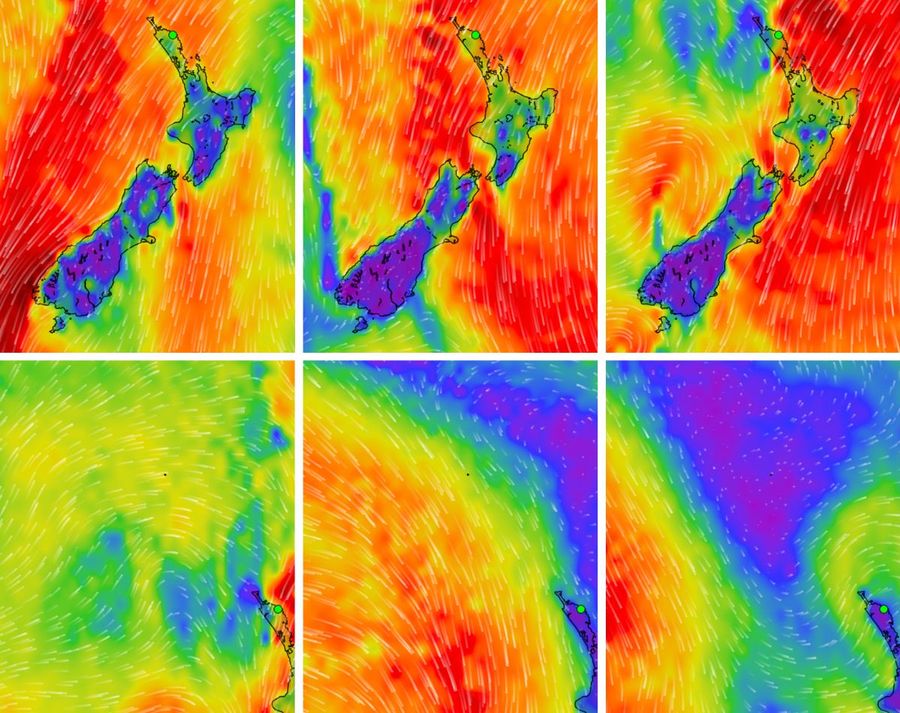
The dominant feature shaping the first half of the race is a low pressure system designated L1, currently sitting at 997 hectopascals in the middle of the Tasman Sea, with a cold front trailing away to the east. Conditions for the opening days will largely be dictated by L1's behaviour.
Departing Opua, a high pressure system moving clear of New Zealand will push northeast winds of 15-20 knots into the fleet, with one-metre seas building gradually. By Sunday midnight, as boats work around Cape Reinga, that breeze is expected to climb to 25 knots from the northeast and seas will have grown to 2.5-3 metres. The front itself arrives at Monday noon, bringing north winds of 25-30 knots with gusts of 35-40 knots, potentially higher inside rain squalls, and seas running at 3-4 metres. At that stage the fleet will be on a reaching angle, taking wind and waves from the starboard side.
The routing model highlights a pronounced rolling signal throughout day two, and Monges was direct about what that means for those on board: "It can be unsafe. It will be difficult to walk around the boat."
A strong blocking high to the east is effectively pinning the cold front in place, so sailors will spend considerably longer inside its influence than they would with a faster-moving system.
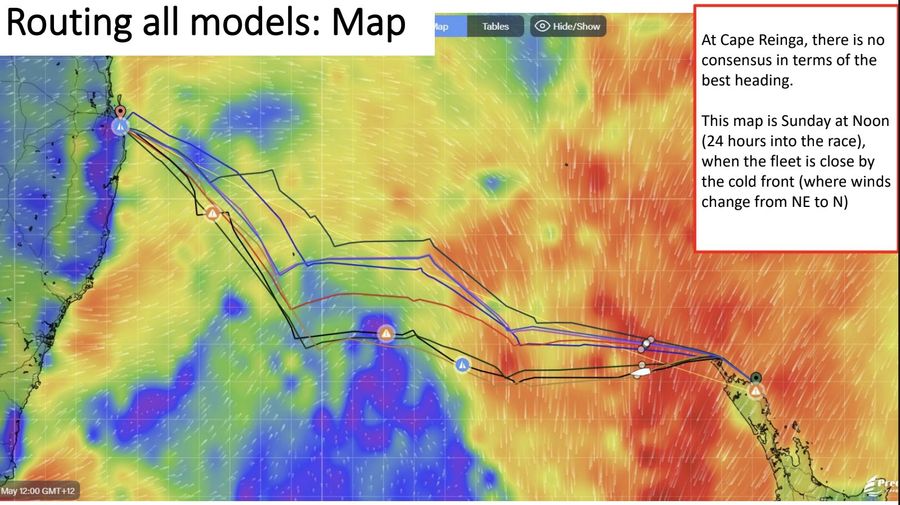
After L1 clears, winds ease to 10-15 knots and shift west to southwest. That window of roughly a day to a day and a half gives those who pushed hard through the front a chance to recover before attention turns to what is building next.
By Wednesday, a second system, L3, is forecast over Tasmania, bringing its own cold front and winds of 25-28 knots with seas to 3.5 metres. The nature of the discomfort will differ from L1. Where the first front produces the lateral rolling of a reaching leg, L3 will put boats bow-first into oncoming seas, with the vertical acceleration and hull-slamming that comes from punching through waves rather than riding across them. The routing model shows a stronger slamming signal during L3 than during the L1 passage. Thursday is forecast to bring lighter westerly conditions as the fleet approaches the Queensland coast.
Across the full passage, all four models agree on a seven-day crossing. True wind speed averages 15-20 knots throughout, with gusts topping 40 knots during the L1 period. Working from a Beneteau First 36 polar, the routing model calculates an average boat speed of 7.5 knots. The sailing mode breaks down as roughly 70% reaching and 30% upwind, with no downwind sailing anticipated at any stage.
Start timing was also examined, with Saturday's departure weighed against Sunday, Monday, and Tuesday options. A Sunday or Monday departure would actually deliver stronger conditions rather than lighter ones, and Tuesday would be the first window offering a genuinely easier run. The Race Committee confirmed the Saturday start. With the updated forecast not materially shifting that picture, the monohull fleet was expected away at 12:06, with the two multihulls starting at 12:00.