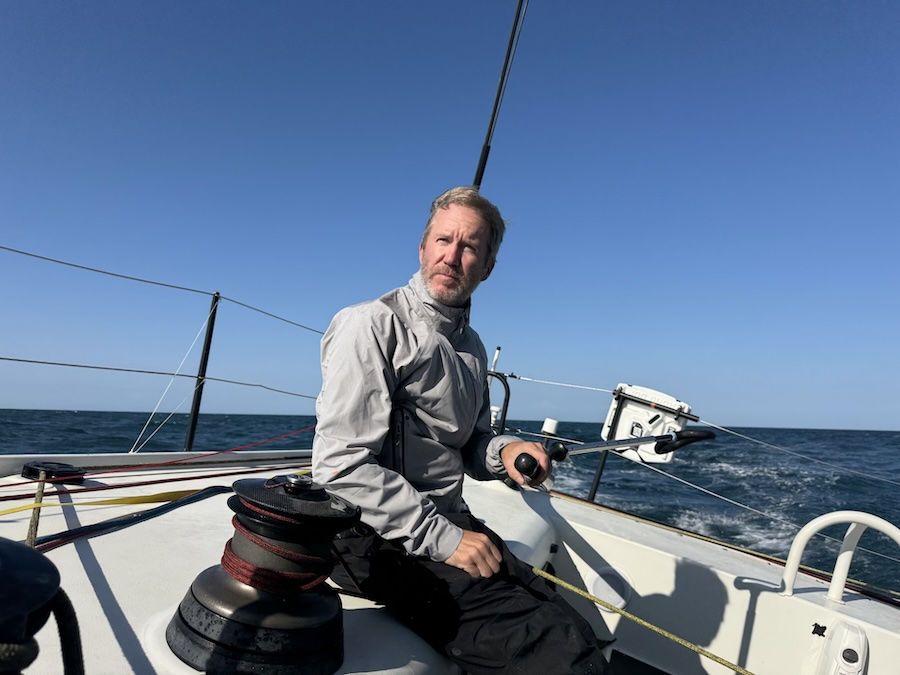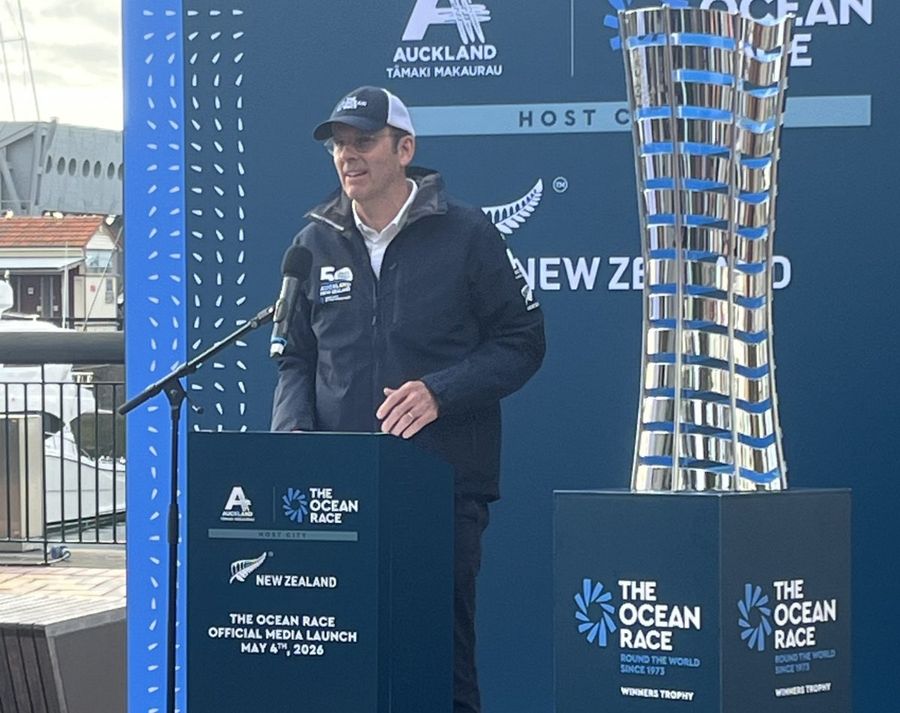
Richard Brisius says exactly what he thinks. The co-owner and race chairman of the Ocean Race arrived in Auckland for a brief visit to mark the official confirmation of the city's 2027 stopover, and when he sat down with Go Boating NZ, he spoke with the directness of someone who has spent a career at sea.
"Kiwis were the kings of the ocean," he said. "Kings of round the world racing. Not anymore. And I think it's time to start to build back into that."
His first arrival in Auckland came when he was 21, still raw from the Southern Ocean, cold and physically spent. The warmth found him somewhere north of the Hauraki Gulf, before the skyline appeared. "Suddenly, out of the ocean, you see the city of New Zealand. Coming into the rocky gulf, and fortunately, the oasis of Auckland is there. It's so personal, and you feel very, very welcome. And the fans are genuinely knowledgeable." He would make that approach many more times, first as a sailor, then as a team manager, and eventually as the person who owns the race itself.
The event was still called the Volvo Ocean Race when Brisius and his partners took ownership in 2018. Three changes were needed, and all three were made. Ocean science became the race's foundation, with every competing boat now carrying instruments that sample oceanographic data continuously from two metres below the surface, gathering information from stretches of open water that conventional research vessels almost never reach. A broader racing calendar was built around the main around-the-world edition, with the Ocean Race Europe and the Ocean Race Atlantic added to give teams more time competing and more room to develop. The communications infrastructure was also rebuilt, replacing older satellite systems with new low-orbit technology that made genuine real-time footage from aboard the boats possible for the first time.
"We have developed the in-house technology system to capture what's going on in the boats in real-time," Brisius said. "There are cameras, there are microphones."
The opening leg from Alicante to Auckland runs to 14,000 nautical miles, making it the longest single stage in the race's history. Brisius makes no apology for the distance. "We said, let's make this harder than we started. If you make it through that, you make it through." The route threads out of the Mediterranean past Gibraltar, crosses the North Atlantic, tracks south down the South Atlantic, drives through the Southern Ocean and then turns north toward New Zealand. For sailors approaching that ocean without prior experience, Brisius is measured but honest. "If you have never been in the Southern Ocean and you go down there the first time, you don't really know what to expect." Solo racing, he observed, tends to produce more cautious boat handling, and he drew a direct connection between Ocean Race experience and performance in events like the Vendée Globe. "Typically, the ones who've done the Ocean Race are probably better in the Vendée Globe, because they've learned where the limits of the boats are."
When the fleet makes landfall in Auckland around 20 February, the Ocean Live Park will open on the Viaduct waterfront on the same day, free to the public and running for three weeks through to the Grand Departure on 14 March. The 2018 Auckland stopover drew what the organisers counted as half a million visitors. Brisius captures the appeal without fuss. "You can come and go and watch the boats, learn about the ocean, try the cockpit simulators, get close to the boats on the docks, meet the sailors, have a beer. It's just good times."
The talent question is one he raises himself. New Zealand offshore sailors are competing at the highest level, crewing on the best boats in the world and performing well. But they are doing so as hired crew rather than as the architects of their own campaigns, and that distinction sits with him. "There's no nationality with the culture, the values, the Kiwi mentality that is a better match for racing on the high seas. And now the question is: do we want to be that ocean nation?"
He singles out Conrad Colman by name. Colman is building his Aotearoa Ocean Racing campaign and will lead a Kiwi crew in the Ocean Race Atlantic later this year. "Conrad is passionate, he's driving very hard, he has this dream and he wants to make it happen."
The boats will come in the way Brisius once came in, cold and battered after the Southern Ocean crossing, and the Waitemata will fill with people wanting to watch that arrival. For Brisius, the moment carries a meaning that reaches beyond sport. "You have to not forget who you are," he said, "because you lose your heritage."