Few courses reveal their strategic fault lines quite so early. Within hours of leaving the dock, the Vendée Arctique fleet had fractured along two sharply opposing views of how best to navigate a 2,400-nautical-mile route curving northward toward the Arctic Circle, and every skipper had staked their campaign on one reading or the other.
The conditions at the gun were hardly dramatic. Five to eight knots of breeze greeted the fleet, the kind of gentle air that demands precision rather than power. From the very beginning, Manu Cousin and Arnaud Boissières committed to the west, seeking a position they believed would pay off once stronger pressure arrived. The rest of the field took the opposite view, staying close to the Breton coastline and setting a course toward Île d'Yeu, backing shelter and cleaner sailing through the early miles.
Race director Mathias Louarn left little doubt that the division was tactical rather than accidental. "The start was about establishing a western position that some skippers could maintain through the early stages," he said. The start itself had been faultless. Not a single boat crossed the line early, no equipment gave way, and the whole departure unfolded without a hitch from beginning to end.

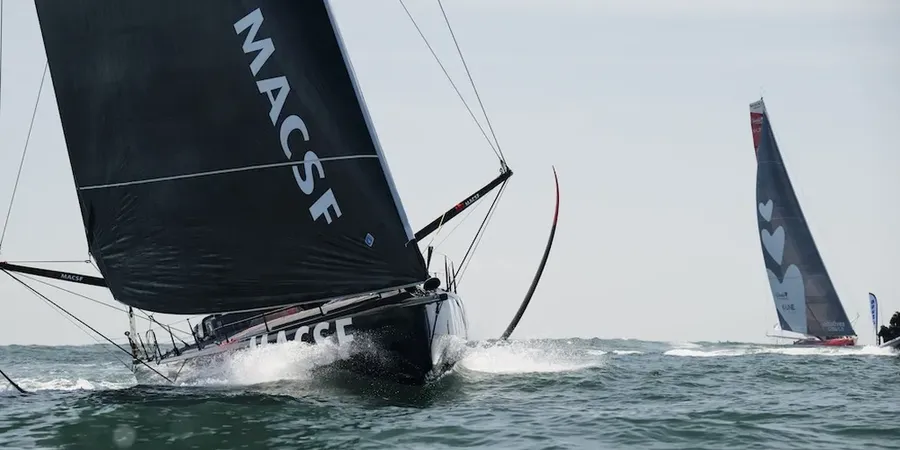
Corentin Horeau, sailing MACSF, captured the atmosphere well in his first video report back to shore. The long summer light had transformed the start line into something almost leisurely, and the mild conditions lent the occasion a warmth that faster sailing might have stripped away. "Beautiful sailing, beautiful sea, mates everywhere, an incredible send-off," he said, the words carrying as much relief as celebration.
Unlikely company formed in those gentle early miles. Nico d'Estais, whose centreboard boat would ordinarily be shed by the foiling fleet the moment wind strength climbed, found himself sailing in the same patch of water as Élodie Bonafous, Violette Dorange and Sam Goodchild. He made no attempt to oversell the situation. "As long as the wind stays light, this is how it stays," he said, knowing full well the arrangement had an expiry time.
Beneath that unhurried surface, hard calculation was already underway. The division crystallising near Île d'Yeu reflected two genuinely competing theories about what the weather was about to deliver. Cousin and Boissières had backed a westerly that would reward boats already established offshore. Those hugging the coast were counting on shelter and consistent air, accepting the risk that a changing pressure system might eventually work against them. Neither gamble was obviously superior, and both would face scrutiny long before the race reached its northern turning point.
The fleet had slipped out together. Within a handful of hours, the Vendée Arctique had quietly become two separate contests.