Judged a category winner at IBEX in Tampa, the clear, biocide-free coating takes Propspeed's foul-release approach off the propeller and onto outboard legs, thrusters, stabiliser fins and RIB tubes. General government guidance on foul-release coatings says they clean themselves best on boats that are used often and at speed.
Propspeed has spent more than 25 years keeping barnacles off propellers and shafts. With Foulfree Multi-Surface, it has turned to the parts below the waterline that aren't bare metal. It has now collected two US industry awards for it in as many months.
On 6 October the coating was named a joint winner of the Boat Care and Maintenance category at the 2026 IBEX Innovation Awards in Tampa, Florida, sharing the category with Spectrum Color's TouchPro, a kit for repairing powder-coated metal. Judge Tony Esposito pointed to underwater gear such as transducers, interceptors and bow thrusters, which he said "can be fouled to failure by bio marine growth". He also noted that the system gives dealers and boatyards an extra value-added revenue stream.
The National Marine Manufacturers Association (NMMA) runs the awards programme and Boating Writers International judges it. This year the panel picked 12 winners and three honourable mentions from 100 entries, a field that also recognised Scanstrut's wireless navigation pole light and Garmin's Signal VHF 400.
The IBEX win comes a year after Propspeed first showed the product at the same show, and a few weeks after it was named Best Operational, Maintenance & Safety Product at the Newport International Boat Show's Newport for New Products awards in September.
Both honours go to a home-grown product. Propspeed was founded in 1999 by Guy Jacobsen, who wanted a way to keep growth off the running gear of his sportfishing boat, moored in the Bay of Islands. The company is still headquartered in Auckland, where chief executive Marcus Hamilton told Soundings Trade Only it runs one site for production and R&D and another as its head office.
What it goes on
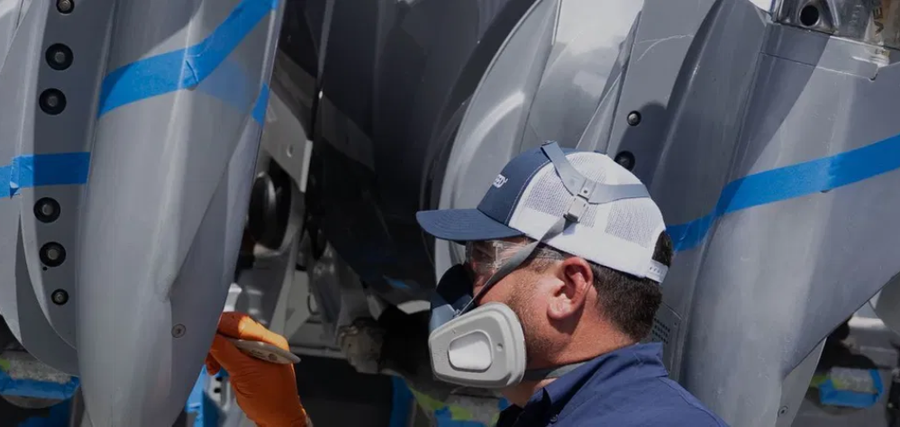
The original Propspeed relies on an etching primer that bonds to metal. Foulfree Multi-Surface swaps that for its own primer, so it can go on components that Propspeed says previously went unprotected or relied on antifouling paint. On its product page, the company lists outboard lower units and bracket assemblies, stabilising systems, thrusters, stabiliser fins and RIB tubes as typical targets.
Those parts are made from a wide mix of materials, and Propspeed's compatibility table ticks 14 of them, including fibreglass, carbon fibre, ABS, Delrin, nylon, polypropylene, polycarbonate, HDPE, PVC, Hypalon and factory outboard paint. Bronze, stainless steel and uncoated aluminium are crossed out, and owners are pointed back to the original Propspeed for those. The company says it tested the coating against ISO and ASTM criteria on more than 20 substrate classes, OEM parts and factory coatings, with the highest adhesion ratings on all of them.
Over the primer goes a clear silicone topcoat, which Propspeed says is effectively invisible once applied. Like the company's other coatings it contains no biocide. Instead of killing marine growth, its slippery surface reduces how firmly that growth can attach.
Putting it on
Getting a clean bond is most of the job. Propspeed's application instructions start with a green Removal Pad to take off fouling and any old coating, then a red Prep Pad to lightly scuff the surface, although the company says the scuffing isn't needed in every case. An MSclean solvent wipe follows until a white rag comes away clean. Only then come the two coats: a thin brushed layer of MSprime, left for between 10 minutes and an hour, and a thin brushed layer of clear.
Temperature is key at both ends of the process. MSprime gels in the cold and needs warming to at least 20°C before use, and the application guide says the boat can go back in after at least 12 hours at 20°C, or 24 hours between 5°C and 13°C. Propspeed also advises checking chemical compatibility with the component's manufacturer before starting.
Everything for the job comes in the box apart from gloves, eye protection, a mask, clean rags, tape and, for heavy growth, a plastic putty knife. The small kit holds 60 ml of each liquid and covers about 0.5 m². The medium kit, which Propspeed pitches at RIBs and stabiliser fins on yachts, holds 240 ml of each and covers about 2 m². To note, because the clear coat cures with moisture, an opened tin won't keep, and Propspeed says its warranty is void if one is used again later.
Once it's on, the coating needs some care. The technical data sheet describes it as a soft coating that can be damaged mechanically, and Propspeed warns it has to be protected while out of the water. When the time comes to recoat, the old layer must be removed completely. Propspeed doesn't recommend its Stripspeed remover for this product, so that job falls to the Removal Pad.
How boat use affects fouling
A slippery surface doesn't stop growth settling altogether, and that's where the way a boat is used comes in. In technical guidance on vessel biofouling, the Ministry for Primary Industries explains that foul-release coatings rely on regular use and water flowing over the surface to dislodge growth, and that boats left sitting can still foul.
Neither MPI nor Propspeed puts a figure on how often, or how fast, a boat needs to run for Multi-Surface to keep itself clean. For New Zealand owners that question has a regulatory edge, because outboard legs, thrusters and fins are exactly the niche areas biosecurity rules care about. Auckland Council's guide for boat operators limits any craft in the region, moving or not, to light fouling on the hull and in niche areas, and the council's marine biosecurity team has been urging owners to book haul-outs early this spring. Marina operators, meanwhile, have raised concerns about antifoul performance since the Environmental Protection Authority's reassessment removed some products.
Propspeed promises protection "throughout the entire boating season", but many New Zealand boats stay on their moorings all year. Owners now have a chance to say how biocide-free coatings have fared on boats like theirs. Those registered with Yachting New Zealand are being asked to rate biocide-free antifouling in an MPI-backed survey run by Land Water People, covering effectiveness, cost and maintenance.
Questions about it can go to recvesselsurvey@landwaterpeople.co.nz.