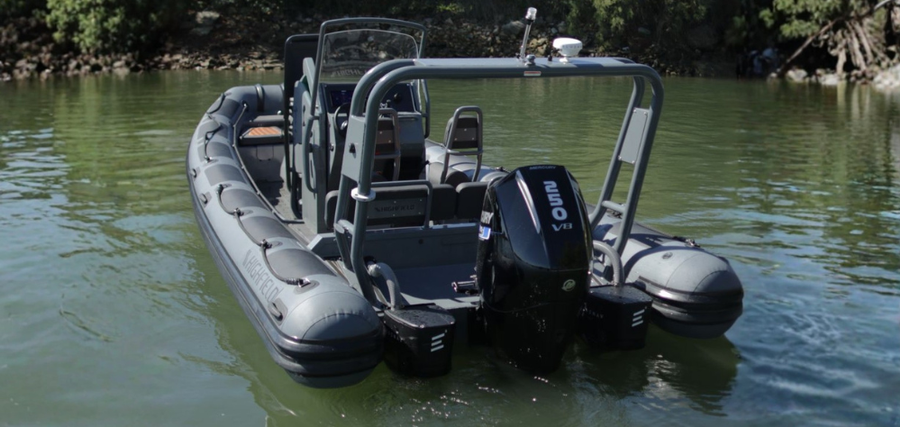
Mercury Marine and French electric propulsion company BlueNav have put together a hybrid demonstrator for this week's Cannes Yachting Festival. Rather than replacing the boat's petrol outboard, BlueNav adds electric propulsion alongside it.
The boat is a Highfield Patrol 700, a 6.99m RIB rated for a single outboard up to 250hp. Its main engine is a 250hp Mercury SeaPro, with two retractable 8kW BlueNav BlueSpin electric outboards alongside it. The electric motors drop into the water for low speed manoeuvring and marina work, then retract when the Mercury takes over. There's no shared propeller or combined drivetrain, just two separate propulsion systems on the same transom.
Where the electric motors earn their keep
BlueNav is concentrating on the slower parts of a boating trip. The company estimates that boaters spend almost 30 per cent of their time travelling at five knots or less. At those speeds, the electric motors can be used instead of the 250hp Mercury. Smart Navigation also provides Virtual Anchor position holding, Smart Mooring and 360 degree docking.
The BlueSpin units can also be retrofitted to a boat without removing its existing outboard. An owner can therefore add electric propulsion while keeping the petrol engine already on the transom.
Not tied to Mercury
BlueNav has already lined up a second installation with a different engine brand. A Honda-powered Tiger Marine 750 Open Fishing, fitted with the same twin 8kW configuration through a partnership with Tiger Marine France and Boats Distribution, is due at Grand Pavois in La Rochelle later this month. BlueNav also unveiled an 11kW motor at boot Düsseldorf in January, its first with an in-house designed turbine, sitting between the existing 8kW and 15kW models. Together, those moves point to BlueNav positioning itself alongside outboard brands rather than against them.
What's still missing
Battery capacity, electric-only range and speed, and any measured fuel saving from the Highfield installation remain undisclosed.
<table style="width:100%; border-collapse:collapse; font-family:Arial, sans-serif;"> <tr style="background-color:#008080; color:#ffffff;"> <th style="padding:8px; text-align:left; border:1px solid #cccccc;">Spec</th> <th style="padding:8px; text-align:left; border:1px solid #cccccc;">Status</th> </tr> <tr><td style="padding:8px; border:1px solid #cccccc;">Combined electric output</td><td style="padding:8px; border:1px solid #cccccc;">Confirmed: 16kW (2 x 8kW)</td></tr> <tr style="background-color:#f2f2f2;"><td style="padding:8px; border:1px solid #cccccc;">8kW motor + Smart Navigation, single unit</td><td style="padding:8px; border:1px solid #cccccc;">Confirmed: from €13,950 excl. VAT, batteries, installation, shipping (each)</td></tr> <tr><td style="padding:8px; border:1px solid #cccccc;">Battery capacity and weight</td><td style="padding:8px; border:1px solid #cccccc;">Not disclosed</td></tr> <tr style="background-color:#f2f2f2;"><td style="padding:8px; border:1px solid #cccccc;">Electric-only speed and range</td><td style="padding:8px; border:1px solid #cccccc;">Not disclosed</td></tr> <tr><td style="padding:8px; border:1px solid #cccccc;">Measured fuel saving</td><td style="padding:8px; border:1px solid #cccccc;">Not disclosed</td></tr> </table>
Charging is part of that gap. BlueNav points to Mercury's alternator output, up to 115A on some V6 and V8 engines, as a practical advantage of pairing with a Mercury outboard, though that figure describes the engine range generally rather than this specific SeaPro installation. The BlueNav system runs at 48 volts, and without published figures for battery capacity, charging rate and conversion losses, there isn't enough information yet to work out how much petrol running time would replace an hour of electric use.
A different approach to hybrid boating
The attraction of the system is that it doesn't require an owner to choose between petrol and electric propulsion. The existing outboard remains the main engine, while electric power is added for the slower parts of the trip.
Whether the extra motors, batteries, weight and installation cost make sense will depend on how a boat is used. The demonstrator at Cannes should provide a better idea of how the two systems work together on the water.