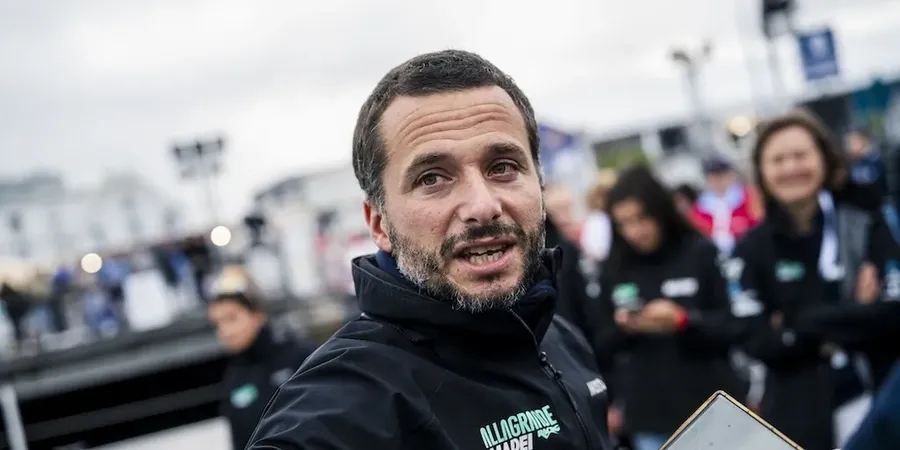
Two back-to-back Vendée Globe completions give Manuel Cousin a kind of authority that statistics alone cannot fully capture. For anyone with a feel for what the Southern Ocean demands of a sailor, his record speaks clearly. He finished the 2020 edition, returned four years later, and completed that one too. Consecutive finishes in the world's most punishing offshore race are not merely a measure of endurance. They signal a depth of seamanship and mental composure that places Cousin among a small and serious group of offshore competitors.
His boat for the Vendée Arctique 2026 is Coup de Pouce, an IMOCA 60 with a distinctly Southern Hemisphere heritage. Designed by Farr Yacht Design and built by Southern Ocean Marine in New Zealand in 2007, the 18.28-metre yacht carries close to two decades of ocean racing in its hull. For this campaign, Coup de Pouce arrives with new foils fitted, and that single fact frames much of what Cousin's preparation involves. A freshly foiled boat behaves differently, sometimes unpredictably, and the Arctic is not the kind of place to encounter surprises unprepared. Performance development and genuine race competition must unfold at the same time, in conditions where the cost of a misjudgement is high.
Those who have sailed alongside Cousin speak of a man whose competitive fire sits alongside a genuine warmth toward other people. That quality extends well beyond racing circles. As patron of the Coup de Pouce association, an organisation dedicated to preventing school dropout across France, Cousin has built a solidarity dimension into the core of his racing programme. Every mile logged at sea converts into tangible support for disadvantaged students ashore. The model transforms competition into something with reach beyond any leaderboard, and it gives his campaigns a human purpose that few performance sailors bring to the sport.
{{TABLE_1}}
Where the Southern Ocean delivers relentless westerlies and long, rolling swells, the Arctic offers a different catalogue of difficulty altogether. Ice fields, compressed light cycles, and the particular psychological weight of sailing toward the polar circle call for a different kind of attention than Cousin has needed on his two globe circumnavigations. Yet the underlying discipline connecting both environments is the same: understand what the boat is doing, manage risk with clear eyes, and hold firmly to the reasons that drove you offshore in the first place. For Cousin, those reasons carry unusual depth. Coup de Pouce, the vessel and the association whose name it shares, represents a commitment that extends well past any single finish line.