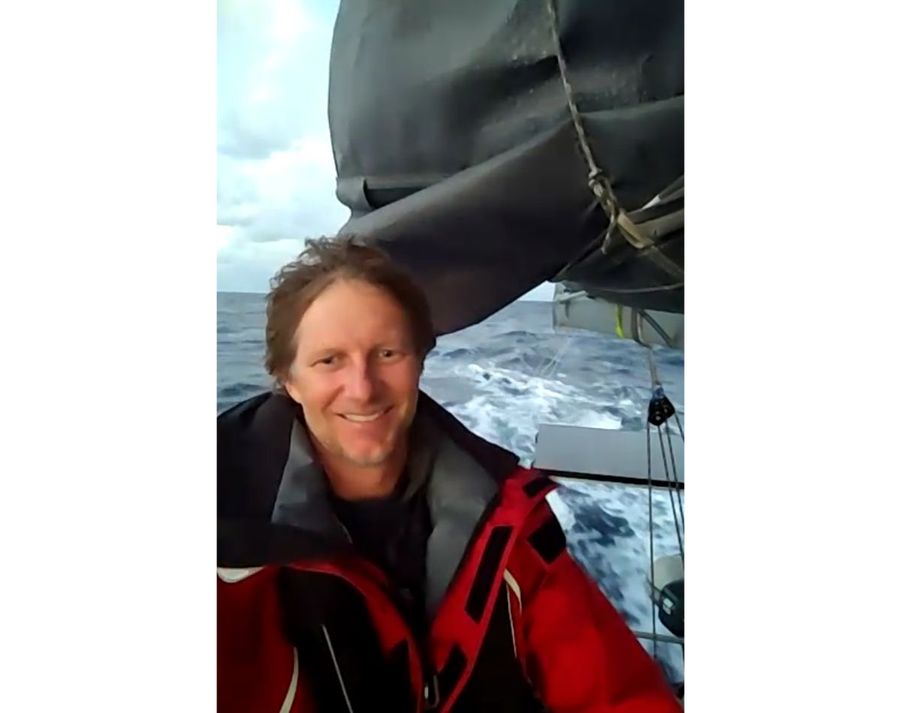
Two hours from the finish of the 2026 Solo Trans-Tasman Yacht Challenge, James Foster was on a WhatsApp call that bore little resemblance to the conversations he had given before leaving Opua a fortnight earlier. The confidence was still in there somewhere, but the Tasman had ground it down to something rawer. He was only now allowing himself to believe the worst was behind him.
"You wouldn't have seen a smile yesterday or the day before," he said. "Maybe a few tears. It was pretty rough out there."
The final 24 hours alone had produced 220 nautical miles of progress. Somewhere around midnight the wind swung onto a reach and Electron responded at once, settling into nines and tens through the water and surfing down to twelves and thirteens on the bigger runs. Between 4am and 8am that morning, Foster recorded a new boat speed record of 24.8 knots, the autopilot steering while he rode a wave down in the dark. He had an alarm set to trigger at 20 knots. "The alarm goes off and it doesn't actually feel any different," he said.
Electron, the 48-foot aluminium Mumby catamaran Foster commissioned and the Hull brothers built at Harvey Bay, had spent three years in the fitting-out shed before she ever met the sea. She was now seven days and ten hours into the passage, comfortably inside the seven-and-a-half-day target Foster had set before the start. The same boat he had described before departure as "not a racing boat" had been moving at a pace that put that assessment into serious question.
The hardest stretch of the crossing had unfolded west of Lord Howe Island, a piece of water Foster knows as well as almost anywhere. He has visited the island eight times with his family and holds it in the same affection many New Zealanders reserve for the Great Barrier. He had been grinding westward for hours, fighting adverse current and watching for a wind shift that simply would not come. When the change finally arrived, just before midnight, it brought a squall with it.
"It just absolutely destroyed me," he said. "I blew all my sheets. Sails going everywhere. Wind coming from every direction. I felt like I was heading back on all those hard-won miles."
He was, in fact, heading east. Every one of Electron's blended Technora lines, chosen because they rank among the strongest available, had been ripped clean through the jammers under squall loads. Foster spent that night on deck repairing what he could, managed to get one headsail working, set a 20-minute alarm, lay down, woke to find the boat still going the wrong direction, and set it again. "Slowly we came around. Then another 48 hours beating north-northwest." He paused before adding: "It couldn't have been more horrible weather for a Trans-Tasman. But that's why we did this race."
That night west of Lord Howe was the low point, but it was not the only difficult stretch. Squalls had come through eight to ten times across the full crossing, each one carrying 40 to 50-plus knots. Rounding Cape Reinga, Foster had taken a line slightly further north than several of his competitors and felt he came off a little more lightly for it. His summary of the crossing as a whole: "War of attrition. Boat-breakingly bad."
After a week of that, it was reasonable to ask why anyone would choose a catamaran for such a passage. Foster traced his answer back to the original intent behind the build. "My last boat was a big heavy displacement long-keel cruiser that could handle offshore work," he said. "I wanted a catamaran that could do the same. The Mumby design is built exactly for long offshore passages in quick time. She's not a racing boat but my god, she's looked after me."
Electron measures 7.5 metres across the beam, and Foster credited that width with making a genuine difference in four and five metre breaking seas. Through conditions that might have unsettled a narrower boat, she had stayed stable throughout. The combination of that beam and the waterline length of a 48-foot platform gave her a steadiness in rough water that had, by his own account, surprised even him.
{{MEDIA_1}}
Comfort aboard Electron put her in a different category from much of the rest of the fleet. Some competitors had sailed the crossing with a bucket in place of a head, a single cooking element, and in Sharon Ferris-Choat's case aboard Vixen Racing, a space blanket tucked inside her thermals for warmth. Foster had two heads, a shower, two fridges, a freezer, and two hot water systems. He cooked proper meals when conditions allowed and resorted to freeze-dried food when they didn't. An electric blanket, packed against the risk of hypothermia, had more than earned its place in the kit. Wet and cold in the small hours, he had plugged it in and described the warmth as extraordinary. The autopilot steered for 99.99 percent of the passage, with Foster touching the helm himself only during a handful of jibes.
With 30 miles remaining and Electron tracking at ten knots, his thinking had already moved past the finish line. He talked about family cruising the following year, a possible entry in the 2028 Round Australia Race, and Brisbane to Gladstone. He wanted to race Electron against other multihulls and find out where she sat in the fleet. "She's got some unfinished business," he said.
His sister was heading out by boat to meet him at the line. His father might be with her. Adele and the kids would be waiting at the dock, or there when he cleared customs in the morning.
Before the start, Foster had been careful to frame the attempt in modest terms: not racing, prioritising safety and comfort, trusting the boat to bring him through. At 49, the youngest competitor in the fleet, with 220 miles in the log for the day and the Gold Coast Seaway somewhere ahead in the dark, that was more or less exactly how things had gone.