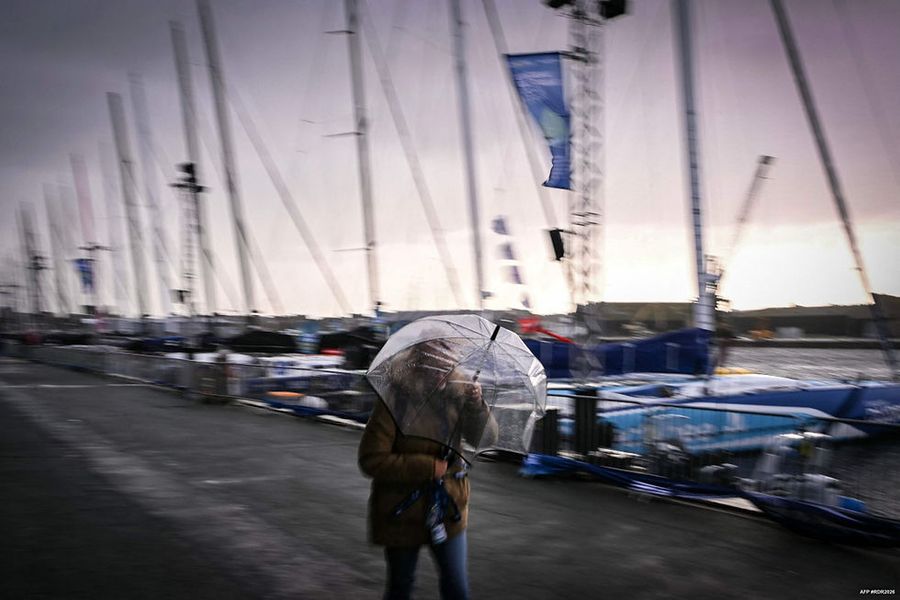
Strong gusts forced organisers to shut the Route du Rhum village for safety reasons through Wednesday morning, before crowds poured back in once the wind eased.
The closure wasn't entirely unexpected. Organisers had already moved the IMOCA fleet's lock passage forward to Tuesday rather than Wednesday, anticipating the stronger conditions. When the wind proved too much on Wednesday morning, officials decided the site could not "ensure the safety of all visitors" and shut it down. As the morning wore on, the wind eased enough for organisers to reopen the village at 2pm.
Pontoons and walkways that sat empty in the middle of the day were soon packed again, just as they had been the day before. Thousands turned out under sunshine to admire the boats and wander through the exhibitor stands.
The village itself covers 70,000 square metres, and it filled up fast, returning to its usual buzz. And this is still just the build-up.
Each afternoon, a charity gets its moment on the event's 360° stage. Today it was Phare 40, which supports the physical and psychological recovery of injured military personnel and gendarmes. The association is backed by Class40 skipper Mathieu Claveau.
Over at the tourist office, the daily autograph sessions continued too. Class40 sailors Mateo Sericano, skipper of Lucente, and Robin Follin, skipper of Solano, both signed for fans this afternoon.

The race's daily look at Guadeloupe turned today to Claude Bistoquet, who sailed the Route du Rhum twice, in 1990 and 1994.
In 1990 he was a complete amateur, working at the Chamber of Commerce when he decided to take on the crossing. "I had never sailed solo before, nor faced storms," he said in an interview. "When I saw the coast of France disappear, I realised there was no turning back." What followed was a string of breakages: a blown gennaker, a torn mainsail, battery trouble, a full electrical blackout. He held on regardless, only to run aground at Capesterre-Belle-Eau after an autopilot failure.
The disappointment cut deep, and criticism followed him for years. "For years, I preferred to look towards La Soufrière rather than look at the sea at that spot," he admitted.
Four years later he returned in a multihull, holding his own for a time against Laurent Bourgnon and Paul Vatine. But roughly thirty hours from Guadeloupe, he capsized again. More setbacks followed, and more criticism that stung for years afterward.
Even so, Bistoquet remains one of the great figures of Guadeloupean sailing. He has stayed closely involved with the archipelago's sailing community ever since, notably as president of the Cercle sportif de Bas-du-Fort.