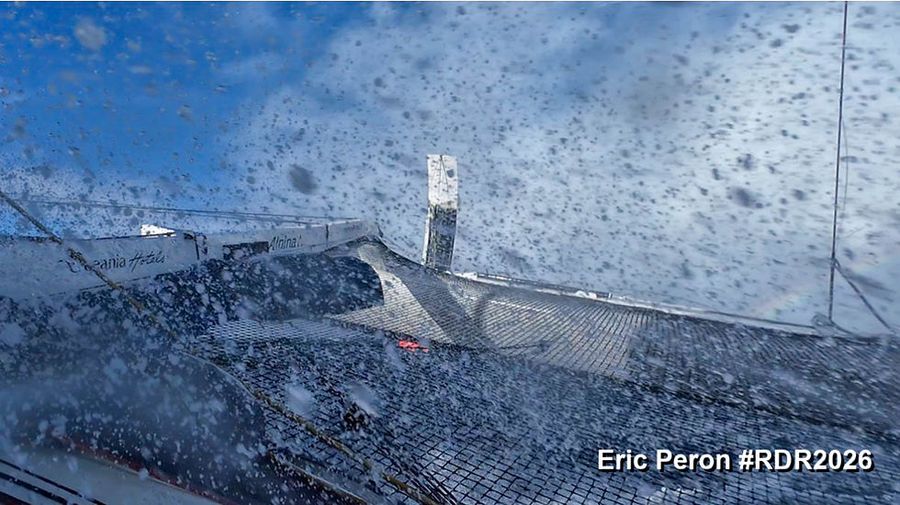

Tom Laperche, aboard SVR Lazartigue in the ULTIM class, is on the final approach to Guadeloupe and looks set to cross the finish line first overnight between Saturday and Sunday. But according to race director Francis Le Goff, the closing stretch of this Route du Rhum - Destination Guadeloupe is proving far from routine.
The traditional lap of Guadeloupe has been upended by the weather. In previous editions, boats would pass Tête à l'Anglais and hug the leeward coast. With a south-westerly blowing this year, Le Goff expects Laperche to approach from offshore instead, since the rock isn't an official course mark and allows for a long tack all the way to Basse-Terre.
"I'll venture to say this year it might actually be less brutal, with a south-westerly wind there could be a steady little breeze," Le Goff said. But he's wary all the same. "The skippers arrive at the end of the race, exhausted, and they still have to manoeuvre. We saw it with Francis Joyon and François Gabart in Ultim, and with Alex Thomson in IMOCA in 2018, unfortunately everything can turn on this lap of Guadeloupe."
Further back in the fleet, the Class40s are battling a ferocious low-pressure system that shows no sign of easing. Some boats risk being swallowed back into it. The leading group, headed by Guillaume Pirouelle on Sogestran - Seafrigo and Robin Follin on Solano, sit on the edge of the system and are pushing hard for performance. Those behind face a trickier balance between speed and safety, with winds up to 40 knots and a heavily built-up sea.
The Ocean Fifty trimarans, meanwhile, are closing in on a tropical depression north of Guadeloupe. Unlike the Ultims, they won't be able to simply push through it. "It'll be about positioning the balance between speed and commitment for the next 24 to 36 hours," Le Goff said, warning that being too conservative risks exposure to destructive waves, while being too aggressive carries its own dangers.
For Le Goff, this edition stands out less for its difficulty than for its character. The fleet left Saint-Malo under an anticyclone, sailing downwind for two days in near-summer conditions, a rarity for northern Brittany. There have been no trade winds to speak of, a track close to the American coast, and now upwind sailing into the finish.
"Climate change, in the end, is something we're observing more and more with each edition, each offshore race," he said, noting increasingly atypical squall systems. Still, he's careful not to overstate it. Every Route du Rhum is hard. That's simply what the race is.
Sixteen retirements after five days doesn't alarm him either. Fewer than 14 percent of the fleet has withdrawn so far, well below the roughly 30 percent seen in some past editions. The headlines have been driven instead by the profile of those involved, particularly the capsize of Armel Le Cleac'h aboard Maxi Banque Populaire XI, a hugely experienced sailor on a big, well-known boat.
Race direction is first to know when something goes wrong.
"We live it by compartmentalising things, the emotion comes afterwards," Le Goff said. The priority is procedural: alerting rescue services, diverting nearby boats, tracking the stricken vessel's signal if it's still transmitting. The process is identical whether it's an Ultim or a Class40.
Understanding what happened to Le Cleac'h matters, Le Goff said, pointing again to the instability of modern offshore weather. Was it a gust too strong, a wave bigger than the rest? He suggested that sailing approaches, and perhaps boat construction itself, may need to adapt as the climate continues to change.