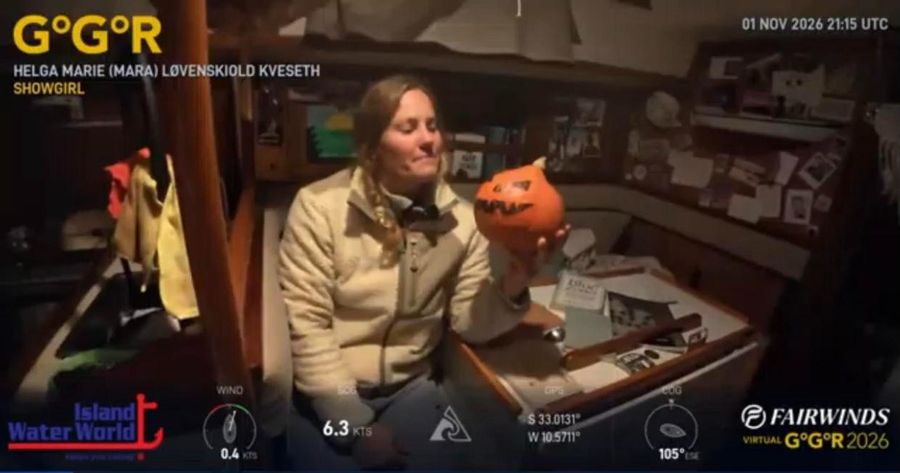
Damien Guillou still leads the Golden Globe Race by 767 nautical miles after 57 days at sea, exactly the margin he had a day ago, because he and Ertan Beskardes each made 139 miles good. Most of the fleet spent Monday running east in a strong blow from a passing low, and Mara Kveseth found time to carve a pumpkin.
At 20:00 UTC on Monday 2 November, Guillou's Solarem had 19,125 nautical miles to run to the finish at Les Sables d'Olonne. Beskardes in Miss Beagle is second on 19,892, and Andrea Lodolo in BiBi is third on 20,302. Pär Nyman in Lazy Otter made the fleet's biggest daily run, 144 miles, while Lodolo made the smallest, 16. Daily runs here are the tracker's 24-hour distance made good, which measures progress towards the finish rather than miles sailed. Kveseth's row had not updated since 16:01 UTC when we wrote this, so we have not ranked her against her neighbours. Our read of the forecast models has the low easing on Tuesday, a light-air spell until Friday and a stronger northerly by the weekend.
Golden Globe Race at a glance, Day 57 (20:00 UTC, 2 November)
Leader: Damien Guillou, Solarem, 19,125 nautical miles to go, 7,993 sailed
Second: Ertan Beskardes, Miss Beagle, 19,892 to go, 767 behind the leader, the same gap as a day ago
Third: Andrea Lodolo, BiBi, 20,302 to go, 410 behind Beskardes
Best 24-hour runs: Nyman 144 miles, Guillou and Beskardes 139, Henry Wootton in Privateer 138, Gunnar Christensen in Pompoen 132
Tightest scrap on updated rows: Christensen on 20,944 and Woodside on 20,970, 26 miles apart on distance to finish (Kveseth's stale row left out)
Golden Globe Race 2026: distance sailed
Tracker snapshots, start to Day 57
Source: Golden Globe Race live tracker (Yellow Brick)
Who is leading the Golden Globe Race on Day 57?
Guillou's lead over Beskardes is 767 miles for the second day running, because each made exactly 139 miles good in 24 hours. Guillou has now sailed 7,993 miles, 1,283 more than Beskardes, whose slow crawl through the calm featured in our report on a passing ship and a sextant.
The bigger changes came among the chasing boats. Lodolo sailed about 116 miles, from 6,537 to 6,653 on the tracker, yet moved only 16 miles closer to the finish. The race office has him fighting easterly winds ahead of the low. That let Beskardes stretch his lead over third place from 287 miles to 410, and let Messikommer close from 221 miles behind Lodolo to 132. Wootton's 138 miles trimmed his gap to Pinsky from 86 miles to 64. Matt Woodside in Tipi Haere made only 17 miles good after heading south, with the wind turning south-south-east around him.
Has Beskardes crossed the Greenwich meridian?
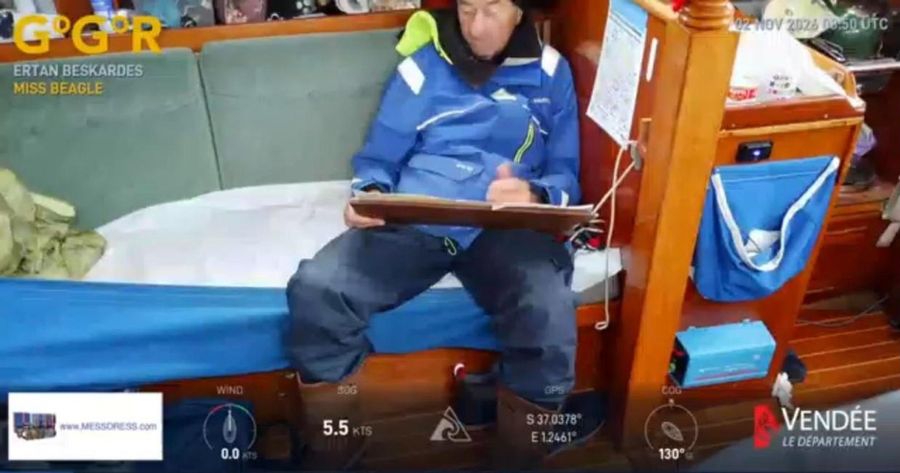
Yes. At 08:59 UTC on Monday the overlay on his stream read 37.05 degrees south and 1.26 degrees east, so Miss Beagle is now east of the Greenwich meridian, and his own dead reckoning had told him the same. He was heading about south-east at five to five and a half knots, and hopes to reach 38 south and roughly 2 east by the evening. He has no plans to hurry down to 40 or 42 south. He says he will go where the wind is, and he is not copying Guillou's latitude, although he thinks some of the others are following that south-easterly route. He plots his progress by hand on a 20-mile grid, and describes feeling a little guilty about reefing before telling himself not to be greedy.
The westerly he hoped for arrived mid-morning and he swung onto a beam reach, shook a reef out of the main and waited the three to five minutes the self-steering needs to settle. Earlier his cabin camera had gone dark, and he mended it live on air with a cheerful claim to be a good fixer who can plug and unplug. The fault turned out to be the cable, not the camera. A squirt of contact cleaner fixed it, and he noted that he has one spare cable left.
Even making tea took some juggling. He made it in a way he called acrobatic, lost a few drops of precious water, and drank it from a lidded cup. Lunch was a tortilla with chicken, rice and hot sauce, "to make it more palatable". And he has company on the radio: Indian ships, he says, always answer his hourly call.
Why is Mara Kveseth holding a pumpkin at sea?
Because the pumpkin came from a carpenter in Les Sables d'Olonne, and a gift like that deserves a face. Kveseth held up her carved Halloween pumpkin on her stream at 21:15 UTC on Sunday 1 November, with Showgirl making 6.3 knots at 33 degrees south, 10.6 degrees west. There was face paint and costumes too. Her viewers, she said, had missed both her equator party and her Halloween party.
Kveseth also had more serious matters on her mind. Kveseth had called a passing vessel on the VHF and found she was further south than she had hoped. She had a reefing puzzle: reefing the main pushes the bow south, and reefing the Yankee costs speed, with the worst of the wind expected around midday the next day. By her next recording the barometer had fallen from 1,020 to 1,008 hPa, and she said she trusts the barometer over a late warning. She also hoped Pinsky was coping, the same Pinsky who had hand-steered through an earlier night.
She now has a regular eight o'clock radio chat with Messikommer, Pinsky and Wootton, and her stream started an hour late because it ran over. All four are puzzled by an unexplained north-easterly. Wootton writes "what the crap happened here" in a notebook, and Kveseth plans to replay the date afterwards to find out. There was a menu swap too. She and Pinsky traded hummus and pizza notes, and she dined on soup of dried vegetables, soy, rice noodles and tofu. The radio group's verdict is that this is the last storm for now, with a high and westerlies to follow under South Africa in about ten days.
How are Messikommer, Christensen and Nyman coping with the blow?
Messikommer took his noon sextant sight on Monday and expected 25 to 30 knots, with the front arriving that evening and a plan to dive south towards 35 degrees once it passed. The race office expected him and Pinsky to feel the strongest conditions. He signed off with greetings to supporters from Bern to Brest.
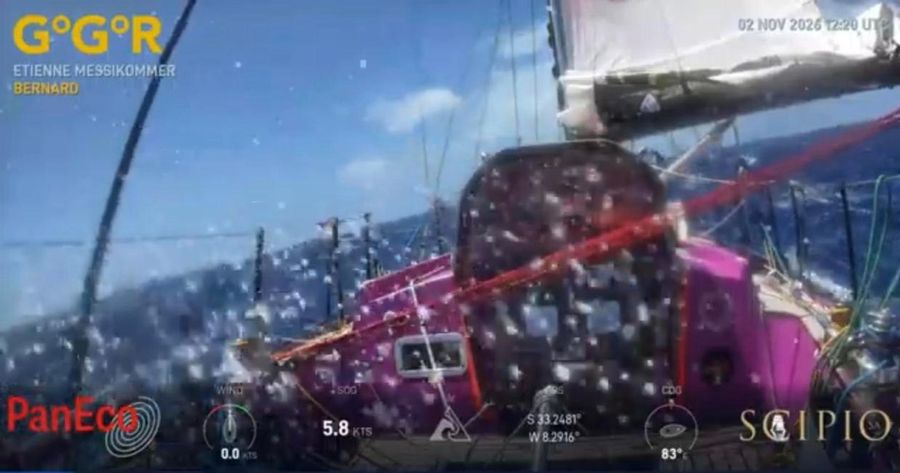
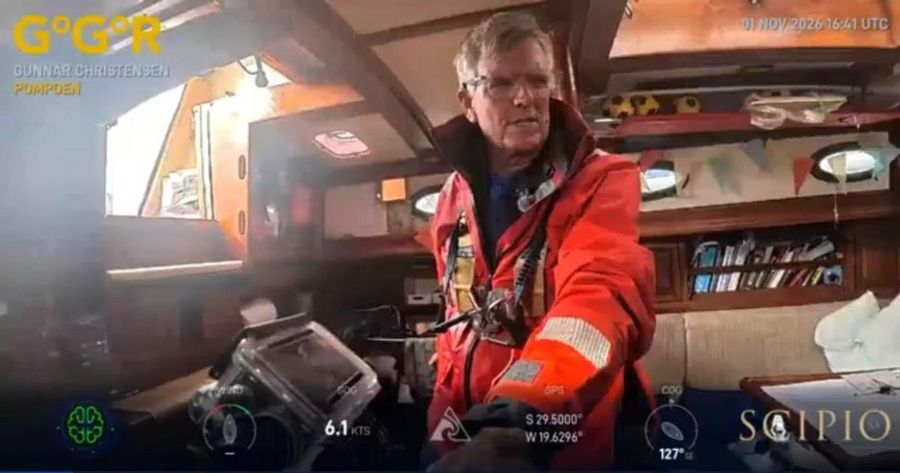
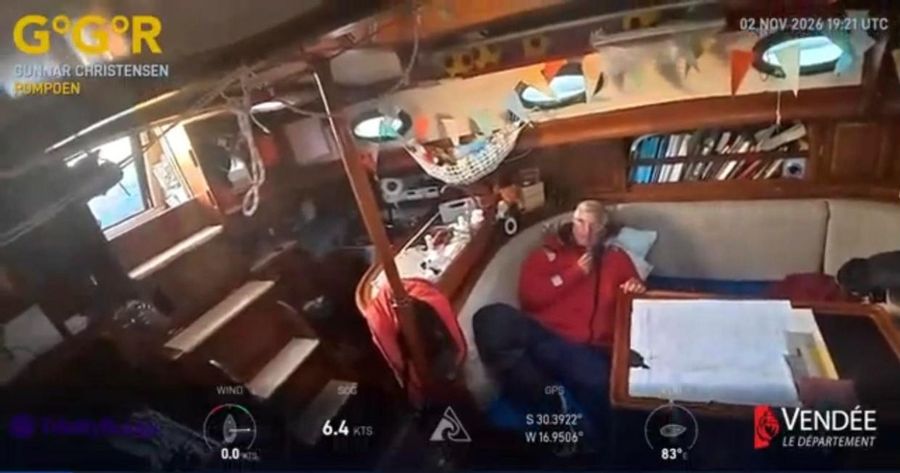
Christensen made 132 miles good, the fifth-best run of the day, and spent his evening wedged on Pompoen's saloon seat with pillows, a triple-reefed main, a reefed staysail and a scrap of jib. The wind had eased a little from 30 to 35 knots, and the waves were hitting the beam. His forecast promised 28 knots 200 miles from the low, yet he was 400 to 500 miles away and getting 30 to 40. A chicken burrito bowl lifted the mood. So did the BBC World Service, which gave him half an hour on standardising screw sizes, and he decided that was exactly what you do when you are being beaten up in the South Atlantic.
He counts himself, Isa Rosli and Woodside as the three musketeers of the back group, keeps an eight o'clock radio chat for better propagation and wants to stay near other boats to hear them. He is the skipper who apologised to the wind only a couple of days ago, so the wind gods appear to be keeping score.
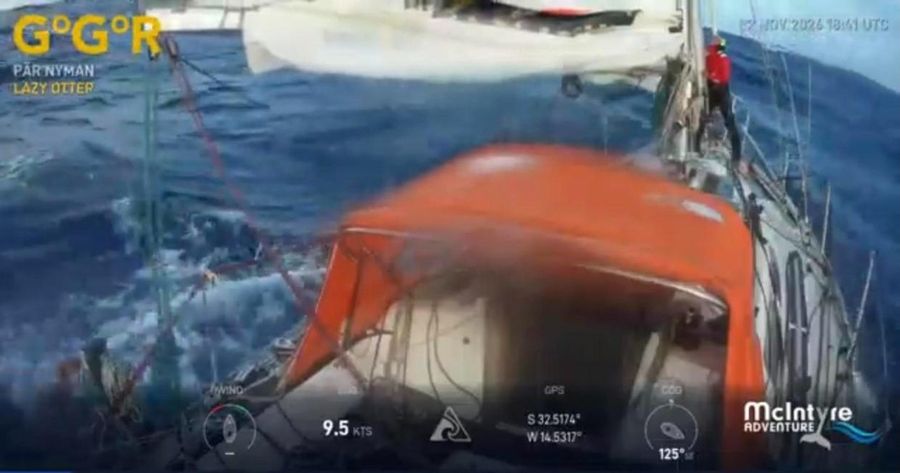
Nyman had the day's best run, 144 miles good, and the camera caught Lazy Otter making 9.5 knots at 18:41 UTC under her orange dodger, with a figure in red on the side deck by the mast. He had fought a jittery, narrow jib that afternoon and calmed it by tightening a line. The boat was almost on the right course and at a good speed, and he thanked his supporters.
Where is the weather risk for the fleet?
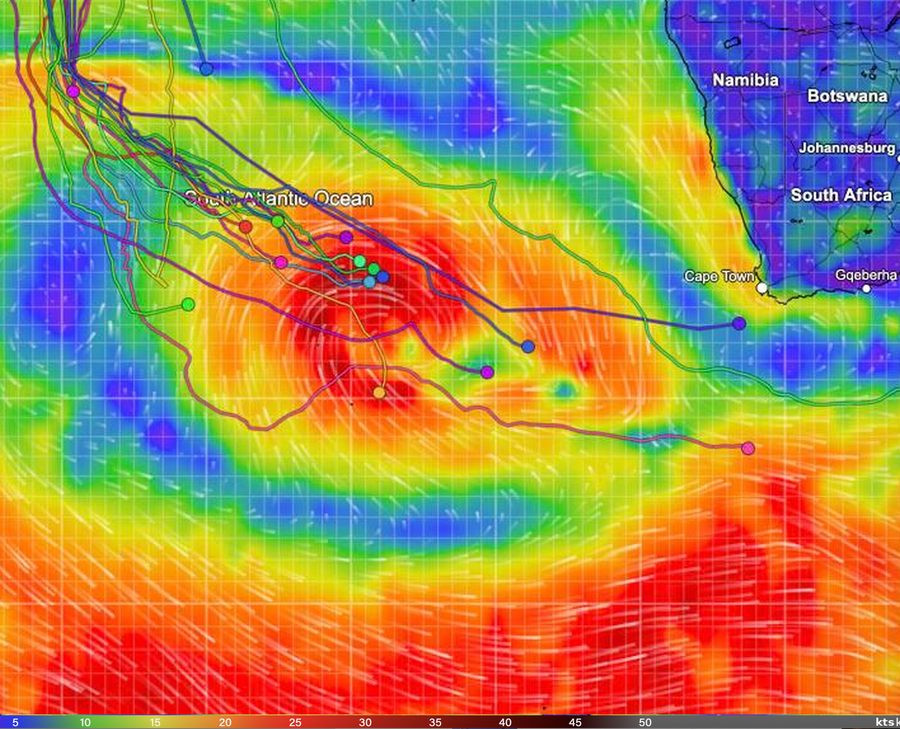
Our read of the two global models, the European ECMWF and the American GFS, side by side in PredictWind, is that the compact low is still the main player. At one point in the middle of the fleet, near 35 degrees south and 7 degrees west, the wind eases from about 34 knots on Monday to around 18 on Tuesday, with the pressure climbing from 994 hPa to 1,007 hPa and then 1,020 hPa by Wednesday. Both models then show light air of roughly 9 to 12 knots on Wednesday, Thursday and Friday, before a northerly builds on Saturday 7 November to about 28 knots at that spot, with stronger breeze around it. The race office also expects the low to weaken and move away over the next day or two.
After a day in 30 knots a lull is welcome. These are forecasts, not observations, and the timeline labels in PredictWind are in local time, so we have kept to days rather than hours. Our earlier reports on the second gale and Guillou's run through the storm gap show how hard these systems can bite.
Follow the whole race on our dedicated Golden Globe Race 2026 page. Now also follow our Globe 5.80 Transat coverage.