Damien Guillou has slipped past the Cape of Good Hope and out of the Atlantic, and he still leads the Golden Globe Race by 743 nautical miles after 58 days at sea. Most of the fleet is back on its way east as the latest low moves off, and the next Southern Ocean low is already showing on the charts.
At 20:00 UTC on Tuesday 3 November, Guillou's Solarem had 19,022 nautical miles to run to the finish at Les Sables d'Olonne. Ertan Beskardes in Miss Beagle is second on 19,765 miles to go, and Etienne Messikommer in Bernard is next on 20,308, although Andrea Lodolo's row, last updated at 16:05 UTC, has BiBi only 14 miles behind him, so the order of those two is uncertain.
Beskardes and Guido Cantini in Hannah of Cowes made the biggest daily runs, 128 miles each, against 102 for Guillou, so the leader's margin eased from 767 to 743 miles. Daily runs here are the tracker's 24-hour distance made good, which measures progress towards the finish rather than miles sailed.
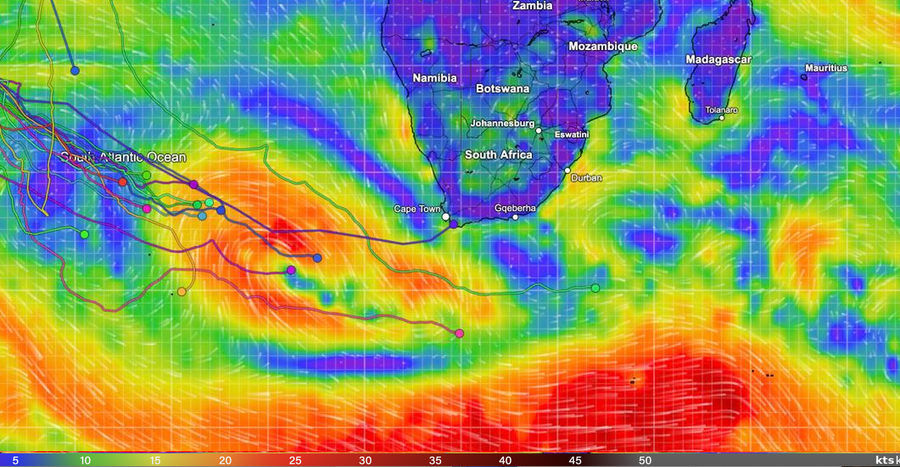
Our read of the forecast models gives the main pack lighter air on Thursday and Friday, then a northerly by Saturday, while both models show 30 knots or more near Guillou's present position by Friday, although he should be further east by then.
Golden Globe Race at a glance, Day 58 (20:00 UTC, 3 November)
Leader: Damien Guillou, Solarem, 19,022 nautical miles to go, 8,100 sailed
Second: Ertan Beskardes, Miss Beagle, 19,765 to go, 743 behind the leader, down from 767 a day earlier
Next: Etienne Messikommer, Bernard, 20,308 to go (Lodolo's older row reads 20,322)
Best 24-hour runs: Beskardes and Cantini 128 miles, Messikommer 126, Henry Wootton in Privateer 125 (his row is from 18:06 UTC)
Tightest scrap: Gunnar Christensen in Pompoen on 20,838 and Matt Woodside in Tipi Haere on 20,857, 19 miles apart (rows updated at 20:00 UTC only)
Guillou's distance from the race's 45 degrees south limit: about 92 miles
Golden Globe Race 2026: distance sailed
Tracker snapshots, start to Day 58
Source: Golden Globe Race live tracker (Yellow Brick)
Who is leading the Golden Globe Race on Day 58?
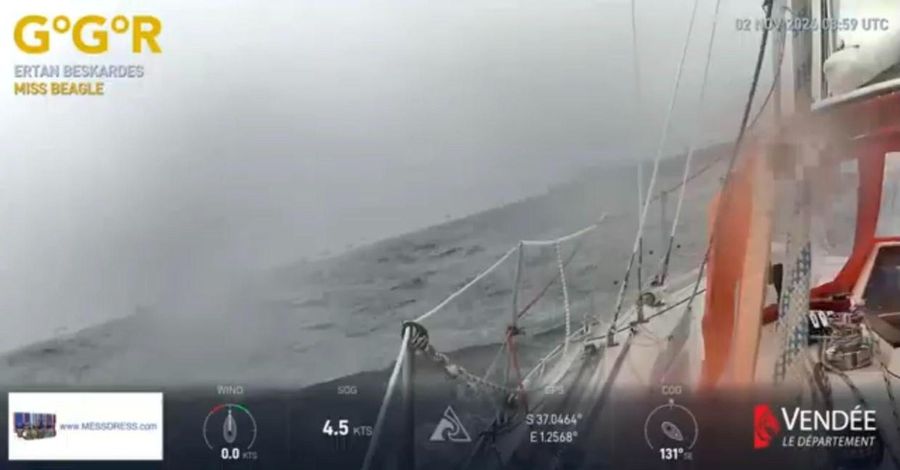
Guillou, by 743 miles. He has sailed 8,100 miles to Beskardes' 6,847, a gap of 1,253 in miles sailed, and is only 743 miles closer to the finish. Beskardes, who plots his position by hand on a 20-mile grid and whose sextant sights were confirmed by a passing ship, took back 24 miles in the day. The race office has him heading east at about 4.7 knots and expecting more strong wind, which it says he appears to be managing.
Lodolo, meanwhile, has been heading west rather than east. At the 08:00 UTC positions the race office had him heading west at about 3.2 knots, apparently running off before the wind and seas as the low went through, which can be sound seamanship even when it costs miles. His tracker row shows minus 28 miles of progress for the 24 hours. Messikommer, meanwhile, keeps leading the middle group with 126 miles good.
Has Damien Guillou cleared the Cape of Good Hope?
On the tracker, yes. At 20°09.8 E, Solarem is east of 20 degrees east, the meridian Britannica gives as the official boundary between the Atlantic and Indian oceans, so Guillou has left the Atlantic behind. He is also a very long way south of the headland itself, at 43°27.6 S.
The Cape of Good Hope is not the southern tip of Africa, a common mix-up. That is Cape Agulhas, about 150 kilometres east-south-east of it. The race route still treats the Cape as a mark, and the fleet must leave it to port. After it comes the Prince Edward Islands, the Crozet Islands and the Kerguelen Islands, all to starboard, with an imaginary line along 45 degrees south that entrants must not cross or take a time penalty. At 43°27.6 S, Guillou is about 92 miles from that line, which is 1.5 degrees of latitude at 60 miles a degree.
Guillou has unfinished business here. The race office notes that this is the area where his 2022 Golden Globe Race ended, with a retirement and a return to Cape Town, and on the tracker he is now clear of that area. Guillou has already been through heavy weather on the way south.
Why is the Cape of Good Hope so feared?
The Cape has troubled sailors for centuries. Britannica describes the Cape as known for stormy weather and rough seas, standing where the warm Mozambique-Agulhas current from the Indian Ocean meets the cool Benguela current from Antarctic waters. One account says Bartolomeu Dias named it the Cape of Storms after sighting it in 1488, and that King John II of Portugal renamed it the Cape of Good Hope. Other sources credit Dias with the name we use now, so we will leave the naming argument to the historians.
The worst seas come when strong wind opposes the current. Writing in Yachting World, Chris Tibbs says the Agulhas Current can run at up to 5 knots, is generally under 50 miles wide and hugs the edge of the continental shelf. Cold fronts from the Southern Ocean bring gale-force south-south-westerlies behind them, and when that wind blows against the south-flowing current the sea can turn dangerous quickly, with freak waves he says can break boats. His answer is timing: arrive when the usual north-easterlies blow with the current, and stay clear of a front. Weather observations there are sparse, so sailors lean on computer model files.
A paper from the weather company DTN says deep lows over the Roaring Forties bring the strongest gales mainly in winter, from June to September, and that lows deepening over the warm Agulhas current can intensify explosively. An old account of the 1984 Vasco da Gama Race, on sailing.co.za, tells of yachts that went for the core of the current, 15 to 30 nautical miles off the coast, being among the hardest hit by a south-westerly gale. It reckons the quickest course to the coast was the safer one. None of these sources gives wave heights, and neither do we.
One caution. Those accounts mostly describe the coast to the east and south-east of the Cape, where the current runs close to the shelf, and the Golden Globe fleet passes far to the south of it. For Guillou the issue is less the Agulhas than the Southern Ocean lows themselves. Race rules say entrants must not be given any form of weather routing, so there is no shore team plotting him a course. The race office sends weather alerts to the fleet, but the choice of course and sail is his alone: read the barometer, judge the day, keep out of the worst of a front, and come out the far side with the boat in one piece and no time lost. It is southern spring now, not the winter peak DTN describes, yet both of our models, further down, still show a strong low coming.
How are the chasing skippers coping now the low has passed?
A quieter day on the tracker, with the biggest run down to 128 miles from Monday's 144. Cantini matched Beskardes exactly, the second time this week two boats have finished a day with the same figure, after Guillou and Beskardes both made 139 on Monday. Messikommer made 126, Wootton 125 on a row from 18:06 UTC, and Pär Nyman in Lazy Otter 118, while Isa Rosli in Olleanna made 114 and Woodside in Tipi Haere 113. Woodside is once again heading south of east, which the race office reads as an effort to reach the more southerly airflow.
Daniel Pinsky in Exodus had the smallest of the fresh runs, 87 miles. The race office noted him making about 3.4 knots from a position further south and wondered whether he had lighter wind near the centre of the system, though it said that was unconfirmed pending a look at the charts.
The closest contest on the leaderboard is at the back, where Christensen and Woodside are separated by just 19 miles on distance to go, with Rosli 93 miles ahead of Christensen. Christensen is the skipper who calls himself, Rosli and Woodside the three musketeers of the back group. He made 106 miles good on a day when the race office had him making about 5.3 knots.

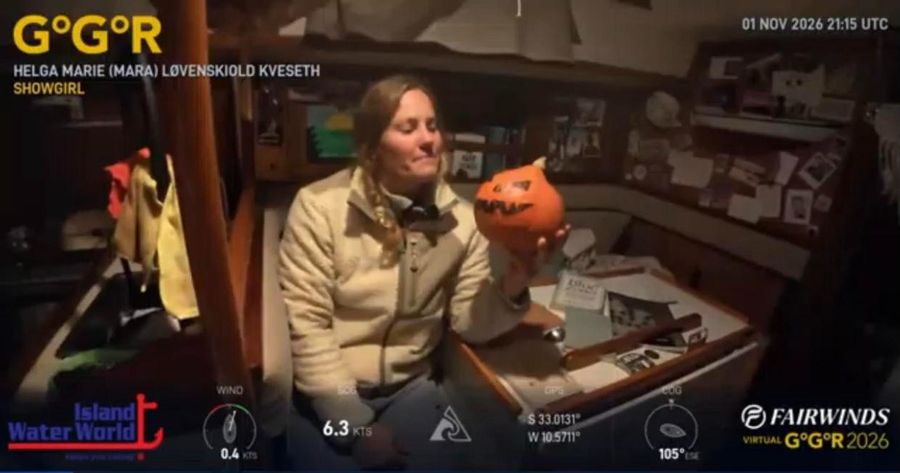
One more name is missing from the order. Mara Kveseth's row on the tracker was last updated at 04:08 UTC on Tuesday, well behind the rest, so we cannot rank her against her neighbours. Her last appearance in our reports was holding a pumpkin, and we will look for her fresh fix tomorrow.
Where is the weather risk for the fleet?
We read the European ECMWF and American GFS models side by side in PredictWind, and they agree on the broad picture. Near 35 degrees south and 4 degrees west, around the front of the main pack, the wind eases through Wednesday, to about 18 knots in ECMWF and 19 in GFS, then drops to about 11 on Thursday and 7 to 8 on Friday, with the pressure climbing to roughly 1,022 to 1,024 hPa. A northerly then builds on Saturday 7 November to 23 knots in ECMWF and 27 in GFS, and it is still 15 to 19 knots on Monday 9 November.
The forecast is less settled further south. Around Guillou's present position, at about 43 degrees south and 20 degrees east, the wind is 10 to 13 knots on Wednesday and Thursday. By Friday 6 November, ECMWF shows 32 knots from the west-south-west and GFS 35, with pressure near 1,000 hPa, before easing on Saturday. Guillou will have moved east by then, so that is the weather around where he is now, not a forecast for his exact position. It still tells us that a low is on its way across the Southern Ocean south of Africa. PredictWind labels its timeline in New Zealand time, and the Friday frame we used is 11:03 on 6 November NZDT, which is 22:03 UTC on Thursday 5 November.
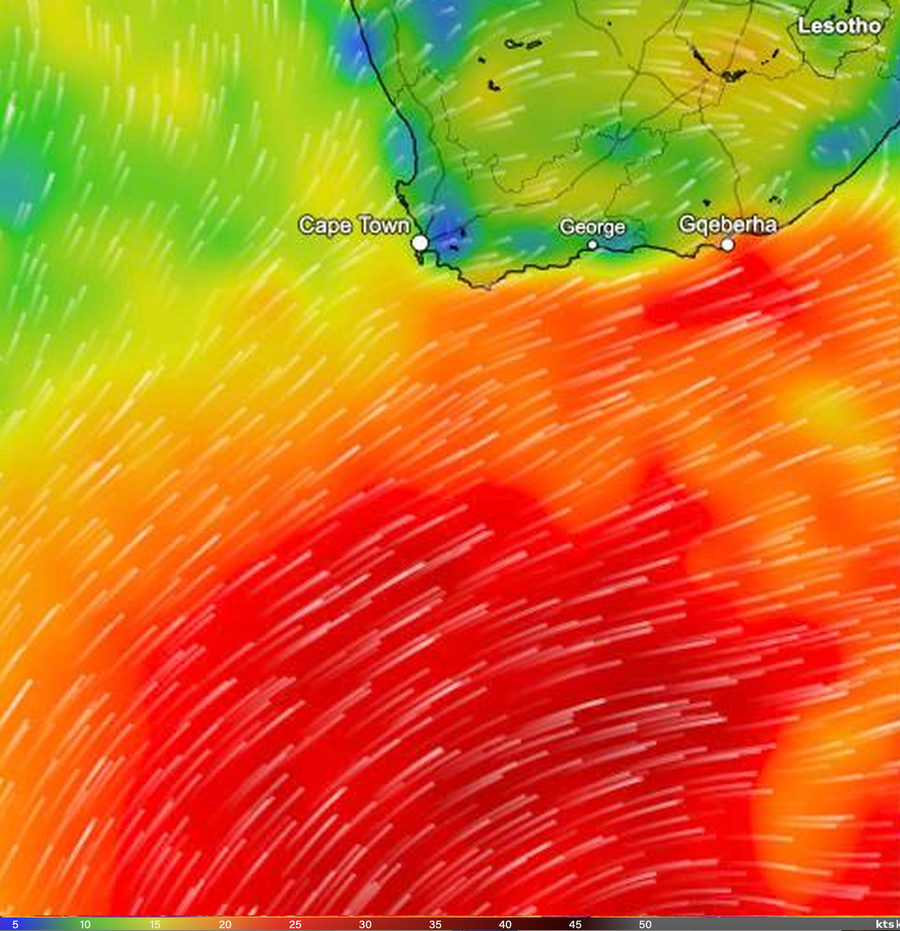
These are forecasts and the models may shift. Our earlier reports on Guillou threading the storm gap and Pinsky hand-steering through the night show what the fleet has already faced in these conditions. How far east Guillou gets before this low arrives is the question for the next two days.
Follow the whole race on our dedicated Golden Globe Race 2026 page.