
Few races place their competitors quite so directly inside the story they are meant to tell. The Vendée Arctique sends its fleet through a corner of the planet where temperatures are climbing at four times the global average rate, making the competition itself a kind of live dispatch from the front line of environmental change.
That figure provides an immediate sense of what these sailors are heading into. As the fleet crosses the Arctic Circle, competitors will encounter firsthand the phenomenon researchers call Arctic amplification, a feedback process tied directly to the fate of sea ice. Under normal conditions, the bright surface of that ice reflects solar energy back out into space. But as the ice thins and pulls back, it exposes the dark ocean beneath, which absorbs heat rather than reflecting it. The warming then accelerates, feeding itself in a cycle that has no natural mechanism to slow it down.
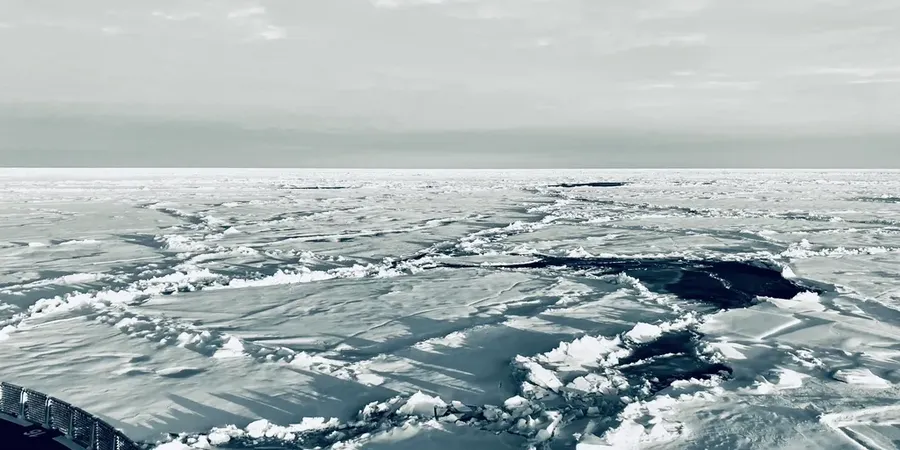
Camille Lique, a researcher at France's Ifremer oceanographic institute and coordinator of the CLIMArcTIC research project, has tracked how the region's sea ice has grown younger, thinner, and far more mobile over recent decades, making it increasingly vulnerable. The changes extend beyond the ice itself. The ocean's surface layer is simultaneously desalinating and acidifying, a combination that is already disrupting marine food webs and ecosystems across the region.
The consequences reach well beyond the Arctic's own boundaries. Close to four million people live within the region, and the environmental shifts underway are already remaking daily life and traditional ways of living for those communities. Beyond them, alterations to ocean circulation and atmospheric behaviour in the Arctic carry the potential to reshape weather patterns and climate conditions across much of the wider world. Researchers often describe the region as a canary in a coal mine, an early signal of environmental change that the rest of the planet may not feel for years or even decades.

The Arctic is not, however, a single uniform place. The Baffin Sea off Greenland's western coast behaves quite differently from the Chukchi Sea north of the Bering Strait, and conditions vary considerably across the broader region. Climate models agree that the pace of change will intensify, but they diverge on how quickly and severely that will unfold in specific locations. Narrowing those gaps has become a priority for researchers, who are pushing for more precise projections tied to particular areas rather than the region as a whole.
The CLIMArcTIC project, coordinated by Ifremer and drawing together twelve partner institutions alongside roughly fifty researchers and engineers, will bring its findings directly to the public through an exhibition called "The Arctic: An Ocean in Transformation," staged at the race's start village. The display addresses the current state of Arctic climate science, the intricacies of the region's ecosystems, and the mounting pressures facing the communities who live there.
In routing this race through the Arctic, the organisers have made a pointed choice, placing the event inside one of the most rapidly transforming environments on Earth. The skippers will be competing hard for a finish line, but they will also be moving through terrain that renders the science tangible and immediate in a way that no classroom or conference ever could. They sail as witnesses to a frontier under serious and accelerating pressure.