Two decades have passed since the X3 first appeared on these pages, but the timing of this second look could hardly be better. Trailer sailors and compact dinghies are enjoying a quiet resurgence right now, and the qualities that made this boat worth writing about in 2006, durability, versatility, and genuine performance in a small package, feel just as relevant today.
Pitched simultaneously as an entry-level trainer for young children, a youth racing boat, and a fun boat for adults, the X3 is an unusual creature. Geoff Green enlisted two experienced sailors to put the boat through its paces and find out whether it could really deliver across such a wide range of applications.
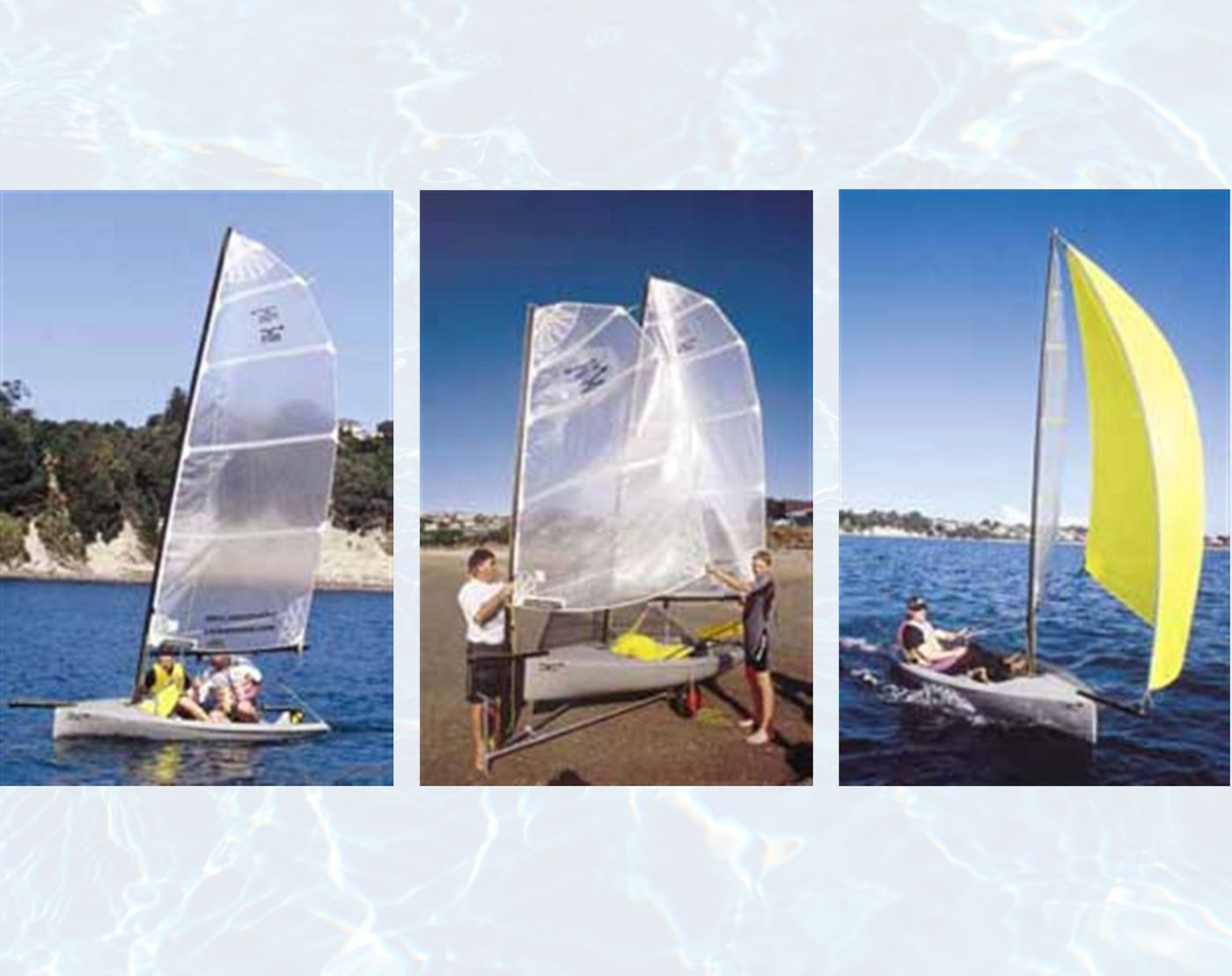
In 2006, Rhys Nolan of Performance Sailing Equipment in Kerikeri was the man bringing the Australian-designed and built X3 centreboard yacht to New Zealand. The appeal was straightforward: a tough, low-cost boat capable of serving both as a beginner's sail trainer and a performance youth boat. That breadth of purpose is made possible by two separate rig sizes. One is an education-oriented sail plan on a shorter spar; the other is a taller, more powerful setup built for speed and excitement.
The X3 was designed and built by Jim Close in Melbourne. Close learned to sail in Sabots at the Royal Brighton Yacht Club before becoming a sailmaker and going on to compete in numerous offshore campaigns, among them three Whitbread Round the World races. While working to generate support for a Melbourne-backed entry in the 2001-2002 Volvo Ocean Race, he noticed that Sabot sail training at his old club had fallen away sharply. Not long afterwards, at a sailing summit, he heard International Sailing Federation CEO Paul Henderson make the case for a durable and versatile centreboard class capable of being crewed by two teenagers. That was the moment the seeds for the X3 were planted. Close and fellow Whitbread veteran David Allen subsequently formed Sail Extreme to produce it.
Rhys points to the boat's modern appearance as a key part of its attraction as a trainer. "My son wasn't interested in learning to sail and showed no interest in getting into a P-Class, Sabot or Optimist, but he became really enthusiastic when he saw the X3. He liked it because it looked like a 29er or 49er skiff."
That reaction from his son was one of the things that motivated Rhys to bring the boat to New Zealand. The other was the sheer versatility that comes with a single hull and two rig options. "My son is learning to sail it using the small mainsail only, but it is powerful enough to carry a crew weighing 120kg with the big rig. That's two teenagers or an adult-child combination."
The rigs can be bought separately, meaning families can make a staged investment as their children grow. Usefully, the small gennaker can be flown from either mast. "It can be matched with the tall mainsail to create an intermediate fractional rig that allows new crews to get to grips with launching, setting and retrieving an extra without being overpowered in the learning process. It also gives an option to reduce sail area, but maintain performance on windy days."
Rigging the X3 is quick and straightforward. The mast is free-standing and, despite the tall rig carrying a reasonably powerful sail plan, the mast section itself is quite small. Rhys explains that the solution lies in purpose-designed fittings. "The X3 uses purpose-designed fittings where necessary and the mast is a prime example of this. It's extruded with internal cross webs to provide the stiffness associated with a larger cross-section. An added bonus is that the halyards can't cross, because they run on different sides of the internal strengthening webs."
Shackles play no part in rigging the X3, and that is entirely deliberate. "Tying the halyards and sheets on teaches the children to tie reliable knots," says Rhys. Other considered design choices include a pivoting centreboard and rudder, which reduce the risk of damage when a novice runs aground. Even the colour of the foils carries a practical rationale. "They're bright yellow, so the boat is easily seen if it tips upside down."
The X3's dish-shaped hull is rotationally moulded from polyethylene and is a neat piece of engineering. Built with 3-4mm inner and outer polyethylene skins around a polyethylene foam core, the structure is entirely contiguous. There are no joins anywhere, not even a hull-to-deck join, making it a true monocoque. Rhys notes that the material is recyclable, though given the boat's durability and ease of repair, that is unlikely to become relevant for many generations.
During research for this review, a number of people reached for the Laser as a reference point when describing the X3. The two boats are quite different, but the comparison does provide a useful benchmark. At 3.1 metres, the X3 hull is 1.13 metres shorter than a Laser and, at 55 kilograms, only 3 kilograms lighter. It is beamier than the Laser, measuring 1.5 metres across compared with the Laser's 1.37 metres. The big mainsail's 5.8 square metres of area is 1.26 square metres less than a Laser's sail, though the X3 offers something a Laser cannot match: gennaker options in two sizes, the large at 8.2 square metres and the small at 4.5 square metres.
To get a proper sense of how the X3 performs, Richard Potter of Trade-A-Boat was asked to take the helm. Potter has sailed internationally in Lasers and J24s, and his light-airs test sail produced a measured assessment. "It's a little more demanding to sail single-handed than a Laser because with the gennaker there are more ropes to pull and sails to co-ordinate. This also makes it more exciting. In the light breeze, it went to windward well and the balance was very good. The cockpit is comfortable, there are no sharp edges or angles, and it was large enough to move about in easily. The boat carried my 88kg weight well and was very stable."
At the time the original article was written, Martyn Baker, a sailmaker at Halsey Lidgard Sails in Auckland, also sailed the X3 and arrived at similar conclusions. Baker's connection to the boat ran deeper than that test sail: the X3's sails were originally designed by Jim Close and subsequently made slightly more production-friendly by Halsey Lidgard Sails, where they are now manufactured.
The mainsails for both rigs are made from a reinforced monofilm fabric, comparable to windsurfer sail material but incorporating a scrim that gives it significantly better tear strength. In practical terms, this means that if someone falls into the sail during a capsize, it will not blow out the way a windsurfer sail sometimes does.
Baker highlights several features of the mainsail design, starting with a bag near the tack for stowing the tail of the main halyard. "The bag is near the sail's tack and helps keep the cockpit tidy. If the main needs to be dropped in a hurry, you know exactly where to find the halyard," he says. The battens are fixed permanently in their pockets, removable in theory but not easily so, which removes any temptation to fiddle with batten tension between races.
The gennakers are cut from 0.75oz nylon in a radial pattern. Baker says this produces a well-balanced sail that is both fast and easy to trim. "Both gennakers have two retriever patches on them to eliminate the need for a full-length retrieval chute and this system also collapses the gennaker a lot quicker during a drop."
On the X3's broader potential, Baker is positive. "It went really well in a light breeze. The rigs are simple, but efficient, and the helm is light and responsive." He also agrees with Rhys that having two rigs stretches the boat's useful life considerably, making it viable from beginner right through to senior level.
Rhys is promoting the X3 to yacht clubs as both a sail trainer and a performance youth boat, and says his intention is to keep it within the spirit of a one-design class, regardless of the various crew and rig combinations available. "It's all about building up a durable club class that can provide close racing and flexibility in terms of age, weight and crew numbers. And, of course, the boat can double as a fun family beach boat. In a breeze, it could be a blast."
Specifications
Length: 3.1m Beam: 1.5m Hull weight: 55kg Mast height – Education: 4m Mast height – Fun: 5m Mainsail – Education: 4sq m Mainsail – Fun: 5.8sq m Gennaker – Education: 4.5sq m Gennaker – Fun: 8.2sq m