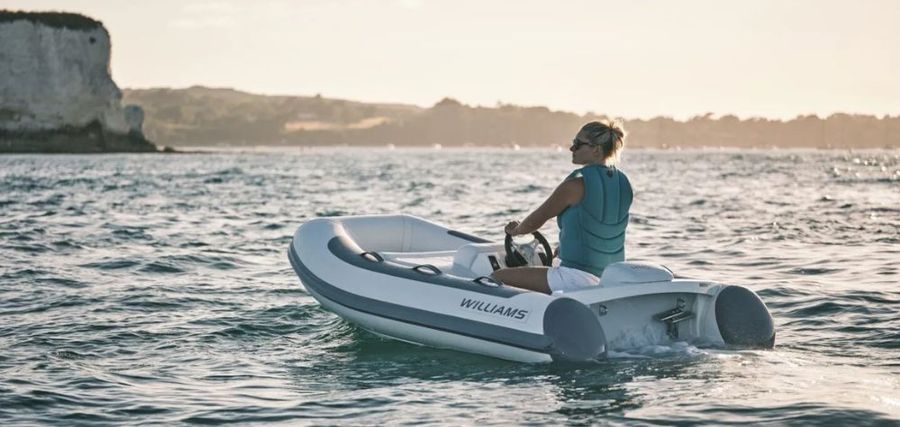
At 2.79 metres, the Williams TurboJet 280MX sits at the small end of the tender scale, built for yachts where garage space and platform lifting limits rule out bigger options.
It replaces the MiniJet 280, Williams Jet Tenders' smallest, lightest and most compact model, aimed at sub-45-foot yachts with restrictive tender garages or strict lifting limits.
The 280MX was officially launched earlier this month, with orders opening immediately through Williams' global dealer network. First customer deliveries are expected from January 2027. MiniJet 280 production ends in September 2026, closing out that platform in favour of the TurboJet 280MX.
The 280MX doesn't arrive on its own. It's one half of Williams' new TurboJet MX range, alongside the larger TurboJet 320MX, which the company describes as its new entry-level jet tender offering. The 320MX measures 3.19 metres, carries four adults and one child, and uses a 90 hp engine for a top speed of 45 mph, priced at £19,995. Williams commercial director Mathew Hornsby has pitched the range as a way to broaden the brand's customer base without giving up the fit and finish buyers expect from Williams, noting that pricing at this level hasn't been available from the company since 2017.
Williams frames the change around three things: pricing, performance and handling, and updated styling and customisation.
Pricing and performance
The sub-70ft yacht market has been pushing for more competitive pricing without giving up premium positioning. Williams says building the 280MX on the same production scale as its larger TurboJet models lets it price the boat around 20 per cent below comparable jet tenders.
The MiniJet 280 was already agile, but factory testing let Williams refine the hull dynamics and the weight-to-torque balance of the updated BRP Rotax ACE 900/903 engine. The 280MX is only marginally heavier than the outgoing model, 230 kg against 227 kg, but Williams says it delivers better stability, improved tracking and a higher top speed of 42 mph, up from 40 mph.
Fitting a small yacht
The 280MX is aimed squarely at owners of sub-50-foot yachts working around tight garage space and modest lifting capacity.
At 230 kg dry, it's around 30 per cent lighter than a typical luxury jet tender of similar size, and the 60 hp BRP Rotax ACE 903 gets it to 42 mph. Capacity is three adults and one child, enough utility for most tender duties without pushing the limits of a swim platform hydraulic system or davit crane.
Stowed height is a low 0.71 metres with the quick-release steering wheel fitted, letting it slide into garage bays and swim platforms that a standard RIB with an outboard leg wouldn't fit into.
The enclosed jet propulsion removes the exposed propeller found on outboard-powered tenders, which matters when swimmers, water skiers or divers are boarding from the water. Without an outboard leg or stern drive, it can also work closer to shallow coastal water and beaches without the risk of hitting bottom. A built-in power limiter lets owners restrict output while younger or less experienced crew get used to handling the boat.
Styling has been updated to suit modern motor yacht interiors, with new upholstery, a choice of white or grey tubes and a redesigned dashboard.
Lifting capacity
Dry weight is 230 kg, but that's not the figure to plan a lifting system around. Williams gives a wet operational weight of around 266 kg once fuel and equipment are aboard, and recommends a crane, davit or hydraulic swim platform rated to at least 300 kg Safe Working Load to allow for that and a dynamic safety margin.
Key specifications
Length: 2.79 metres (9 ft 2 in) Beam: 1.54 metres (5 ft 2 in) Dry weight: 230 kg Engine: BRP Rotax ACE 903, 60 hp Fuel capacity: 28 litres Capacity: three adults and one child Top speed: 42 mph Stowed height: 0.71 metres (quick-release wheel fitted)