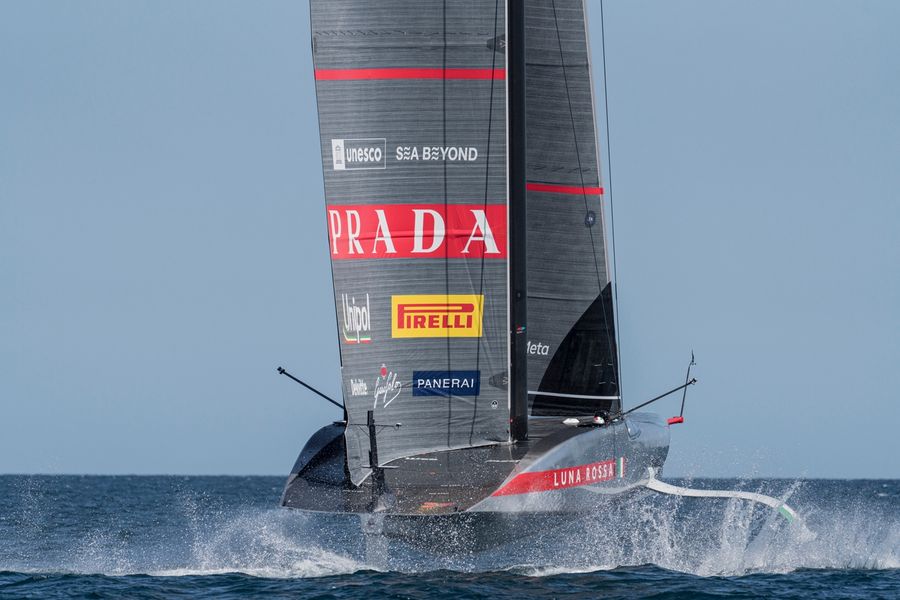
The AC75 mainsail looks ordinary enough from a distance. Up close, it is one of the cleverest pieces of aerodynamic engineering in modern sailing.
Rather than a single sail hung off the back of a mast, the AC75 rig combines the spar with two separate sail skins, one running down each side. Together they behave less like a conventional sail and more like a wing, a clever workaround to a problem that plagued the previous generation of Cup boats.
The rigid wingsails used on the AC72 and AC50 were brutally efficient but a logistical nightmare. They needed specialist shore crews and cranes just to step and unstep them. The AC75 keeps much of that aerodynamic advantage while returning to something that can actually be hoisted and lowered like a normal sail. Making it work, though, is a different matter entirely.
**Two sails, one aerofoil**
Think of it less as a sail and more as an aircraft wing standing on its end. A conventional mainsail is a thin membrane with pressure on one side and suction on the other, and the airflow has to cope with an awkward transition off the blunt mast and onto that membrane. That transition costs performance.
The double-skin system fixes the geometry problem. One skin attaches to each side of the mast, the two separating around the spar before converging at the leech. Seen in cross-section, the mast and sail form a much more continuous aerofoil shape, smoothing the airflow at the leading edge and reducing separation. Because there are two skins, trimmers can also manipulate the windward and leeward surfaces independently, giving them far more control over the three-dimensional shape of the whole package than a single-skin sail ever allowed.
**Is camber king?**
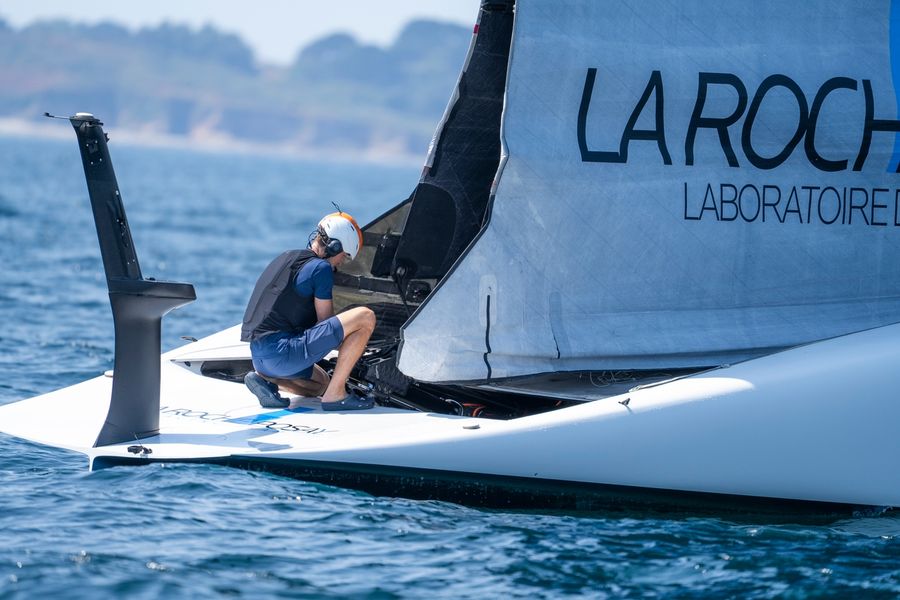
Camber, how deep or curved the aerofoil is, remains fundamental. More camber means more power but more drag; less camber flattens things out and cuts drag, and the ideal setting keeps shifting depending on what the boat is doing.
Coming out of a manoeuvre or accelerating low in the foiling range, the priority is power. Once the AC75 is through 40 knots and the apparent wind has swung hard forward, drag becomes the enemy and the sail needs to flatten out while still generating enough force to keep the boat flying.
This is the counter-intuitive bit about foiling. The faster the boat goes, the stronger the apparent wind gets. So the shape that gets an AC75 up onto its foils is not the shape it wants once it is settled at 45 or 50 knots, and the trimmer is constantly managing that handover.
**Twist, the three-dimensional problem**
The wind at the bottom of the sail is not the same as the wind at the top, so the rig cannot be trimmed as a single flat plane. It needs twist, changing the angle of attack with height so as much of the sail as possible stays working efficiently.
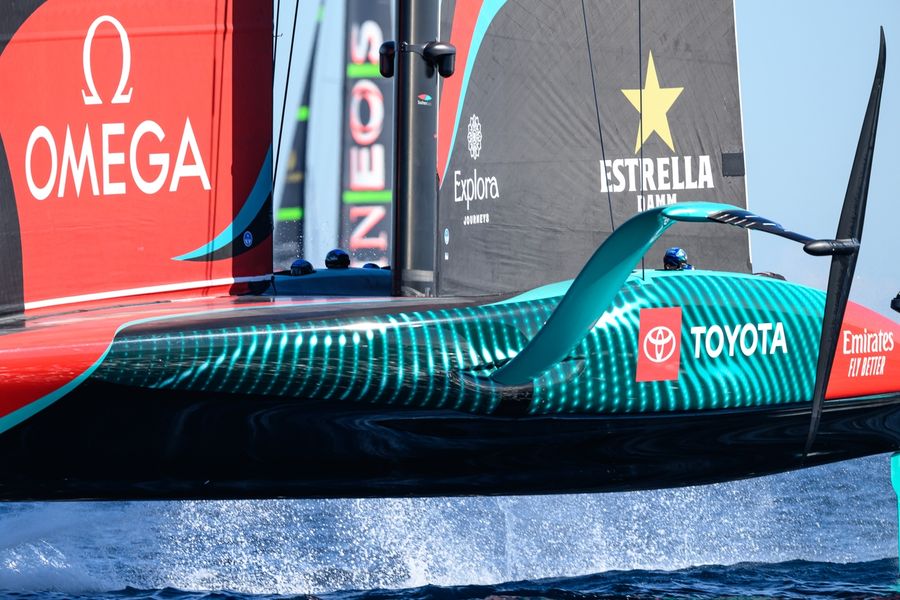
On a displacement yacht, trim is mostly about drive and heel. On an AC75, the aerodynamic forces are tangled up with an underwater foil system controlling ride height, pitch, roll and leeway all at once. Change the mainsail and you change forces acting on the whole platform, not just the rig.
**The lower mainsail**
One of the more interesting details sits right at deck level. The foot of the AC75 mainsail runs close to the deck, acting almost like an endplate to stop high-pressure air escaping round the bottom edge towards the low-pressure side.
On a conventional yacht that leakage is simply accepted as a loss. Bring the sail close enough to the deck, though, and the deck itself effectively becomes part of the aerofoil. It is one reason designers spend so much time on the shape of the lower mainsail specifically.
**The mast is part of the sail**
A conventional mast sits awkwardly in front of the mainsail, aerodynamically speaking, a necessary obstruction. On the AC75 it is not an obstruction at all, it is part of the wing. Mast rotation and sail shape have to be coordinated so the leading edge meets the apparent wind at the right angle and hands off smoothly onto the leeward skin. Get the rotation wrong, or the shape behind it wrong, and the flow separates.
**Power to get flying**
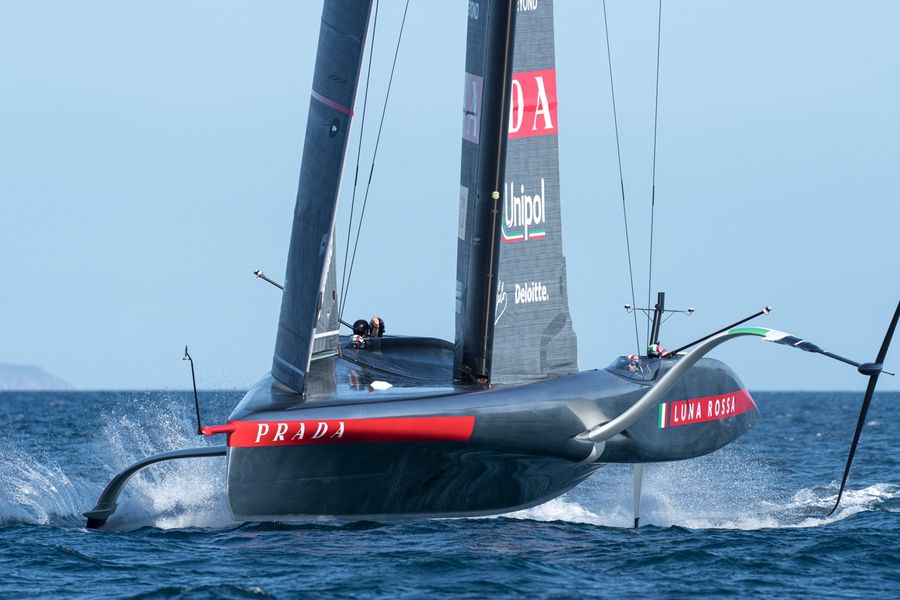
Getting an AC75 up onto its foils is one of the toughest moments of any race. The rig needs to be deeper and more powerful than at any other point, hauling several tonnes of boat through the water until the foils generate enough lift to clear the hull.
Then it all changes very fast. Hydrodynamic drag drops away sharply as speed builds and the apparent wind moves forward, and suddenly the shape that was needed for take-off is producing far more force than the boat actually wants. Trimmers have to flatten things out quickly.
**Once you are doing 50 knots**
At that point it is all about efficiency. The problem is no longer finding power, it is generating exactly enough of it with minimum drag.
The mainsail flattens further and twist becomes extremely fine-tuned. Every unit of extra aerodynamic force has knock-on effects elsewhere, heel, foil loading, underwater drag, so the fastest setup is the one where the aero and hydro sides of the equation are working together rather than against each other.
**Upwind: height or speed?**
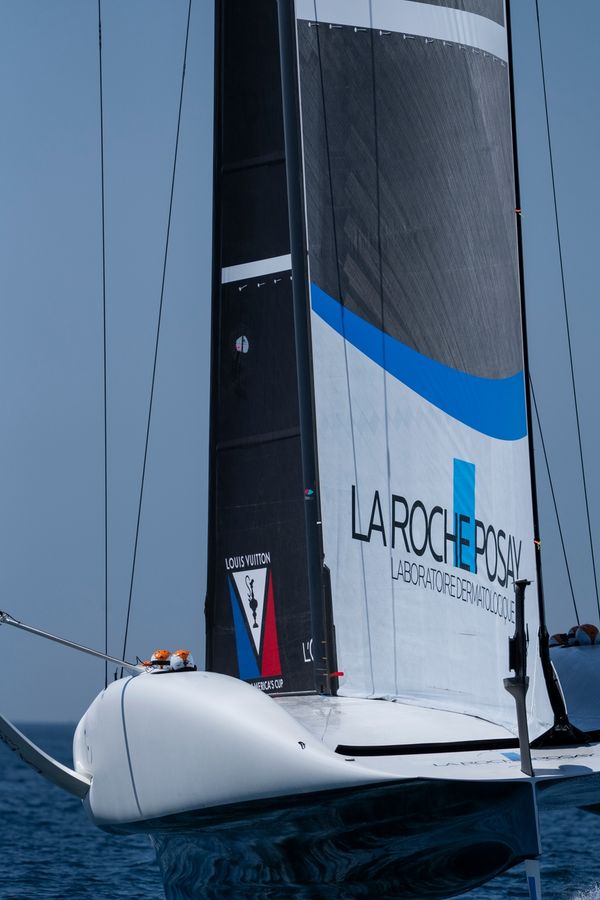
The old upwind compromise between pointing and speed still applies, just at a radically different scale. More loading can add side force and let the boat point higher, but it also loads the foil harder and adds drag. Flatten off and the boat accelerates but loses height.
Because AC75 boat speed can be several multiples of true wind speed, tiny changes in speed shift the apparent wind direction dramatically. Finding the balance between the two is the whole game.
**Downwind: still close-hauled**
This is the part that baffles anyone used to conventional sailing. An AC75 running downwind at speed is still feeling apparent wind from well forward of the boat.
It is heading towards the leeward gate, but aerodynamically the rig is working much as it would reaching, or close to the wind. That is why you never see the deeply eased sails of a traditional yacht running downwind on an AC75. These boats are too fast for that. Their own speed generates the wind they sail in, and the sails stay tight and loaded accordingly.
**Manoeuvres, the critical moment**
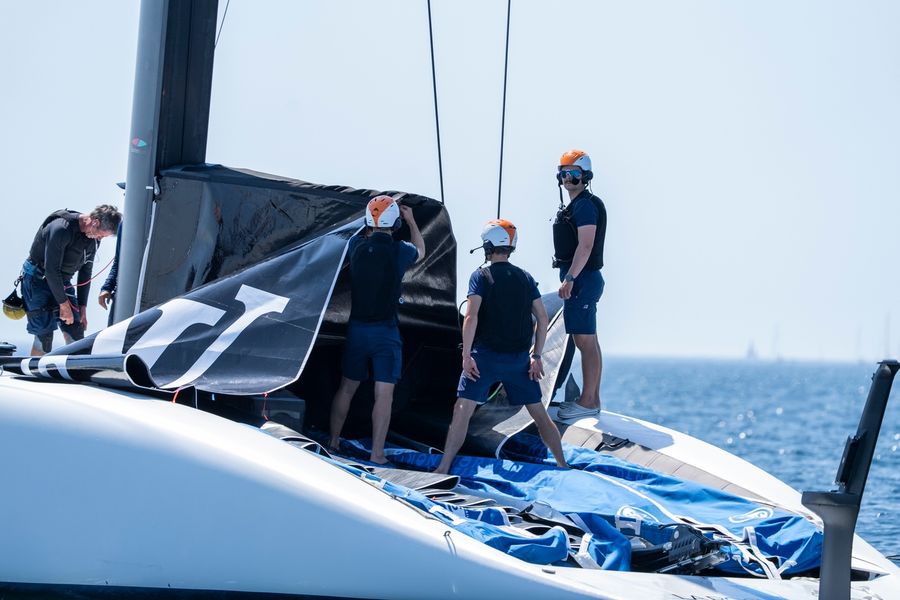
Tacks and gybes are where good sail control really shows its value. Through a manoeuvre the boat is changing direction, shifting load between foils, altering the apparent wind angle and trying not to shed speed.
Lose too much speed and the apparent wind drops, foil lift falls away, and the boat risks a splashdown. Power may need to come on sharply to drive the boat out of the turn, but too much at the wrong instant can tip the whole platform off balance.
**The real secret: repeatability**
What separates this generation of America's Cup sailing from everything before it is repeatability. A gifted trimmer stumbling onto a fast shape by feel is not enough anymore.
Teams need to know why a shape was fast, record it, and reproduce it on demand. That means marrying sailor feel with huge volumes of data: sail shape, loads, boat speed, foil loading, heel, pitch, ride height and apparent wind, all measured and cross-referenced.
Across thousands of hours of simulation and sailing, teams build ever more detailed models of what works where. The sailor's job becomes partly about hitting those targets, and partly about recognising the moment reality stops matching the model, an endless conundrum at the heart of the modern Cup.