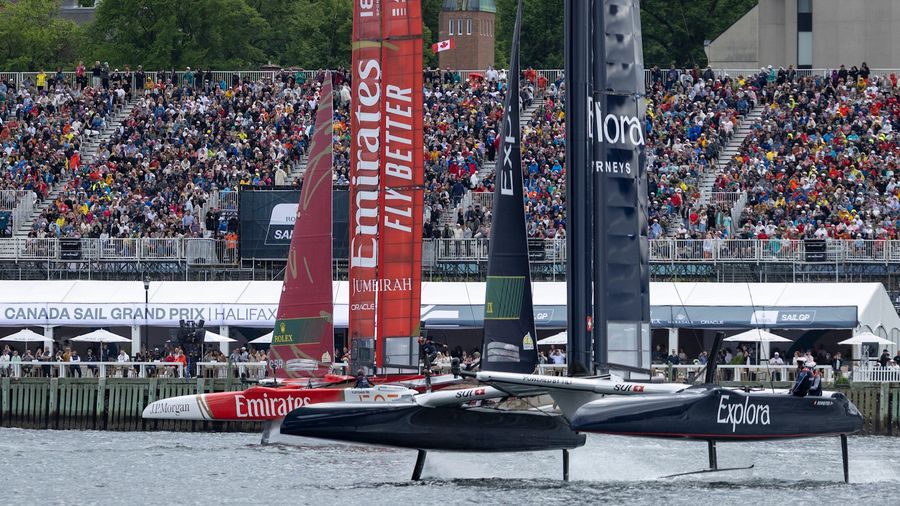
Racing at more than 100 km/h on water is not a theoretical exercise in risk management. It is the daily reality for SailGP athletes, and the systems that keep them alive reflect years of deliberate engineering, rigorous training, and hard-won operational experience. When a capsize or collision happens at these speeds, the consequences are immediate and severe. The question is never whether something might go wrong. The question is whether every possible preparation has been made for when it does.
Safety in SailGP is not built around a single device or a single rule. It is an interconnected framework covering equipment standards, boat construction, crew training, and on-water response, each element developed in response to the realities of sailing machines that continue to get faster.
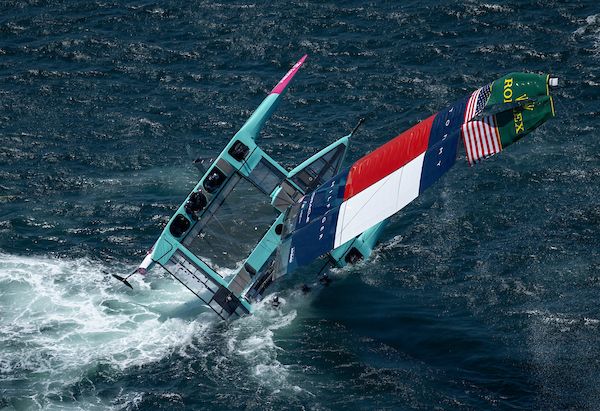
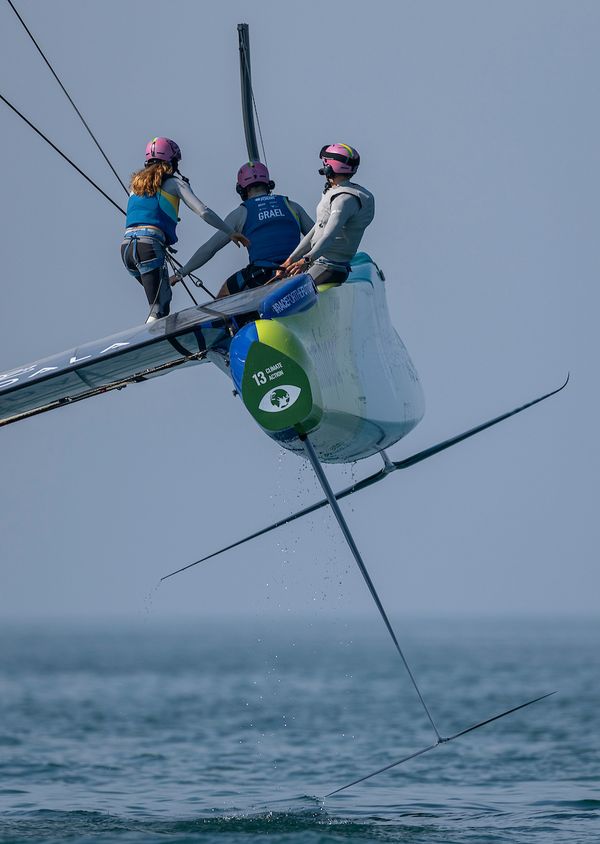
The F50 catamarans at the heart of the series represent a significant leap over any previous generation of one-design foiling boats. Advances in control systems and foil geometry have made it possible for crews to race in closer proximity, at higher speeds, and for longer stretches than before. The physical consequences of that speed are considerable. Impact with water at these velocities is nothing like a conventional capsize. It is closer to striking a solid surface. A sailor thrown clear of the boat faces an immediate risk of losing consciousness, which is why the first priority of modern foiling safety is preventing ejection in the first place.
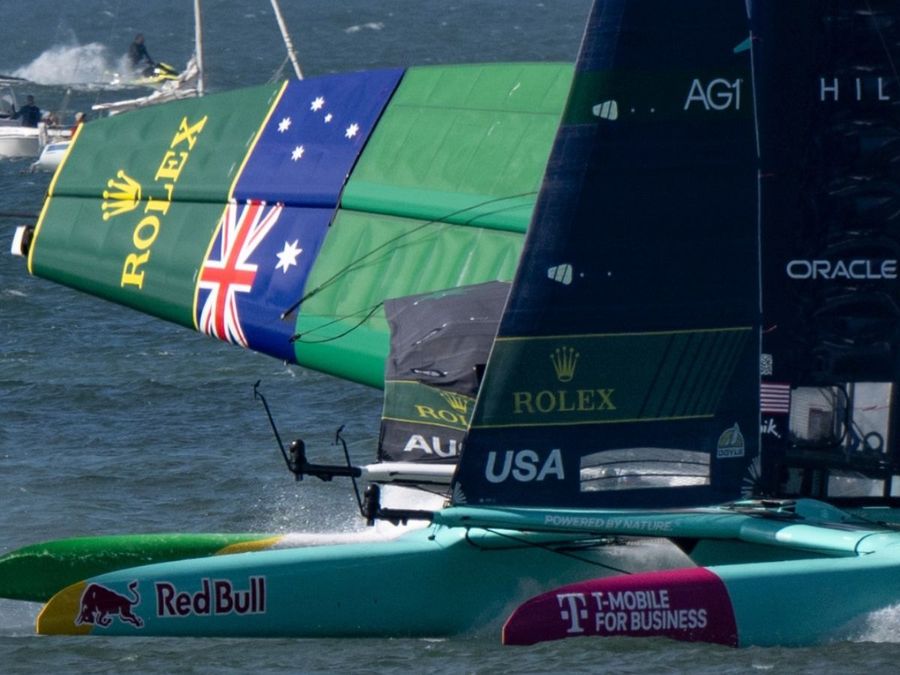
Every SailGP athlete wears a harness and tether system engineered to keep them attached to the boat through sudden manoeuvres, collisions, and violent events. A waist-mounted spreader bar distributes the load across the body, reducing the risk of injury even when the forces involved are extreme. The tethers themselves are rated well beyond the loads encountered in conventional sailing. An athlete who stays with the boat remains oriented, protected from head impact, and accessible to rescue crews far more quickly than one who separates from it.
Attachment only provides safety if an athlete can get free in an instant when the situation demands it. SailGP runs a standardised quick-release system fitted in the same location on every boat across the fleet. Under pressure, with adrenaline high and time short, knowing exactly where to reach without searching is not a minor advantage.
Athletes are drilled on a fixed escape sequence until it requires no conscious thought. Secure air. Control breathing. Release the tether. Move clear of the structure. Each step follows the next not because it has been reasoned through in the moment, but because repetition has made the sequence instinctive.
Breathing is its own challenge when trapped underwater. Each athlete carries a compact Emergency Breathing System produced in partnership with diving equipment manufacturers, providing roughly two minutes of compressed air depending on how calmly and steadily it is used. That distinction matters. Athletes are trained not to surface immediately but to pause, take controlled breaths, and then move with deliberate care. Panic burns through air supply and increases the risk of becoming entangled. Composure extends the available time. Additional air supplies mounted on the boat itself provide a backup option if a sailor cannot access their personal system.
No piece of equipment functions properly if the person using it has never practised under realistic conditions. SailGP underwater escape training is designed to remove comfort from the equation. Visibility is cut. Body orientation is deliberately confused. Familiar reference points disappear. Drills are structured to elevate heart rate and induce genuine stress before the skills are called on. What gets tested in training is not knowledge of the procedure but the ability to execute it when everything feels wrong. The repetition is intentional, because when a real incident occurs there is no time to work through a problem from first principles.
The F50s themselves are built with the assumption that things will sometimes break. Certain components, including foil tips, are deliberately sacrificial. Under impact, they are designed to give way in a controlled fashion rather than allow rigid carbon structures to breach the hull or cockpit. Escape routes, handholds, and knife access points are integrated into the layout of the boat, and safety equipment is duplicated across multiple positions. Modifications to foil materials and rudder systems have progressively improved the predictability of the boats at speed, reducing the incidence of sudden loss of control.
Onboard systems contribute another layer of protection by tracking other boats in the fleet and projecting closing paths in real time. Visual and audible alerts flag moments when separation between boats is becoming critical. These tools are not a substitute for the experience and judgement of the sailors operating them, particularly in congested sections of the course around marks where closing speeds peak. They support decision-making rather than replacing it.
When an incident does occur, dedicated safety teams are positioned to respond immediately. Their first task on reaching a capsized or damaged boat is a rapid head count. Rescue craft are tasked with arriving within a minute of any incident, after which medical assessment and recovery proceed once all athletes have been accounted for.
The principles underpinning all of this are not unique to professional foiling competition. Preparation must happen before anything goes wrong. Equipment must be reachable and operable without hesitation. Training must be repeated to the point of automaticity. Systems should fail in predictable, controlled ways rather than catastrophically. These are the same ideas that inform good safety practice across sailing at any level.
SailGP puts those principles to the test at their most demanding end. At 100 km/h, there is no room for improvisation. Every response that works in a real emergency was built long before the start gun fired.