Taranaki iwi and hapū are asking for another two years of protection along 63km of coastline while a longer-term Mātaitai Reserve is worked through. Here's what's on the table, and how to have your say.
Taranaki iwi and hapū want another two years added to the temporary closure covering 63km of the western Taranaki coastline. Fisheries New Zealand opened the request for public submissions on 6 August, and the window closes at 5pm on Wednesday 16 September 2026. Anyone with an interest in the fish stocks or the effects of fishing in the area can make a written submission.
What's on the table
The application, lodged by Taranaki Iwi and ngā Hapū o Taranaki Iwi through Te Kāhui o Taranaki Trust, asks for the existing section 186A closure to run for a further two years, from 15 December 2026 to 15 December 2028. The current closure expires on 15 December 2026.
Nothing else changes. The area, the species covered and the method restrictions stay exactly as they are now: no taking of any shellfish except rock lobster, no seaweed beyond what washes up on the beach, no anemones, no stingrays, and no conger eel of either species, Conger wilsoni or Conger verreauxi.
A separate list submitted with the application names 24 species regarded as taonga and now under threat on this stretch of coast, among them kina, kuku, koura, paua, the octopus known as te weke, and karengo and other seaweed.
The area
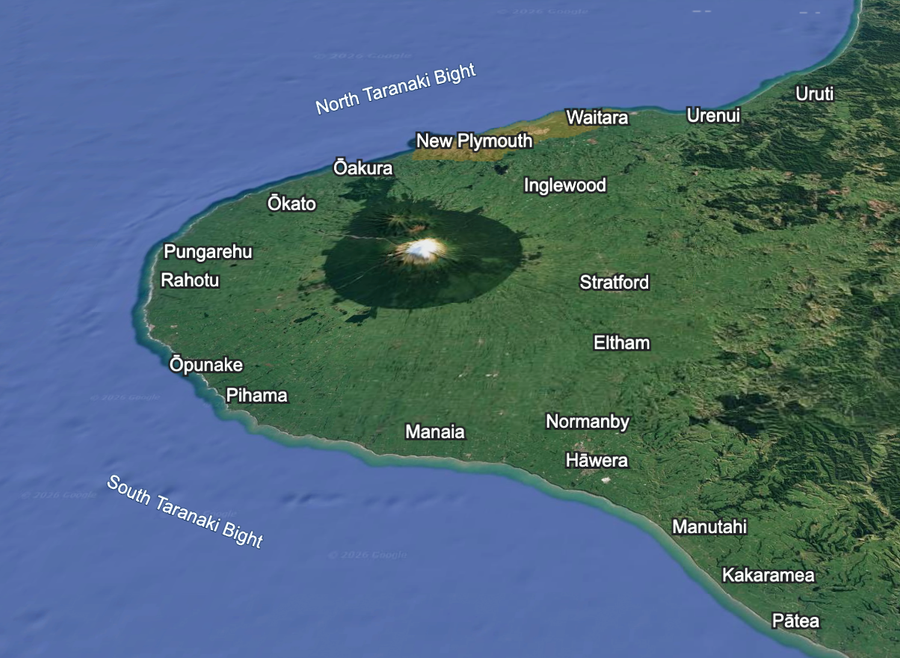
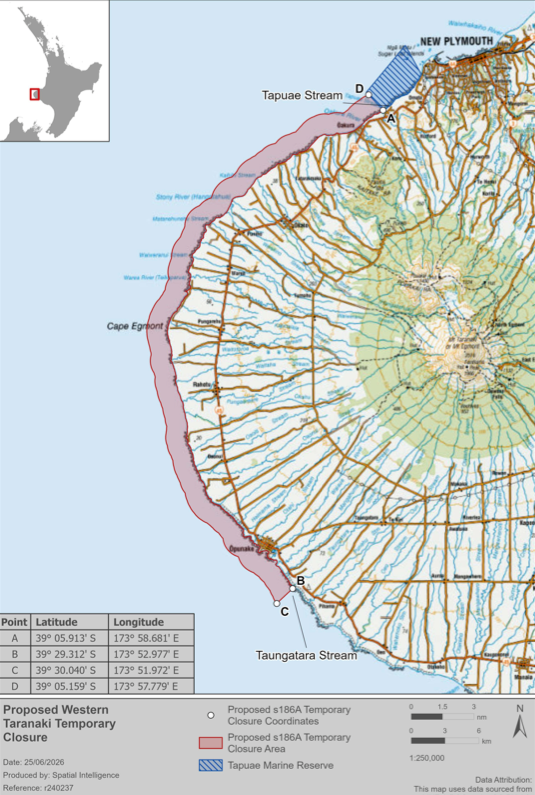
The closure covers around 112 square kilometres of fisheries waters, running the 63km from Tapuae Stream, at the edge of the Tapuae Marine Reserve near New Plymouth, down to Taungatara Stream south-east of Ōpunakē, and out to one nautical mile offshore.
How we got here
The rāhui behind all this goes back to January 2022, placed over the western Taranaki inshore kōhanga with the backing of Taranaki Iwi, local hapū and the wider community. Public meetings that May led to the first section 186A application, approved and gazetted that December. A further extension went in during August 2024 and was granted that December, carrying the closure through to its current end date of 15 December 2026.
What the monitoring shows
Since March 2023, the trust has run a dedicated team doing species counts, intertidal surveys, marine monitoring, poaching observation and education work along the coast. Fifty-seven mātaitai surveys and 14 pūkawa surveys have been completed. Compliance monitoring across 61 low tides between 2023 and 2025 turned up illegal harvesting on 10 occasions.
The paua counts tell three slightly different stories. At the first survey site, twenty-minute counts rose from around 100 total paua in October 2023 to more than 130 by September 2025, with the strongest gains among mature adults in the latest survey. At the second site, total paua counts more than tripled between mid-2024 and November 2025, climbing from the mid-30s to over 100. The third site went the other way, with numbers down between its two survey dates; the accompanying report puts this down to sand inundation and lists the site as still recovering.
Why iwi want more time
The case for more time rests on biology as much as process. Paua need at least three years to reach sexual maturity, and koura can take up to 10. Early signs of recovery are still fragile, the application argues, and the monitoring record is too short yet to say how durable that recovery will be.
Before the closure, volunteers monitoring the coast recorded harvesters using wire, shovels, spades and crowbars to strip reefs and intertidal areas, pressure that fell on the wider pukawa ecosystem as much as on the target species themselves. The application also points to Kaikōura, where a fishing closure produced real recovery only for reopening to bring heavy recreational pressure straight back onto the most accessible spots, as the outcome iwi want to avoid on a coast where many pūkawa sit close to road ends and popular access points.
The road beyond the rāhui
Iwi describe the extension as a bridge, not an endpoint. The applicants are working toward a Mātaitai Reserve as the long-term management tool for the coast, alongside a Rohe Moana application lodged in May 2026.
Once a Mātaitai Reserve and an accompanying Relationship Plan are approved and in place, the intention is for the section 186A closure to come off altogether. The target is to lodge the Mātaitai Reserve application by November, after further engagement with marae, pā, hapū and the wider community.
Seven hui held between January and March 2026, at Ōkato, Ōaonui, Cape Egmont Boat Club, Ōpunakē and Kaitake among other venues, turned up a consistent picture. Hapū representatives, recreational fishers, divers, boat club members and coastal residents largely agreed that pressure on the moana has grown, and that going back to open access isn't the answer. There was also fatigue with how long the rāhui has run, sitting alongside a shared view that ending it without something to replace it would leave the coast worse off.
Two hui in May 2026 turned that sentiment into formal backing. At a Community Rāhui Hui at the Ōaonui Community Hall on 24 May, attended by 25 people, a resolution supporting the extension was moved by Kemp Broughton, seconded by Andrew Dobbin, and carried unanimously. Two days later, at a Marae, Pā and Hapū Rāhui Hui at Te Pōtaka Pā, held both in person and online, the same resolution was moved by Jacqui King, seconded by Tapiukura Young, and again carried unanimously.
Community backing
Six hapū and community groups have put their support on record in writing: Ngāti Tairi (Oakura Pā Trust), Ngā Mahanga, Ngāti Moeahu, Te Pōtaka Pā (writing on behalf of Ngāti Haupoto and Ngāti Tuhekerangi), Ngāti Tara, and Ngā Hapū o Ōrimupiko. Each has passed its own hapū resolution backing the Rohe Moana process and the closure extension.
The Ōpunakē Boat and Underwater Club has backed the extension too, on one condition: that a Mātaitai Reserve is applied for and established over the same ground. The club's committee told the trust it had met with Rāhui Steering Group members and come away encouraged by the reef recovery data shown at community meetings, and that it saw the wider tools available under FMA8, PAU2 and CRA9 as too broad for the localised, fragile conditions on this stretch of coast.
Two MPI staff get a specific mention in the application: Barney Anderson, Kaumātua at MPI, and Tanya Sutton, Senior Fisheries Officer for the Central Region, credited with input and accessibility that helped keep discussions on track through the engagement process.
Have your say
Fisheries New Zealand wants to hear from anyone with an interest in the fish stocks involved, or in how fishing in the area would be affected. Submissions close at 5pm on Wednesday 16 September 2026, and can be emailed to FMSubmissions@mpi.govt.nz or posted to Spatial Allocations, Fisheries Management, Fisheries New Zealand, PO Box 2526, Wellington 6140.