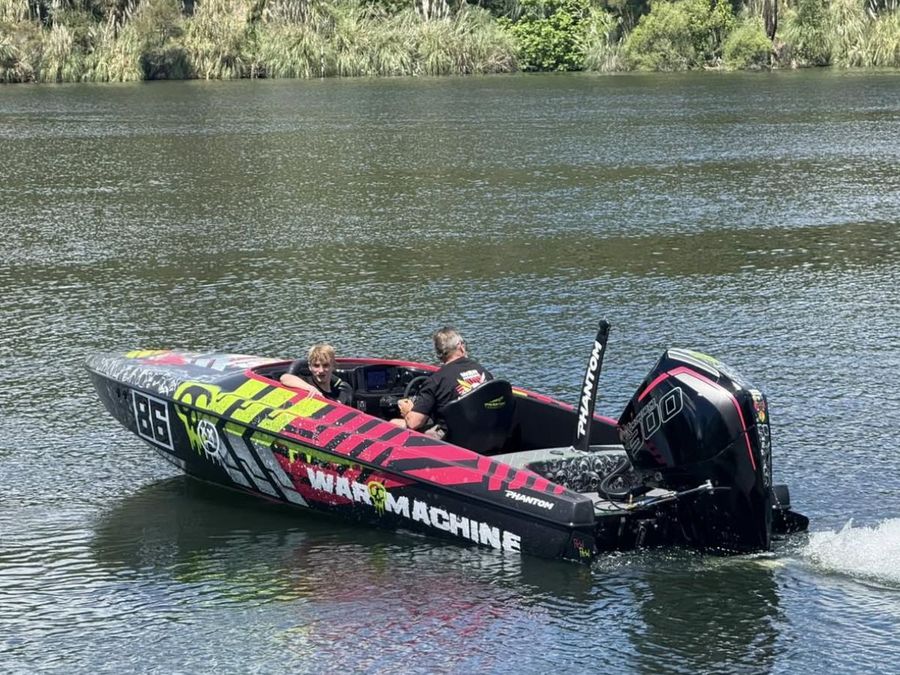
There are boats built to win races, and then there are boats built to change what winning looks like. War Machine, the latest F2 hull from Phantom Powerboats, belongs firmly in the second category. Constructed in Tauranga by Nic de Mey Yachts, it is the lightest and most experimental ski-race boat the Phantom name has ever been attached to, conceived not simply to compete but to challenge every assumption about what an F2 hull can be. With the 2027 World Championships on the horizon, every design choice, from resin ratios to ballast placement, is a calculated push toward the outer edge of what the regulations permit.
Nic de Mey put it plainly when he announced the project in June: "It's one big experiment, trying new things, refining existing things." For a builder and racer with decades behind him, War Machine is something more than a commission. It functions as a factory prototype and a floating laboratory simultaneously, with the express purpose of informing the next generation of high-performance Phantom hulls.
The existing Phantom F2 range already commands serious respect in the waterski racing world. Each production hull uses vacuum-infused carbon over foam, carries twin 300-litre ballast tanks, and is powered by Mercury's 300R engine. The platform is engineered to IWWF Formula 2 specifications while delivering the structural precision and reliability that elite competition demands. War Machine begins with that proven foundation, then systematically dismantles anything that adds weight or limits stiffness.
Every structural element on this build, including the transom and ski-pole mount, is 100 percent carbon. The hull infusion was completed in just over 36 minutes, a tightly controlled process designed to produce a perfect resin-to-fibre ratio throughout. Nothing was left to guesswork: the fuel tank, the deck reinforcement, and every fitting was individually weighed, logged, and evaluated for what it contributed to or subtracted from performance. The result is a hull that undercuts every previous Phantom on the scales.
Development unfolded over months of incremental progress. Carbon lay-ups were refined, sections were vacuum-bagged, and the finished hull eventually received the all-black finish that gave the boat its name. By late August, War Machine had reached a significant milestone: its first flowcoat applied, an HDPE welded fuel tank in place, twin 4000-gallon aft pumps and twin 2200-gallon forward pumps installed. Advanced as those systems are, the completed hull still came in lighter than anything the Phantom programme had produced before.
The first real test came at the NZ Bridge 2 Bridge Waterski Classic in November 2025. The team put War Machine through two time-trial runs and a full long-race campaign, gathering data from conditions that no workshop can replicate. De Mey's own words captured the mood of that debut weekend: "New boat for the Bridge to Bridge. Only ran it for the first time yesterday, had two very clean runs in the time trials today. Down on speed, but we will see how we go tomorrow."
That combination of hard-earned experience and engineering rigour sits at the core of how Phantom Powerboats operates. De Mey has been racing ski boats for more than 30 years, and he draws directly on that background when shaping a hull's geometry, stiffness, and engine position. "I drive race boats myself. I know what works," he said in an exclusive interview with Boating New Zealand. War Machine is that philosophy expressed without compromise.
Phantom Powerboats' ambitions extend beyond the top tier of competition. In May, the company announced it had acquired the Bullet 1850 moulds, with plans to develop an entry-level model that sits alongside the high-performance F2 range. Both projects carry the same underlying intention: to ensure that New Zealand-built waterski boats remain a genuine force in the global sport.
Development on War Machine continues into late 2025 and beyond. Every race meeting doubles as a data-collection session, and every setup adjustment feeds directly back into future lay-up decisions and tooling refinements. The intelligence gathered from this process will shape the Phantom hulls that arrive at the 2027 World Championships.
The all-carbon War Machine is the product of thirty years of racing obsession, a Tauranga workshop, and a deliberate refusal to treat good enough as a destination.