Few threats to New Zealand's coastline are as silent or as fast-moving as invasive marine species, and the 2026 Auckland Boat Show is set to bring that reality sharply into focus. A range of new experiences, emerging technologies, and fresh research will be on display, all directed at a single aim: stopping marine pests from spreading further through the country's waterways.
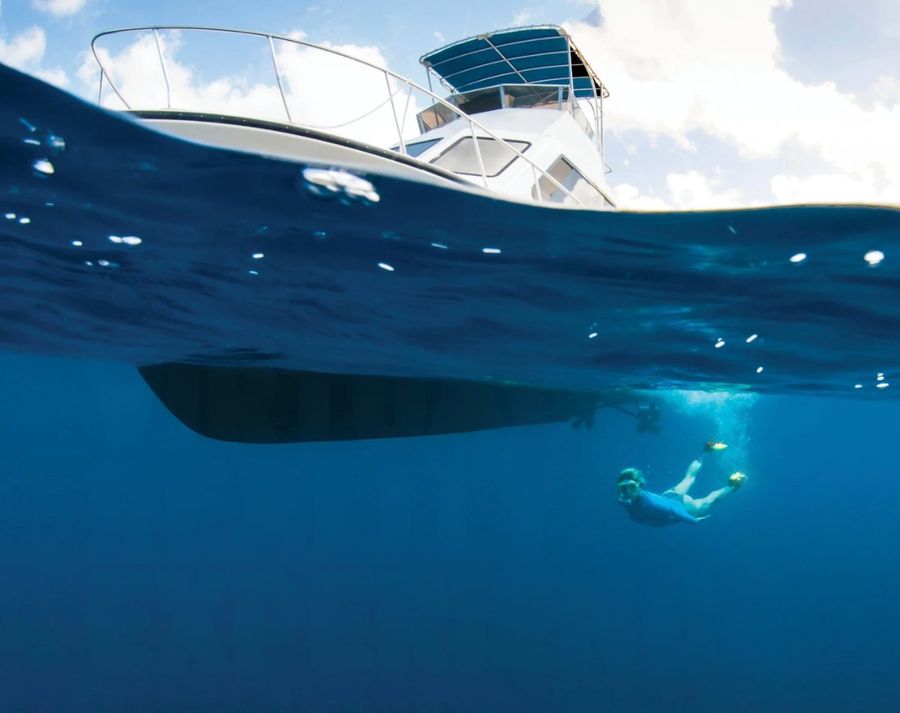
The centrepiece of the programme is an immersive Virtual Reality experience developed by the Blake NZ team and presented at the show through Clean Below? Good to Go. Visitors who step into the headset will find themselves transported beneath the surface at some of New Zealand's most celebrated dive and snorkelling destinations, including the Poor Knights Islands and the Aldermen Islands. The experience is designed to build a genuine emotional connection with these underwater environments before confronting visitors with what threatens them. Exotic caulerpa and Mediterranean fanworm appear alongside the thriving native ecosystems they can rapidly overrun, providing a vivid illustration of what is at risk when biofouling goes unchecked.
The Blake NZ and Clean Below? Good to Go teams hope the experience translates into practical behaviour change among boat owners. Keeping hulls clean, applying antifouling coatings correctly, and washing down boats and gear between trips are among the straightforward steps that can meaningfully reduce the risk of pest transfer. Staff will be available throughout the show to explain how biofouling spreads and what individual boaties can do to protect the coastline.
Marine pests are a serious concern because they can establish themselves quickly in a new environment, degrading marine habitats and affecting recreational boating and fishing in ways that are difficult and expensive to reverse.
New antifouling technology shows promise
Beyond education, new coating technology is also attracting attention for its potential to reduce biofouling at the source. Hempel's fouling release systems, specifically Hempaguard X7 and Silic One, represent a different philosophy to traditional antifouling paints. Rather than relying on biocides to kill attaching organisms, these silicone-based coatings produce an exceptionally smooth hull surface that makes it hard for marine life to gain a foothold. Any growth that does manage to settle can often be dislodged by the normal movement of the vessel or a light clean. The practical benefits extend beyond biosecurity, with potential improvements in fuel efficiency and a reduced environmental footprint compared with products that leach heavy metals.
Early results from Northland are giving those benefits some real-world weight. Duncan Crawford of Paint Smart Group Ltd and Wairau Paint Centre has been tracking the performance of Valinor, which received an application of Hempaguard X7 in December 2024. Crawford shared the following feedback:
"The Hempaguard X7 was applied in December 2024 and as mentioned she has been in Opua, bar a couple of trips to Gulf Harbour since. She had a long lay-up period for several months at Opua due to mechanical issues. The feedback is that it is very clean and only had barnacles and oysters in the skin fittings where there is very little friction, and on a couple of patches where the boat had been propped whilst out of the water."
For a vessel that spent an extended period stationary in the water due to mechanical problems, that level of cleanliness is a notable result, and one that will be of interest to boat owners dealing with persistent barnacle trouble in northern waters.
AI and underwater robotics improve pest detection
Preventing fouling is only part of the challenge. Detecting it accurately and consistently is equally important, and new research suggests artificial intelligence could soon change how that is done. University of Auckland researchers, supported by Kōtare, have been investigating whether autonomous underwater vehicles (AUVs) equipped with computer vision and large language models could carry out biofouling assessments without human divers.
The findings reveal an interesting limitation in conventional approaches. Standard computer vision systems coped well at the extremes, identifying hulls that were either very clean or heavily fouled, but lost accuracy in the middle ground, precisely where early-stage pests tend to begin taking hold. AI language models, when given access to official Level of Fouling assessment rules to guide their analysis, performed considerably better across that difficult middle range. These models could not only estimate a fouling level but also produce written explanations of what they had identified and why it posed a risk.
The researchers suggest the most effective path forward may be a hybrid approach, combining image analysis with AI reasoning to produce assessments that are both rapid and consistent, and that can communicate risk clearly to non-specialists. AUV systems currently under development would be capable of gathering high-quality underwater imagery across entire marinas and coastal areas without requiring a diver in the water, making large-scale surveillance far more practical.
Updated guidance for vessel fouling assessments
Underpinning both the new technology and the detection research is an updated set of guidelines for the Level of Fouling scale, reviewed by the Cawthron Institute. The LoF scale was first developed in 2002 and organises fouling into six categories based on the estimated percentage of hull surface covered. Its strength lies in its simplicity. Surveillance teams and marina operators can work through an assessment without needing to identify individual species, while still arriving at a reliable picture of biosecurity risk.
That simplicity makes the framework particularly well suited to recreational vessels, which regularly move between marinas, ports, and anchorages and can carry pests over surprisingly large distances without the skipper being aware of it. New Zealand has already used the LoF framework to complete more than 47,000 vessel surveys, a figure that speaks to the country's standing as a global leader in marine pest management. The updated guidance is intended to sharpen consistency across the network of surveyors and help authorities track regional fouling trends over time.
The VR experience awaiting visitors at the show, the promising early data from fouling release coatings, and the advances in AI-assisted detection together reflect a broadening of New Zealand's response to marine pests. What was once largely a matter of public awareness is now supported by a growing range of practical technologies, and the 2026 Auckland Boat Show will be the place where many boat owners encounter that toolkit for the first time.