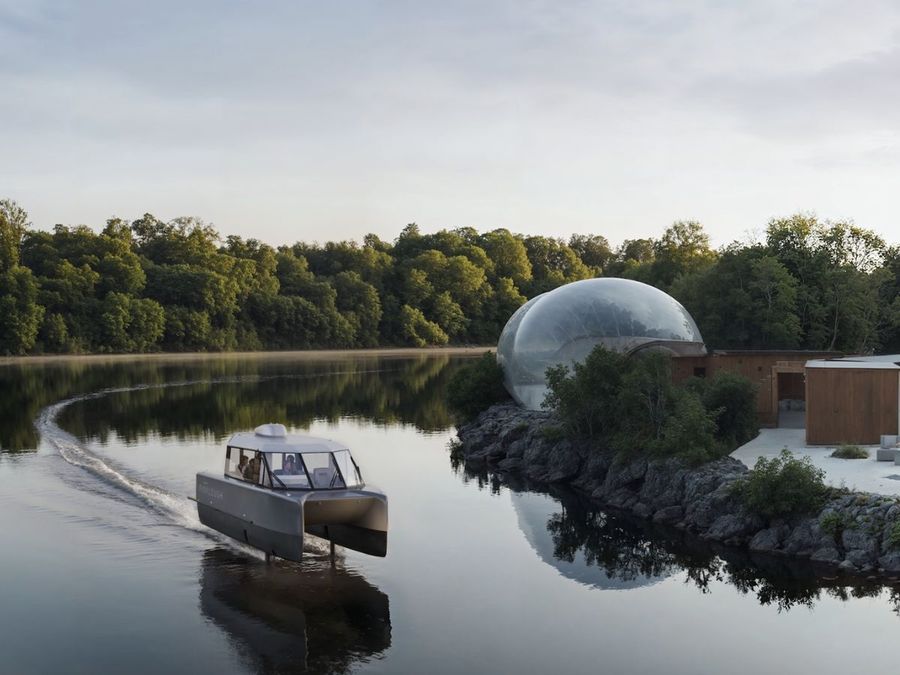
New Zealand marine technology company Vessev has secured its first European customer, with Finn Lough, a lakeside eco resort in Northern Ireland, purchasing a VS-9 electric hydrofoiling vessel. The nine-metre catamaran will carry guests across Lower Lough Erne, and when it arrives in 2026 it will make Finn Lough the first luxury hospitality destination in Europe to offer its guests transport by electric hydrofoiling vessel.
The VS-9 uses carbon fibre hydrofoils to lift its hull clear of the water, producing a smooth, silent passage with minimal wake and zero on-board emissions. Its all-electric propulsion and foiling technology can reduce energy costs by up to 90 per cent. The vessel carries 10 passengers and one skipper, reaches a top speed of 30 knots, cruises at 25 knots, and has a range of up to 50 nautical miles at cruise speed. It charges at up to 0.6 nautical miles per minute, measures 8.95 metres in length and 3.1 metres in beam, and draws between 0.5 and 1.5 metres of draft, with a seakeeping foil capability of up to 0.75 metres.
Finn Lough sits about two hours' drive from Belfast on the shores of Lower Lough Erne. The resort has built its reputation around what it describes as "wildly refined" travel, with its Bubble Domes and design-led approach to hospitality giving guests an immersive connection to their forest surroundings. Co-owner Michael Beare said the VS-9 aligned naturally with that philosophy. "It captures our core belief in the beauty of contrast: pairing the untamed beauty of the lake with a thoughtfully designed, elevated way to explore it," he said. "It connects people more deeply to a place."
For New Zealand readers, the foiling technology at the heart of the VS-9 will carry a familiar resonance. The same innovation that gave Team New Zealand a decisive edge in the America's Cup is now being taken up by international tourism and transport operators who recognise its commercial and experiential potential. Vessev's team draws on expertise from the America's Cup alongside backgrounds at Rocket Lab, Apple, Tesla, Halter, and Navico, with every component of its vessels, from hardware to software, designed, manufactured, and assembled under one roof in Auckland.
Vessev CEO Eric Laakmann said the shift in how operators viewed electric hydrofoiling was already well under way. "A flight on a VS-9 offers passengers an unforgettable experience, while creating opportunities for operators. We're proud to partner with pioneers like Finn Lough who are showing the world what's possible with this technology."
To keep pace with growing international demand, Vessev has brought former Tesla engineer Will McCabe to Auckland to lead production, an appointment that reflects the scale of ambition behind the company's expansion.
The VS-9 has already attracted significant recognition. It recently received a Red Dot Design Award, an international competition celebrating excellence in product design, with judges acknowledging its experience-first approach, including the wraparound glazing that gives passengers an uninterrupted view of the passing landscape. Closer to home, New Zealand's largest ferry operator, Fullers360, already runs a VS-9, Kermadec, on Auckland's Waitematā Harbour, demonstrating the vessel's proven capability in commercial passenger service.
Tourism operators around the world are under growing pressure to cut emissions, and the Finn Lough partnership points toward a broader shift in how the industry thinks about guest experience. Electric hydrofoiling vessels offer a way to move people quietly and cleanly through sensitive environments while adding to, rather than detracting from, the journey itself. The VS-9's arrival on Lower Lough Erne in 2026 will serve as a European showcase for what Kiwi marine innovation can deliver.