Auckland built Kermadec has arrived in America as Vessev lands its first US customer and $32.6 million to build more VS–9s.
Four years ago there were 14 people working on Vessev's electric hydrofoil in Auckland. The VS–9 was still an idea, and the prospect of selling them around the world was some way off.
Things have moved fairly quickly since.
Vessev now employs 58 people. Its boats have covered more than 11,000 nautical miles, its first US customer has signed up, and VS–9 Kermadec has been shipped across the Pacific for an American tour.
On top of that, they've also raised US$19 million, stated as NZ$32.6 million, in Series A and follow on financing as Vessev expands into the US market. That financing will be used to build more boats, grow the Auckland operation and continue work on the software behind them.
Vessev has set itself a decent target. During 2027, it wants to be delivering a new VS–9 every five weeks.
Vessev VS–9 electric hydrofoil arrives in America
The VS–9 entered commercial service with Fullers360 in January 2025 after receiving Maritime New Zealand certification.
A mere year and a half later, Kermadec, Vessev's inaugural production model, begins its US visit at New York Climate Week. Washington DC follows, then on water demonstrations at Lake Tahoe in the Sierra Nevada.
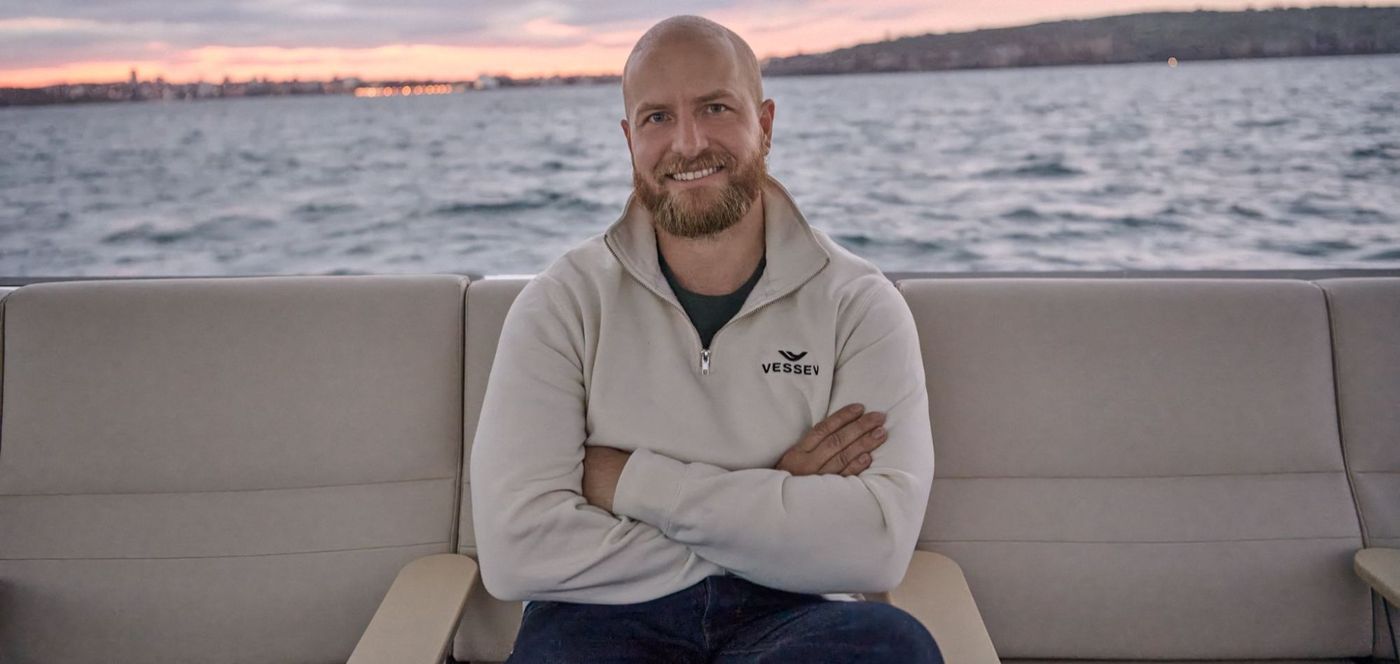
"The US is a key market for us," says Vessev cofounder and CEO Eric Laakmann. "We know there is demand there and there is a real appetite for a better way to move people."
FlyTahoe is the first American operator to place an order. The California based company, founded by tech entrepreneur and engineer Ryan Meinzer, is planning a sustainable water transit network across Lake Tahoe.
The aim is to cut travel between North and South Lake Tahoe to under 30 minutes, around a third of the time it can take by road. FlyTahoe also sees electric, low wake vessels as a way to reduce emissions, ease road congestion and limit shoreline erosion and sediment runoff associated with road traffic.
We've had the privilege of riding aboard a VS–9 electric hydrofoil ourselves. On the water, at least, it's easy to see why FlyTahoe believes the boat fits the job. Kermadec is quick, remarkably smooth once on its foils, and leaves very little wake behind.
Vessev hasn't disclosed how many VS–9s FlyTahoe has bought, beyond confirming the order is for multiple vessels.
Laakmann is keen to get more people aboard Kermadec while it is in the US.
"There is no substitute for that feeling you get when the boat lifts out of the water and you feel yourself gliding over it rather than pushing through it," he says. "It feels more like flying than boating."
Under the Vessev VS–9 electric hydrofoil
The VS–9 is an 8.95 metre carbon fibre catamaran with a 3.1 metre beam. It carries up to 10 passengers.
A 105kWh battery provides the energy, with cruising speed listed at 25 knots and maximum speed at 30 knots. Vessev gives the boat a 40 nautical mile range at cruise with a full load. A lightly loaded boat can reach 50 nautical miles.
At around 17 knots, it climbs onto its foils. Once up, most of the hull is out of the water. There is much less wetted surface and therefore much less drag.
Sensors and flight control software look after ride height, pitch and roll. The system constantly trims the foils as the boat runs. The skipper still gets a wheel and throttle.
Vessev puts the control system's adjustment rate at up to 100 times a second.
It also claims its foiling technology makes the vessel three times more efficient than a conventional boat, and it creates almost no wake when foiling.
The efficiency argument is particularly relevant with battery power. A fast boat needs energy, and batteries are heavy. Pushing a hull through the water at 25 knots takes plenty of power too. The VS–9 gets around some of that by lifting the hull clear.
There is a strong New Zealand flavour to the engineering. Vessev's team includes America's Cup and Rocket Lab experience, as well as people who have worked at Apple and Tesla.
$32.6 million and a busier Auckland factory
Blackbird Ventures led Vessev's latest Series A and follow on financing. GD1 and Rypples joined the round as new investors. Existing backers K1W1, Icehouse Ventures, Shasta Ventures and NZVC also took part, alongside existing angel investors.
A large slice of the funding is going towards production. Looking ahead, a five week turnaround in 2027 will be a sizeable change from the early days of the programme. The company is looking to hire in New Zealand. Vessev is also continuing to develop its telemetry platform, giving the company another way to keep track of boats once they leave home.
While the VS–9 remains the immediate focus, larger boats are under development.
And increasingly, those boats are heading a long way from Auckland.
More VS–9s are heading overseas
Projects are underway in Hobart, Perth and Sydney. Hobart operator Fly Derwent recently doubled its order.
Vessev reports demand across five continents. That is quite a spread for an Auckland company with fewer than 60 staff.
It also changes what needs to happen behind the scenes. Different countries bring different certification requirements. Owners need access to spares and support. Production boats need to come out of the factory consistently.
The engineering team that got the first VS–9 flying is now dealing with the less glamorous realities of becoming a boatbuilder.
Where the Vessev VS–9 electric hydrofoil goes next
Electric passenger hydrofoils remain unusual, but interest in electric marine transport and lower energy use is growing. For Vessev, the new funding arrives just as the company is trying to turn that interest into production boats and overseas customers.
The VS–9 has moved well beyond its first trials on the Waitematā. It has commercial certification and passenger service behind it. Customers are appearing well outside New Zealand.
Back in Auckland, attention will increasingly be on the factory floor.
One VS–9 every five weeks is the target for 2027. Four years after the first ideas were sketched out, Vessev has reached the point where it needs to build them, deliver them and keep them running.
That's a rather different challenge from teaching a boat to fly.
https://www.vessev.com/