Two brand-new IMOCAs have splashed in Lorient within weeks of each other, and when you put them side by side, you would be forgiven for thinking they belong to entirely different classes. That is, in fact, exactly what Boris Herrmann thinks.
"The design philosophies are very different," the German skipper said. "Their boat is large, wide, powerful, while our one is pointy and narrow. They are completely different: the Verdier boat has a bustle. If you put them next to each other, you would think they were two different classes."
Both boats are bound for the inaugural edition of The Ocean Race Atlantic, which starts on September 1, and their face-off will be one of the more fascinating design contests offshore racing has seen in years.
Kojiro Shiraishi's DMG MORI Global One, designed by Guillaume Verdier, was first to launch in early June. Verdier's work on the AC75 foiling monohull for the America's Cup appears to have directly influenced the Japanese boat's most striking feature: a pronounced bustle running the full length of the centreline. Nothing like it has appeared on an IMOCA before.
"Most IMOCA designs are U-shaped," Verdier explained. "This is so that when they heel over the hull's wetted surface is reduced. We decided to go to the other side of the line and create a boat that is designed to mostly stay upright."
Verdier likens the new hull shape to the central hull of a foiling multihull and expects the boat to sail at a normal heel angle of around eight or nine degrees, with the bustle carrying the full displacement volume. "We will displace the full volume of the boat on this bustle," he said. "That's a wetted area equivalent to 70 to 75 per cent – a saving of around 20 square metres." The practical benefit, Verdier says, is a more comfortable ride as the boat skims over the waves.
Team manager Jacques Caraës called it "a new page in IMOCA design-thinking." He said everybody had been waiting to see the boat, and added: "We think it will be very stable and we are hoping that will mean it flies a little earlier too. We will have to wait a little while to find out."
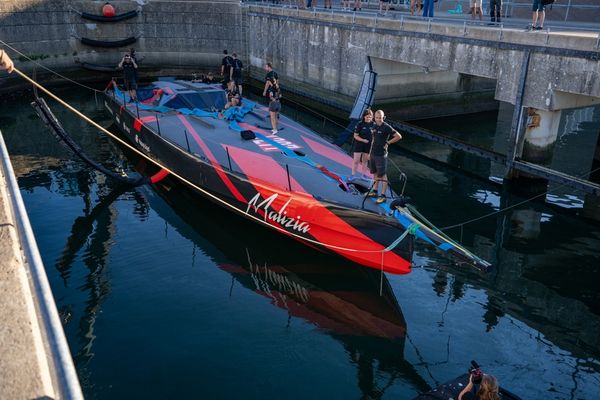
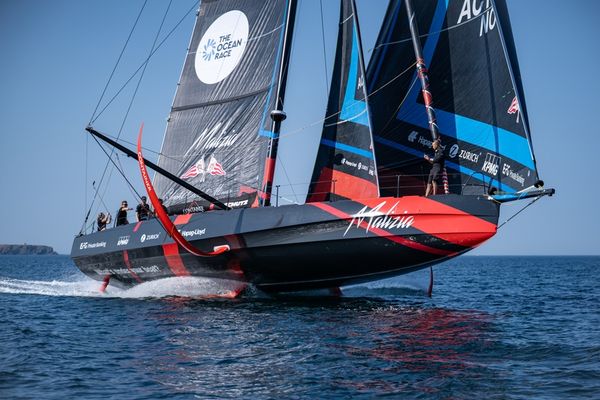
Malizia 4, designed by Antoine Koch and Finot-Conq and launched shortly after, sits closer to evolution than revolution. It is the second of three boats produced through a collaboration between Herrmann, Thomas Ruyant (TR Racing) and Loïs Berrehar (Banque Populaire), all sharing an identical hull form but fitted out differently to suit each skipper. Ruyant's boat launched in Lorient on June 19, with Berrehar's yacht scheduled to be ready in early 2027. Herrmann chose Koch after watching Ruyant and Yoann Richomme handle Southern Ocean conditions so effectively in the 2024-25 Vendée Globe, particularly the way their chined bows coped with big waves at speed.
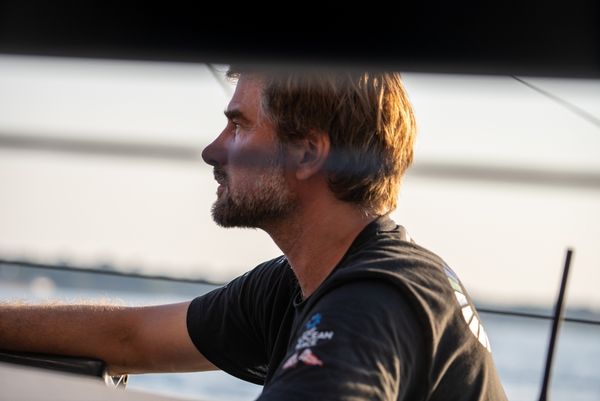
Co-skipper Will Harris described the new boat as more of an all-rounder than its predecessor. "What we have got is the next generation of IMOCA design. We are trying to keep that downwind speed and power with those big chines on the bow to help us get through the waves, but then also we've got more power in the boat, which is going to help us upwind in the medium and the light conditions."
Early results have been encouraging. Within days of launching, Malizia 4 was up and fully foiling on a flat sea in 12 knots. Herrmann said the first week could not have gone better. "Everything is working, so congratulations to the team and to the architect. We managed stable flight and the boat feels really nice on the helm. The steering feels super nice and we can control the boat longitudinally more than the last one. It's nicely balanced and everything feels good. We knew after five minutes of flight that this is something spectacular – the boat is amazing."
With both boats in early commissioning, the immediate challenge is getting them race-ready for transatlantic crossings to New York ahead of the September 1 start. Harris was clear-eyed about what that involves. "You totally shouldn't underestimate what we've got to do to achieve that. Launching one of these new boats is really hard. To make sure every system is working reliably enough to go and send it across the Atlantic – where you've got no technical assistance less than a week away – that's a big thing we've got to be ready for."