The New Zealand National Emergency Management Agency's National Advisory, issued in response to the magnitude 8.8 earthquake off the east coast of Kamchatka, Russia, was formally cancelled at 1:58pm on Friday 1 August 2025. Tsunami activity around New Zealand's coastlines had decreased significantly by that point, though authorities cautioned that strong and unusual currents could persist until Monday and urged the public to remain careful in and around the ocean and estuaries over the weekend.
The earthquake that triggered the advisory struck at 11:25am New Zealand Standard Time on 30 July 2025. At magnitude 8.8, it ranks among the most powerful earthquakes ever recorded. New Zealand's entire coastline, from Northland to Stewart Island and out to the Chatham Islands, came under a National Advisory as a result.
The initial concern for New Zealand boaties centred on surge activity expected around midnight on Wednesday 30 July. NEMA forecast that the first tsunami-related surges and strong currents would reach Lottin Point, East Cape, situated in Hicks Bay approximately 120km from Opotiki and 198km from Gisborne, at around midnight NZST. From there, unusual sea behaviour, powerful currents, and unpredictable shoreline surges were expected to continue for several hours across the country. Authorities were clear that this was not a conventional wave-based tsunami but rather a series of tidal disturbances capable of surging rapidly in and out, catching even experienced skippers off guard. NEMA's advice was unambiguous: no-one should be out on the water.
Although NEMA had warned of tsunami activity in the range of 0.8 to 1.0 metres, the risks for anyone near marinas, rivers, or beaches were real. Strong, surging currents can swamp tenders, drag vessels from their moorings, or sweep people off piers and rocks without warning. Coastal inundation was not expected, but the marine threat was treated seriously throughout.
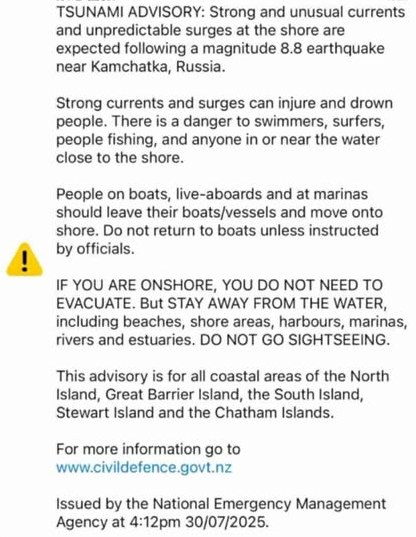
"People on boats, live-aboards and at marinas should leave their boats and move onto shore," NEMA advised. "Do not return to boats unless instructed by officials."
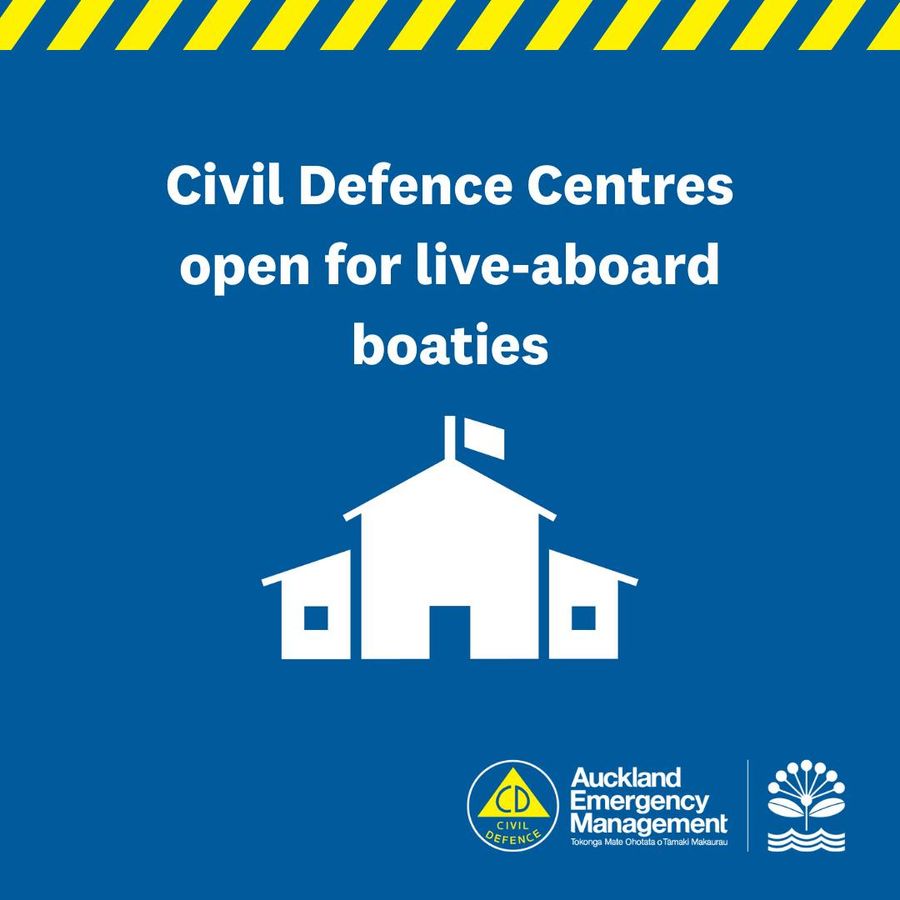
Four Civil Defence Centres opened across the Auckland region from 8:30pm on Wednesday evening to provide onshore shelter for live-aboards.
Early in the event, at around 5:05pm on the Wednesday, alerts went out to parts of the country including Auckland and the Coromandel Peninsula, though the warning was not nationwide. Cambridge, for example, received no alert.
MetService New Zealand issued a coastal situation update at 6:31pm that day, placing a tsunami marine advisory in effect for all marine coastal areas including Stewart Island and the Chatham Islands. Their broader forecast described showery westerlies dominating that day as a front moved away from the Bay of Plenty, with a deep low east of the country directing strong southerlies to the east of both islands the following day. A front was expected onto the lower South Island late that evening, followed by weak fronts in a southerly flow bringing showers mainly to eastern parts of northern and central New Zealand on Friday, while a ridge of high pressure built over the South Island from the Tasman Sea. Over the weekend, the ridge was expected to remain over the South Island while east to southeast winds brought showers to eastern parts of the North Island.
At 6:21pm, the Geological Services Division of the Mineral Resource Department of Fiji issued a warning relevant to anyone cruising across the Pacific.
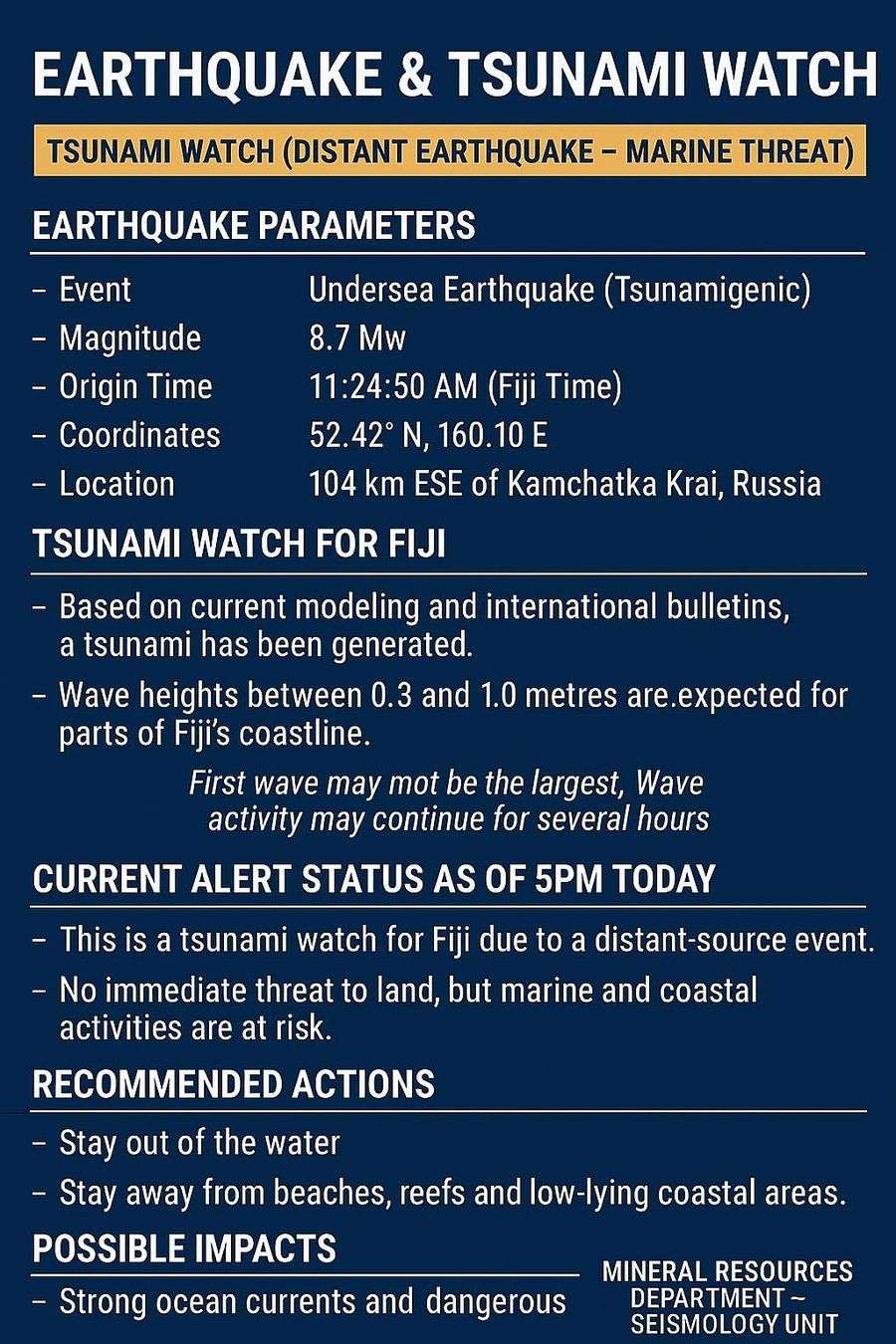
By 9:04pm that evening, reports indicated the tsunami warning issued in Hawaii had been downgraded to an advisory. Nearly two million people had been asked to evacuate in Japan, and California officials requested people stay away from the coast. Indonesia updated its own warning to an advisory only at 10:00pm. Waves of over two metres were expected in the Marquesas Islands and parts of French Polynesia.
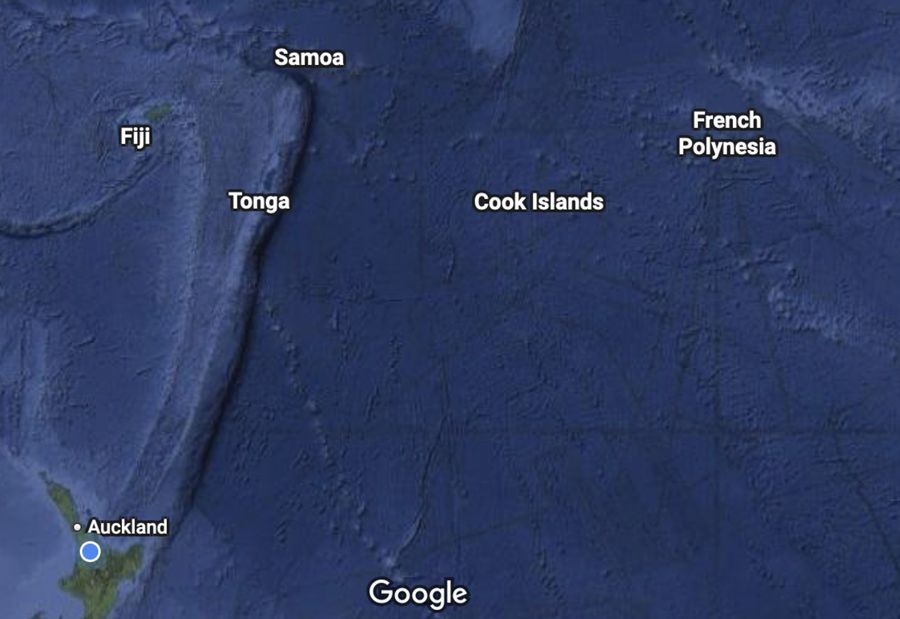
Shortly after midnight, the tsunami watch was cancelled by the Fiji National Disaster Management Office, with tsunami waves having passed Fiji. Japan lifted all warnings, with alerts remaining in place, and no noticeable impacts were reported there.
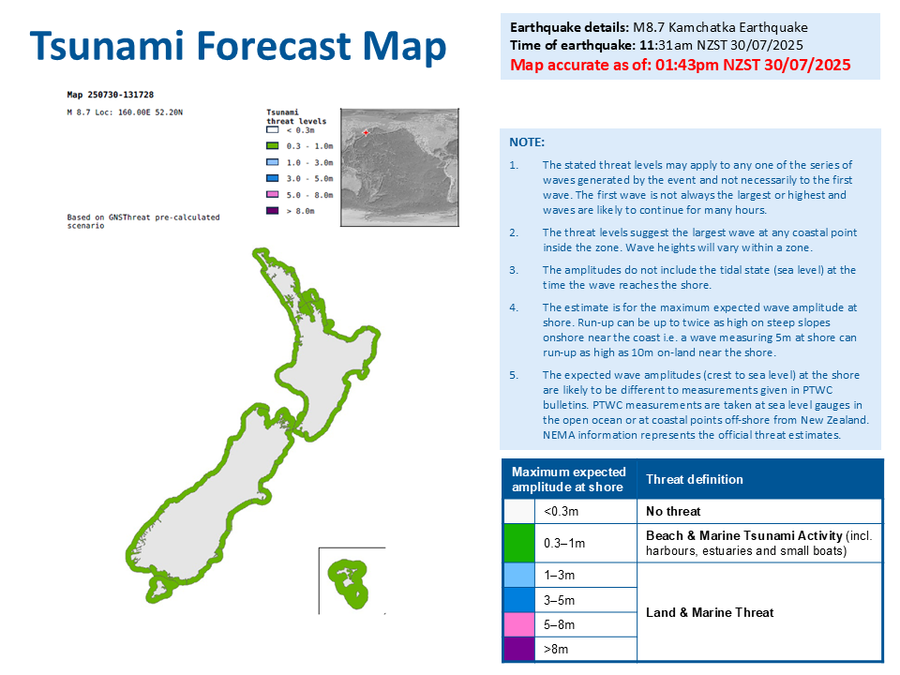
By the early hours of Thursday 31 July, NEMA's advisory remained firmly in place for all coastal areas of the North Island, Great Barrier Island, the South Island, Stewart Island, and the Chatham Islands. The threat was expected to remain in force until at least midday Thursday. Authorities stressed that the first currents and surges were unlikely to be the largest, and that activity would continue over many hours.
At 6:23am on Thursday, NEMA confirmed that areas under threat included all coastal areas of both main islands, Great Barrier Island, Stewart Island, and the Chatham Islands. Swimmers, surfers, people fishing, and anyone in or near the water close to shore were all considered at risk. The guidance remained consistent throughout the event: move out of the water, stay off beaches and shore areas, keep away from harbours, marinas, rivers, and estuaries, and do not visit the coast to observe unusual wave activity given the danger of unpredictable surges.
By the 6:00pm update on Thursday, the areas under the National Advisory had reduced. The east coast of both the North and South Islands and the Chatham Islands remained under the advisory due to rebounding tsunami activity from South America, and those areas were expected to remain under the advisory overnight. The West Coast of the South Island and Cook Strait were assessed as only just reaching the threshold for a Beach and Marine Tsunami threat. Strong and unusual currents on the eastern side of New Zealand were expected to persist for another 24 hours.
The 8:00pm update on Thursday confirmed that conditions on the east coast remained largely unchanged. Rebounding tsunami activity from South America kept the east coast of both islands and the Chatham Islands under the National Advisory, with those areas likely to remain so overnight. The West Coast of the South Island and Cook Strait sat at the low end of the threshold for a Beach and Marine Tsunami threat. A further update was scheduled for approximately 8:00am Friday morning.
Areas still listed under threat at that time included the West Coast of the North Island from Cape Reinga to Ahipara, the East and South Coasts of the North Island from Cape Reinga to Makara, taking in Whangarei, Great Barrier Island, the East Coast of Auckland, Waiheke Island, Waitemata Harbour, Tauranga, Whakatane, Opotiki, Gisborne, Napier, Lake Ferry, the Wellington south coast, and Wellington Harbour. On the South Island, the West Coast from Farewell Spit to Punakaiki including Westport, the North and East Coasts from Farewell Spit to the Catlins including Nelson, Picton, the Marlborough Sounds, Kaikoura, Christchurch, Banks Peninsula, Timaru, Oamaru, Dunedin, and the Otago Peninsula, and the South Coast from Puysegur Point to the Catlins including Invercargill were all included, along with Stewart Island and the Chatham Islands.
By 1:58pm on Friday 1 August, the advisory was cancelled. Tsunami activity around New Zealand's coastlines had decreased substantially, though the possibility of strong and unusual currents extending into the early part of the following week meant caution remained the watchword for anyone heading out to the coast over the weekend.