
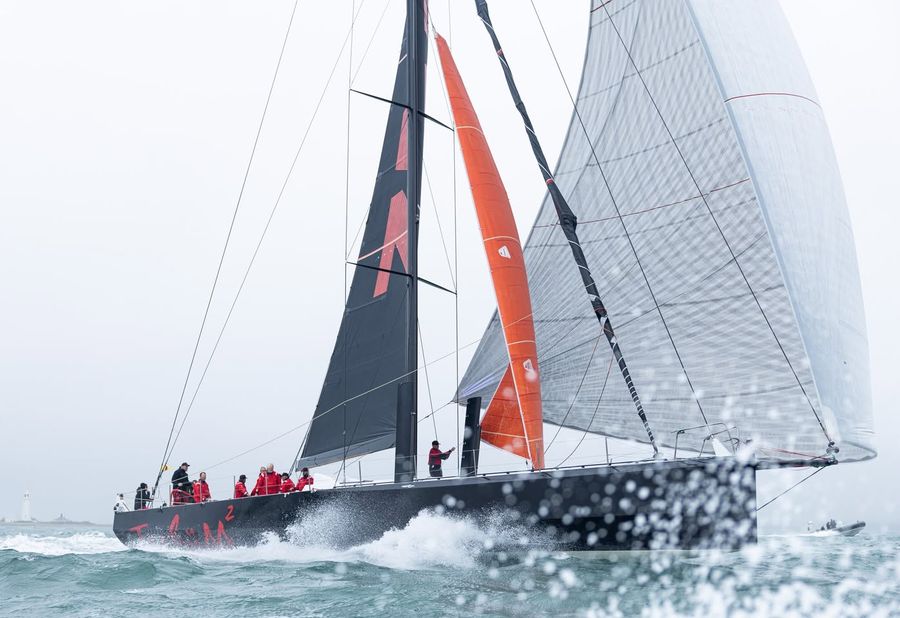
In a year where two of offshore sailing’s most iconic ocean crossings tested the world’s best yachts and crews, one name rose above the rest:
Tschüss 2
. Owned by American-German businessman and RORC member Christian Zugel, the
Volvo Open 70
racing yacht—
Sail Number USA70000
, designed by Juan Kouyoumdjian—swept across the Atlantic not once but twice in 2025, seizing overall victory in the
RORC Transatlantic Race
from Lanzarote to Grenada, and line honours in the
West to East Transatlantic Race
from Newport, Rhode Island to Cowes, England. In doing so,
Tschüss 2
cemented its reputation as one of the fastest and most disciplined offshore campaigns on the water today.
Race One: Grenada or bust
The first act in this extraordinary doubleheader played out in January, as
Tschüss 2
joined the fleet for the
11th edition of the RORC Transatlantic Race
, departing Marina Lanzarote bound for Grenada. Conditions were textbook: a 20°C NE breeze and a flexible course routing after a late course change allowed skippers to play tactics from the off. Multihulls broke ahead quickly, with
Rayon Vert
setting a hot pace. Among the monohulls,
Lucky
—a 88-foot waterline flyer helmed by Bryon Ehrhart—shot forward, tracked closely by
Tschüss 2
. Over the first thousand miles, the two boats traded tactical jabs, with
Lucky
pushing north for a late acceleration and
Tschüss 2
following a steadier track, choosing seamanship and consistency over gambles.
As
Lucky
tore through to break
Comanche
’s 2022 monohull record by just over an hour,
Tschüss 2
kept focus on the bigger prize: the IRC overall win. With 50 gybes executed across the 3,000-nautical-mile stretch, and the last two days sailed without functioning wind instruments, the crew’s performance bordered on legendary. Watch leader Stu Bannatyne later described night driving “by feel” using only starlight and heel angle. Without instrumentation, the yacht maintained consistent 20-knot speeds. Finishing in 8 days, 13 hours, 52 minutes and 51 seconds,
Tschüss 2
delivered a corrected time none could beat. Christian Zugel—taking on his first ever ocean race—described the experience as “relentless, exhausting, and extraordinary,” praising his seasoned crew that included Bannatyne, Johnny Mordaunt, Neal McDonald, and Campbell Field. https://www.boatingnz.co.nz/2025/02/a-historic-finish-in-a-historic-year-the-2025-rorc-transatlantic-race-wraps-up
Race two: 'West to East'
By June,
Tschüss 2
had already logged over 22,000 offshore miles since July 2024, with victories in the Baltic Sea Race, RORC Caribbean 600, and now with the IRC crown from the January crossing in hand, she lined up again—this time on the harder tack: Newport to Cowes. Departing on 18 June, the 2025 Transatlantic Race—jointly organised by the New York Yacht Club and RORC—demanded tactical brilliance and grit. This was the 32nd edition of the legendary crossing, with roots that go back to the 19th century. Over 3,000 nautical miles, sailors faced the worst and best of the North Atlantic—gales, fog, and shifting pressure systems. It was here that
Tschüss 2
truly stretched her legs. With a draft of 4.5 metres and a high-performance rating of 1.615 endorsed under IRC, the 21.5-metre (24m overall)
Volvo Open 70
stormed across the Atlantic in just 7 days, 15 hours, 29 minutes, and 10 seconds, finishing off Cowes to take line honours in emphatic fashion. She became the fastest monohull of the entire fleet and completed a transatlantic double unmatched in the modern offshore racing era.
The crew’s cohesion and precision were instrumental. Mordaunt and McDonald maintained a rolling 4-on/4-off watch system, while Field and Bannatyne coordinated sail changes and weather routing in a race where small errors could cost big time. The team pushed hard across the Gulf Stream and handled strong low-pressure systems near the finish with trademark control. In the broader race fleet,
Moana
took the IRC 1 crown after a nail-biting finish with
Ikigai
and
Haspa Hamburg
, with just seconds separating them after 13 days of racing.
Calamity
, a Finnish Ocean Fifty, took multihull honours in 13 days, 15 hours. The classic 59-foot sloop
Hound
, still going strong after 50 years, finished just two days behind the leaders in IRC 1—a testament to design longevity and skillful handling. Tragedy struck
High Note
, a Baltic 51 in IRC 2, which struck a submerged object mid-Atlantic. Despite valiant efforts by her crew and assistance from
Avanti
,
High Note
’s rudder damage forced abandonment. All crew were safely transferred to a French commercial vessel. The boat remains adrift.
Tschüss 2: a campaign to remember
The
Tschüss 2
campaign stands as the offshore success story of the year. With victories across the Atlantic in both directions, a dominant IRC win in January, and line honours in June, the boat now looks ahead to the 100th edition of the Rolex Fastnet Race and the revived Admiral’s Cup, continuing a staggering run of form. Owner-skipper Christian Zugel’s journey from offshore newcomer to double Atlantic victor in under a year is remarkable. “I’ve never done anything like this before,” he said. “But when you’re surrounded by sailors of this calibre, you push beyond what you thought possible.” In a sport that demands excellence across every detail—design, teamwork, weather reading, and relentless endurance—
Tschüss 2
has proven herself, not just as a fast boat, but as a fully realised campaign.
