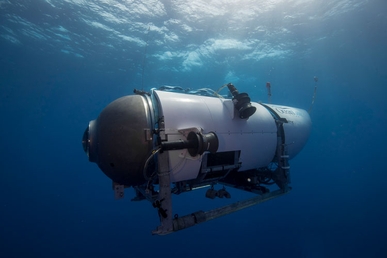
Few maritime disasters in recent memory gripped the public imagination quite like the loss of Titan in 2023. With the Transportation Safety Board of Canada (TSB) having released its final investigation report, the full picture has come into focus. The document reveals a submersible sent repeatedly to the ocean floor on the strength of unvalidated engineering, operating entirely beyond the reach of any regulatory authority.
At the heart of the catastrophe was a fundamental failure to translate theory into verified practice. OceanGate designed its deep-sea submersible around a novel carbon fibre pressure hull but never subjected that hull to the real-world testing needed to confirm its calculations held up under actual conditions. When TSB laboratory analysts examined a cylinder section removed during manufacturing, the findings were stark. The material contained wavy carbon fibre layers and porous structural voids, defects that had already compromised the hull's integrity before Titan ever made a dive.
Standard engineering practice for a vessel of this kind demands that a full-scale prototype endure hundreds of high-pressure cycles before any crew member sets foot inside. OceanGate dispensed with that process altogether, moving straight from design to operational deep dives. In its place, the company relied on purpose-built acoustic monitoring and strain-sensing systems, fitted to detect warning signs during a descent. Neither system had ever been shown capable of giving the crew sufficient time to reach the surface safely if danger was detected. Each successive dive was quietly accumulating damage in the carbon fibre cylinder, deterioration made worse by minor impacts sustained during routine operations and by the vessel being left outdoors through freezing winter temperatures. By the time Titan completed its fourteenth deep dive, the accumulated damage had exceeded what the hull could withstand.
The report turns an equally unflinching eye on the culture inside OceanGate. Decision-making power was heavily concentrated in the CEO, and the environment that resulted was a textbook example of groupthink and confirmation bias. Safety concerns raised by the company's own engineers, and by credible voices from outside the organisation, were either dismissed outright or simply never acted upon. Warning signs from earlier dives were explained away, among them a loud bang recorded during an ascent just a year before the fatal descent. Compounding all of this was Titan's regulatory invisibility. The submersible was unregistered and uncertified, claimed by no flag state and assessed by no classification society, placing it entirely outside the international maritime safety framework.
The TSB has paired its findings with six substantive safety recommendations aimed at preventing a comparable loss. The board calls on the International Maritime Organisation to convert existing voluntary guidelines for submersible operations into binding international law. National regulators are urged to extend their oversight frameworks to cover commercial operations using uncertified vessels, and to strengthen information-sharing between maritime, border, and environmental agencies. The recommendations further press for formal bridging documents between support vessels and dive teams, establishing clear operational protocols and confirming that the support ship's captain holds ultimate authority to abort a dive whenever safety is in question.
{{TABLE_1}}
The complete findings, data, and analysis are contained in TSB Marine Transportation Safety Investigation Report M23A0169.