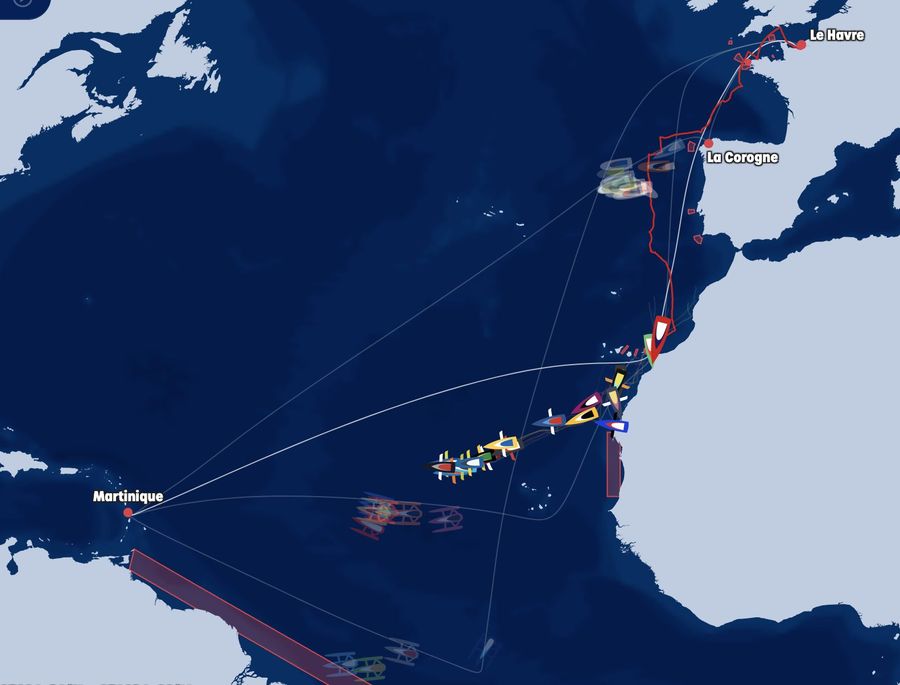
The ULTIM trimarans, those towering 32-metre foiling machines capable of hitting 40 knots, are carving their way down the South American exclusion zone on the final stretch to Martinique. Tom Laperche and Franck Cammas aboard SVR Lazartigue have built a 160-mile buffer between themselves and the chasing pack, but Banque Populaire XI, Sodebo Ultim 3 and Actual Ultim 4 are clawing back distance with every gust, keeping the pressure very much alive.
[gallery td_gallery_title_input="ULTIMUM daily photo gallery. Each photo is taken by the crew of the boat." td_select_gallery_slide="slide" ids="157127,157135,157134,157133,157131,157130,157129,157128"]
Cammas is chasing a record fifth transatlantic win, and he knows precisely what it takes to hold a lead in these conditions. He described the mental demands of keeping one of these machines under control:
"It's always a challenge to maintain those speeds and control these big machines. It's a constant balancing act — exciting, stressful, and never restful."
Even with two crew sharing the load, genuine rest is almost impossible to come by. "There's always someone on the helm remote, always ready for a gust," he added. "You can't let the boat go for even a moment." With fewer than 1,600 nautical miles remaining to the finish, the ULTIM fleet is match racing at 25 knots, a pressure cooker where endurance and precision must coexist without compromise.
In the Ocean Fifty class, Edenred 5, crewed by Basile Bourgnon and Emmanuel Le Roch, holds a 35-mile advantage over Viabilis and has pushed south of the rhumb line in search of stronger trade winds and clean air away from the competition.
[gallery td_gallery_title_input="Ocean Fifty daily photo gallery. Photos are taken by and credited to their boat crews" td_select_gallery_slide="slide" ids="157168,157169,157170,157171,157172,157173,157174,157175,157176,157177,157178,157179,157180,157181,157182,157183,157184,157185,157186,157187,157188,157189,157190,157191,157192,157193,157194,157195"]
Le Roch sounded both relaxed and thrilled when reflecting on the pace they have been sailing:
"When you look at the chart and see where we already are, you realise how fast we're going. And we still have 1 500 miles to go."
With 20-knot trade winds building steadily, the southerly detour looks well-judged. In a class where a single mechanical failure can erase an overnight lead, staying conservative while stretching the gap is a fine line, and Edenred 5 appears to be walking it well.
The 18-boat IMOCA 60 fleet has produced some of the most compelling racing of the event. Charal, sailed by Jérémie Beyou and Morgan Lagravière, recovered from a difficult passage through the transition zone to reclaim the lead. Pushing hard behind them is the American-flagged 11th Hour Racing, with Francesca Clapcich and Will Harris driving fast despite having served a 30-minute penalty after accidentally breaking a safety seal on their liferaft. The setback aside, they have been among the quickest boats on the water throughout this stage of the race.
[gallery td_gallery_title_input="IMOCA daily photo gallery. Photos are taken by and credited to the crews of each yahct" td_select_gallery_slide="slide" ids="157163,157164,157162,157161,157160,157159,157158,157157,157156,157155,157154,157153,157152,157151,157150,157149,157148,157147,157146,157145,157144,157143,157142,157141,157140,157139,157138,157137,157136"]
Clapcich captured the mood aboard with characteristic lightness, joking that "Will is driving the big bus like he stole it" as they powered south toward the Caribbean.
MACIF Santé Prévoyance skipper Sam Goodchild has been equally candid about the unrelenting tempo of the race.
“It’s really intense — everyone’s pushing hard. There’s one on the helm, one trimming, and always something changing. The priority is speed.”
Goodchild acknowledges that the earlier stages suited MACIF Santé Prévoyance's design characteristics better, but he is pleasantly surprised by how the boat has performed since the fleet swung into heavier downwind conditions: "we're surprised how well it's going," he said.
Further back in the fleet, New Zealand's Conrad Colman and French co-skipper Mathieu Blanchard are working their way back through the standings after being badly set back by technical problems in the opening stages. Having lost considerable ground during the light-air transition phase, the pair are now registering a steadier 12 to 13 knots through the stable trade wind belt. Colman, who earned wide recognition for completing the 2016-17 Vendée Globe without using fossil fuels, is no stranger to the discipline this part of the ocean demands. Managing sleep rotations, staying hydrated, keeping every system aboard functioning, and maintaining relentless trimming shifts is the unglamorous work at the core of offshore racing.
In the Class 40 division, the restart from La Coruña has done little to open up the leading group. The top six duos remain packed within six miles of one another, with crews splitting between northern and southern routing options in pursuit of an advantage. SNSM Faites un Don, sailed by Corentin Douguet and Axel Tréhin, holds the southernmost line at the front of the fleet, while Spain's Pep Costa and Pablo Santurde have positioned VSF Sports further to the north.
[gallery td_gallery_title_input="Class 40 yachts. Photos taken by the crew/credit to the crew" td_select_gallery_slide="slide" ids="157196,157197,157198,157199,157200,157201,157202,157203,157204,157205,157206,157207,157208,157209,157210,157211,157212,157213,157214,157215,157216,157217,157218"]
Douguet was guarded when asked about the tactical picture:
“I’m not going to tell you, but I think everyone will do much the same. The key is to regain the lead and accelerate.”
With a small low-pressure trough forecast to develop overnight, the positioning calls being made right now could well determine who reaches the Caribbean trade winds first.
Across every division, the character of this race has shifted. The survival instincts required in the early miles have given way to sustained, high-intensity speed work. The giant trimarans are on pace for record times, the Ocean Fifty and IMOCA fleets are locked in tight speed contests, and the Class 40 standings remain genuinely open.
For New Zealand followers, attention falls squarely on Conrad Colman, still pushing hard through the IMOCA fleet and refusing to surrender ground. His campaign is a reminder that persistence and precision have long defined how Kiwi sailors approach the ocean.