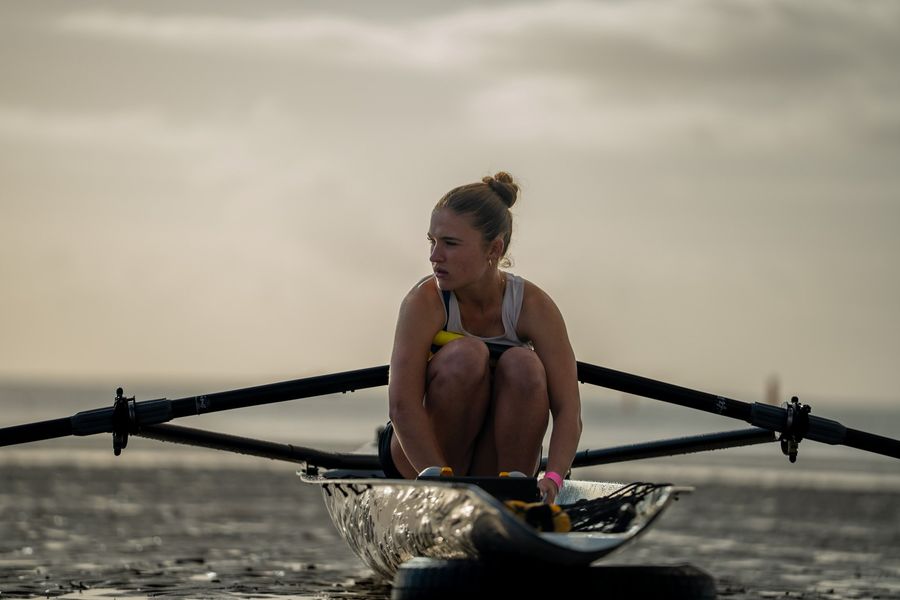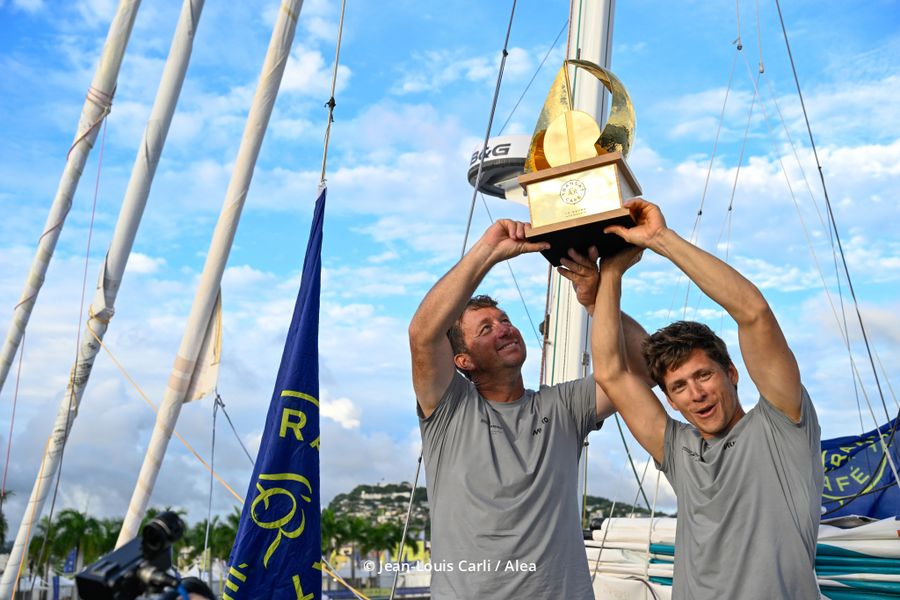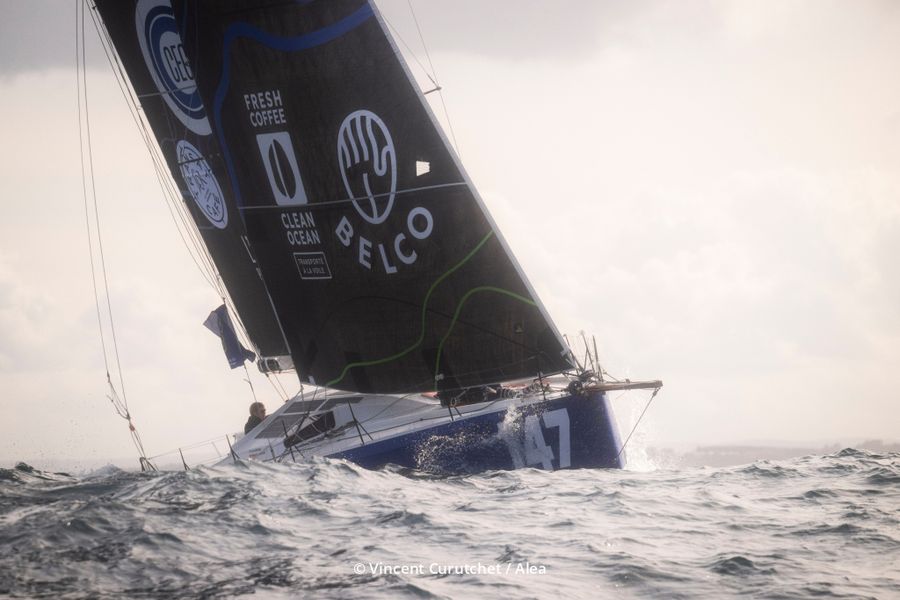
One week into the 17th edition of the Transat Café L'OR Le Havre Normandie, the fleet has already packed what would normally fill an entire campaign into seven relentless days. Seventy-four double-handed entries competing across ULTIM, Ocean Fifty, IMOCA, and Class 40 divisions departed Le Havre on 26 October 2025 into a classic autumn welcome: cold fronts, squalls, and a confused cross-sea that wasted no time sorting the prepared from the unprepared.
[gallery td_select_gallery_slide="slide" ids="156980,156981,156982,156983,156984,156985"]
The Class 40 fleet absorbed the worst of it early, their progress ultimately halted by race control in La Coruña as a significant Atlantic depression tracked through. While the smallest boats sheltered, the larger multihulls threaded south between Madeira and the Canaries, and the IMOCA foilers fought a strangely quiet chess match in drifting conditions that reshuffled the standings entirely.
Out front of the whole fleet, Tom Laperche and Franck Cammas aboard SVR Lazartigue, a 32-metre trimaran that recently competed in the Fastnet Challenge, have made a strong case for their machine as the benchmark for open-ocean speed. Averaging 30 knots through the trade winds, they opened a margin of more than 200 nautical miles over Sodebo Ultim 3. That cushion was tested when the Doldrums delivered on their reputation. "We're completely stopped, the sails flapping from side to side," Laperche admitted during Friday's check-in, a reminder that no lead is safe until Martinique is in sight.
[gallery td_select_gallery_slide="slide" ids="156989,156988,156990,156991"]
Banque Populaire XI responded by clawing back 100 miles, Armel Le Cléac'h and Séb Josse driving at 23 knots through the squall line. With the São Pedro and São Paulo Islands, the traditional gateway to the South Atlantic trades, now the next waypoint of consequence, the ULTIM contest remains very much alive.
In the Ocean Fifty class, the 15-metre trimaran Edenred 5 has been the standout performer of the opening week. The newest boat in the fleet, sailed by Basile Bourgnon and Manu Le Roch, led the division past Cape Verde through sharp sail handling and disciplined around-the-clock helming rotations. "We can still push harder, but we're watching the sheets every second," Bourgnon told race media. That measured approach has kept the boat fast and intact while others have struggled.
[embed]https://images.boatingnz.online/wp-content/uploads/2025/11/02163538/animation-parcours-4-classes.mp4[/embed]
The division's surprise package has been Viabilis Oceans, crewed by Baptiste Hulin and Thomas Rouxel. Beginning the week buried in mid-fleet, they executed a perfectly timed gybe south of the Canaries and climbed to second in class. Their pursuit of Edenred 5 looks set to continue all the way to Fort-de-France, with arrival expected around 8 November.
The 18 IMOCA foilers have lived a thoroughly different race. After a bruising first night in the Atlantic, they spent the middle of the week becalmed in a high-pressure ridge north of Fuerteventura, drifting within sight of one another in breezes barely reaching double figures. "We have nine boats in 30 miles," reported Britain's Will Harris, co-skippering 11th Hour Racing with Italian-American Francesca Clapcich. Their patience proved the decisive factor: they were first to find the re-establishing trade winds and held that advantage for 36 hours.
[gallery td_select_gallery_slide="slide" ids="156995,156996,156998,156997"]
Pressing them hard were Charal, skippered by Jérémie Beyou and Morgan Lagravière, and MACIF Santé Prévoyance with Sam Goodchild and Loïs Berrehar. Swiss-French pairing Justine Mettraux and Xavier Macaire lifted TeamWork, Team SNEF into third, marking the first time two women have appeared simultaneously in the top three of an IMOCA transatlantic race.
Among the international contingent, New Zealand skipper Conrad Colman has drawn notice for steady, measured progress aboard MSIG Europe. A Vendée Globe veteran, Colman's familiarity with heavy-weather boat management and power conservation has served him well as lighter rivals grapple with fragile foil systems and demanding electronics. A conservative opening has given way to consistent gains.
For the 42-boat Class 40 fleet, La Coruña's breakwater became equal parts sanctuary and reset point. Race organisers enforced a minimum four-hour stop, giving crews time for repairs before a noon restart on Saturday under bright skies and 10 knots of breeze. Thirty-seven boats made the line and turned west toward 3,200 miles of open Atlantic.
Seafrigo-Sogestran, crewed by Guillaume Pirouelle and Cédric Château, led the fleet out of port once again, with Faites un don sur SNSM, the pairing of Corentin Douguet and Axel Tréhin who had won the opening leg, in close pursuit. The defining tactical question of the second stage is whether to dive south early or seek the energy of the northern depressions tracking off the European coast. "The first big decision is whether to dive south early or ride the northern depressions," offered Ireland's Pam Lee, co-skippering EmpoHer. "The models disagree, so it's a proper sailor's race."
The 2025 edition also reflects the race's broader ambitions beyond the leaderboard. Cap pour Elles continues its support of all-female Class 40 crews, and Défi Solidaire avec Elye et l'Arche gives adaptive sailors a place on the ocean stage. Environmental partnerships with The Ocean Experience and Prendre la Mer extend the event's reach further, with renewable energy, circular composites, and responsible logistics all woven into what the race has become: a floating laboratory for sustainability.
As November opens, the leaders across all four fleets have finally settled into the trade winds. What lies ahead is the sailing that drew these crews here in the first place: days of reaching under spinnaker, nights paced by moonlight and radar sweeps, and the slow accumulation of miles toward Martinique. Week 1 has already made the point plainly enough. Preparation matters. Resilience counts. On the Atlantic, luck still holds a share in the outcome.
For Conrad Colman, for the crews of Edenred 5 and 11th Hour Racing, and for every boat still chasing Fort-de-France, the hardest miles remain ahead. The 2025 Transat Café L'OR has only just found its rhythm.