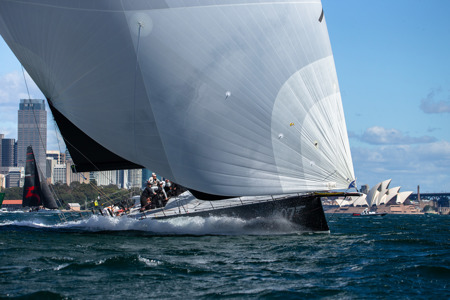
Eighty-eight nautical miles to a rocky island off Port Kembla. That's the simple part.
The forecast is the complicated bit, the kind that will have navigators flicking between weather models rather than sleeping well the night before.
On Saturday 26 September, the Audi Centre Sydney Blue Water Pointscore fleet lines up for race two of the 2026/27 season. The Flinders Islet Race is short by offshore standards, but short doesn't mean straightforward. The fleet starts at 1000hrs, threads out through the Heads and turns south, sailing past the cliffs of the Royal National Park and the escarpment above Wollongong before rounding Flinders Islet, a mile east of Port Kembla, and racing back into Sydney Harbour.
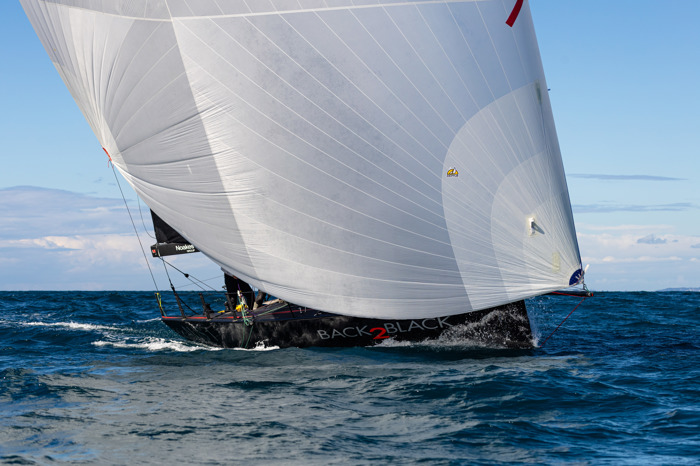
Back 2 Black, winner of race one under the NSGCYR banner, joins the fleet for this leg. That puts Flinders Islet at the point where the series starts to take real shape.
Every model agrees on the start, at least. A light north to north-easterly of 5 to 9 knots sits over the harbour and along Sydney's shore, building through the morning to 13 to 19 knots, stronger the further offshore the fleet gets. Kites up early, then a VMG run south.
The real question is what's coming up the coast to meet them. A southerly change is pushing north, and the models can't agree on when it reaches Flinders Islet. The earliest guidance has it arriving around 1700hrs. Others run later. There's also disagreement on how wide the transition zone between the two breezes will be. Current guidance has the southerly in the mid-20s, gusting into the low 30s. As always, these transitions are notoriously hard to pin down in advance.
That uncertainty sets up a dream scenario for somebody. A boat that reaches the islet just as the southerly arrives could run downwind the whole way down, round the mark, and run downwind the whole way home. Arrive too early and you're beating north into the northerly until the change finally catches you. Arrive too late and you're beating south into the southerly just to reach the rock.
The big boats will almost certainly round well ahead of the change, leaving them a long upwind slog home. Their clock stops earliest, but on corrected time, this one might belong to the middle or back of the fleet.
So, a small-boat race? Possibly one for boats that love a downwind VMG battle.
Moneypenny, the Reichel/Pugh 69, is the biggest boat in the fleet and favourite for line honours. In a building northerly it should round well clear of the fleet, but the earlier it arrives, the longer the wait beating north for the change. Line honours look likely. The overall result is another matter.
Porco Rosso, the canting-keel Cookson 50, is on a new programme and taking on its first offshore race. Canting keels love a downwind run in some breeze, and this forecast could hand them exactly that. Nobody quite knows what this team will do yet, and that's the appeal.
Gusto, the TP52 now under Lee Hawksley's ownership, heads into its second offshore outing of the season, looking to turn early promise into a genuine result.
Smuggler, the reigning 2024/25 Audi Centre Sydney Blue Water Pointscore champion, knows precisely what winning this series requires. A strong showing here would signal the TP52 is back in the title fight.
Back 2 Black, first home in the season-opening Noakes Sydney Gold Coast Yacht Race, arrives as the boat to beat. The Reichel/Pugh GP42 should round well ahead of the southerly, meaning it will need to defend its form through a long upwind stretch home.
Ambition, the other GP42, finished third in that same opener and has a direct benchmark in Back 2 Black. Expect the two sporty forties within sight of each other most of the day, every shift counting.
Disko Trooper, the J/99, dominated race one with a big scoreboard of results. Reaching the rock later in the afternoon, closer to the forecast change than the bigger boats, timing could fall its way. With symmetrical chutes aboard, it's not hard to imagine this one running the rhumb line downwind, both ways, and turning a tricky forecast into the tidiest result of the day.