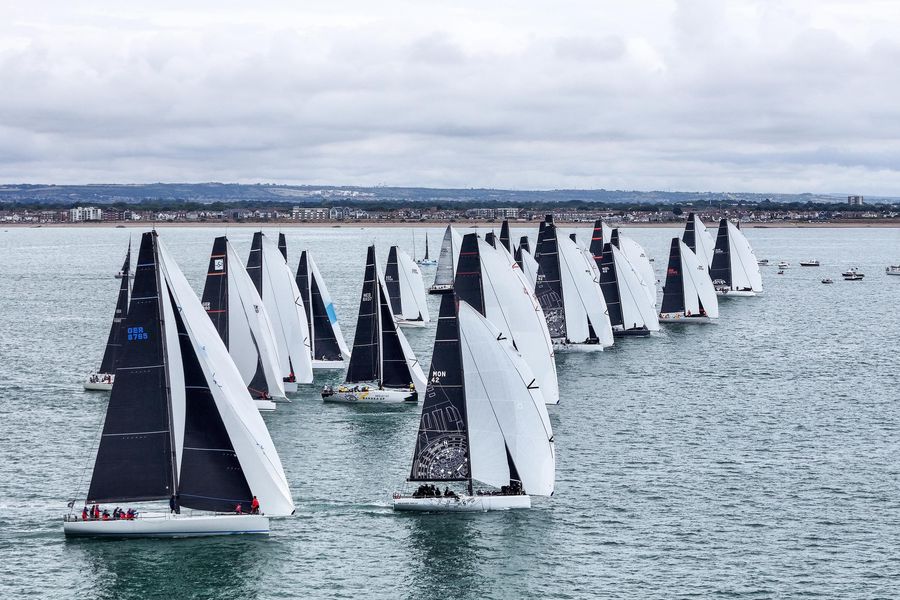
The 2025 Admiral's Cup got off to a lively, if belated, start on Saturday when the Channel Race fleet finally left the Royal Yacht Squadron line at 1210, more than two hours behind its scheduled 1000 BST start. Principal Race Officer Stuart Childerley held the 30-boat fleet back while strong winds and a rough central Solent gradually settled to something more manageable. When the signal finally came, the wait proved worthwhile.
A fresh southwesterly greeted the fleet and drove a tight reach along the southern shore of the Isle of Wight before the course swung west and then south toward the English Channel. Among those trading places at the front in the early stages were the German TP52 Imagine, Red Bandit, and Hong Kong's Beau Geste, along with Monaco's Jolt 6, all posting strong velocity-made-good numbers on what was a fast offshore fetch. As any experienced offshore racer knows, elapsed time on the water is only the beginning of the story.
By 1915 UTC, the corrected time standings were beginning to reveal where the real battle lines were forming. Jolt 6, representing Monaco, had edged into the lead with a corrected elapsed time of 1d 2h 10m and an estimated finish just before 0900 on Sunday. Breathing down her transom on corrected time were Hong Kong's Beau Ideal and Beau Geste, both sitting within ten minutes of the leader. Italy's Django JPK and Monaco's Jolt 3 completed the top five, each showing the boat speed and tactical awareness that makes the mid-race transition zones so decisive.
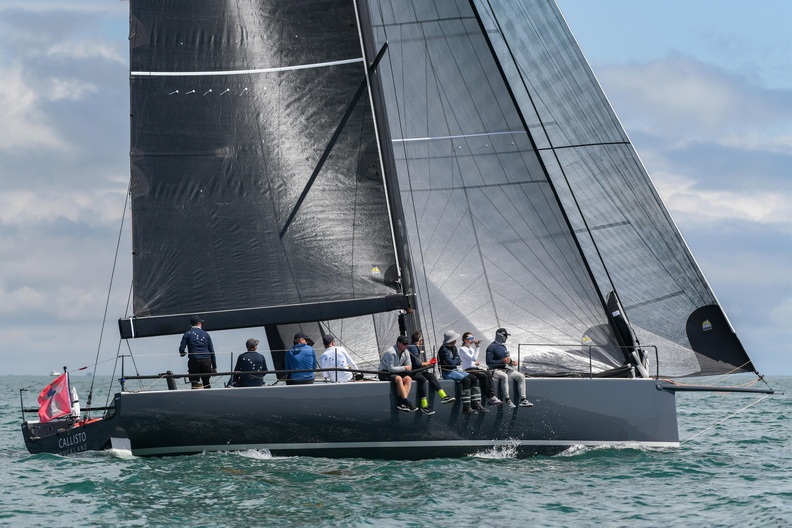
New Zealand's Callisto caught the eye as well, holding sixth on corrected time despite being one of the smaller hulls in the fleet. Her compatriot Caro had a less straightforward time of it. The race tracker suggested Caro may have encountered some difficulty at the start, though this had not been confirmed, and she was sitting seventeenth at the time of the update.
The national team standings were beginning to take shape, with Monaco and Hong Kong emerging as the early pacesetters. With Jolt 6 and Jolt 3 occupying two of the top five corrected time positions, the Monegasque squad looked tightly co-ordinated and well optimised for the conditions. Hong Kong's contribution was equally compelling. Beau Geste and Beau Ideal were holding their own near the top of the standings despite being quite different boats, one a proven offshore TP52 and the other a lighter, more versatile design.
Germany's five entries were scattered through the mid-fleet, with Black Pearl the best-placed in seventh and Red Bandit back in eleventh. The British squad of Sunrise, AMP-LiFi, and Ino Noir presented a mixed picture, with AMP-LiFi placed thirteenth on corrected time and Sunrise well down in twentieth.
Full Corrected Time Standings (as of 1915 UTC, 19 July)
| Pos | Boat Name | Nation | Corrected Elapsed |
|---|---|---|---|
| 1 | Jolt 6 | Monaco | 1d 2h 10m |
| 2 | Beau Ideal | Hong Kong | 1d 2h 17m |
| 3 | Beau Geste | Hong Kong | 1d 2h 20m |
| 4 | Django JPK | Italy | 1d 2h 21m |
| 5 | Jolt 3 | Monaco | 1d 2h 34m |
| 6 | Callisto | New Zealand | 1d 2h 38m |
| 7 | Black Pearl | Germany | 1d 2h 41m |
| 8 | Nola | Estonia | 1d 2h 43m |
| 9 | Albator | France | 1d 2h 46m |
| 10 | Baraka GP | Netherlands | 1d 2h 56m |
| 11 | Red Bandit | Germany | 1d 2h 59m |
| 12 | Garm | Sweden | 1d 3h 4m |
| 13 | AMP-LiFi | Great Britain | 1d 3h 5m |
| 14 | Zen | Australia | 1d 3h 7m |
| 15 | Caro | New Zealand (Switzerland) | 1d 3h 11m |
| 16 | Rán | Sweden | 1d 3h 12m |
| 17 | Final Final | USA | 1d 3h 18m |
| 18 | Ginkgo | Germany | 1d 3h 22m |
| 19 | X-Day | Germany | 1d 3h 35m |
| 20 | Sunrise | Great Britain | 1d 3h 37m |
| 21 | Back 2 Black | Australia | 1d 3h 42m |
| 22 | Abracadabra | USA | 1d 3h 44m |
| 23 | Django WR51 | Italy | 1d 3h 51m |
| 24 | Privateer | USA | 1d 3h 51m |
| 25 | Imagine | Germany | 1d 3h 51m |
| 26 | Van Uden | Netherlands | 1d 4h 35m |
| 27 | Teasing Machine | France | 1d 4h 40m |
| 28 | Ino Noir | Great Britain | 1d 4h 42m |
| 29 | Elida | Germany | 1d 4h 49m |
| 30 | Edelweiss | Germany | 1d 6h 53m |
With most of the fleet still carrying more than 80 nautical miles to the finish, the race was far from decided. Overnight conditions were expected to bring a softening breeze, placing a premium on tidal strategy around the Casquets and smart routing on the final approach back toward the Solent. Those transitions, as much as anything that had unfolded in the opening hours, would likely determine where the Admiral's Cup team points eventually fell.