There is a moment, watching a 75-kilogram catamaran peel silently away from the water's surface at 35 knots, when the engineering behind the spectacle disappears entirely. What remains is something closer to wonder. The PredictWind A-Class Catamaran World Championships 2025, hosted by Milford Cruising Club in Auckland, is built around that moment, and around the extraordinary precision required to make it happen.
The A-Class box rule keeps everything honest. Every boat must fit within 5.49 metres in length, 2.3 metres in beam, and carry a single sail of no more than 13.94 square metres. What sailors and designers do within those boundaries, though, is anything but constrained.
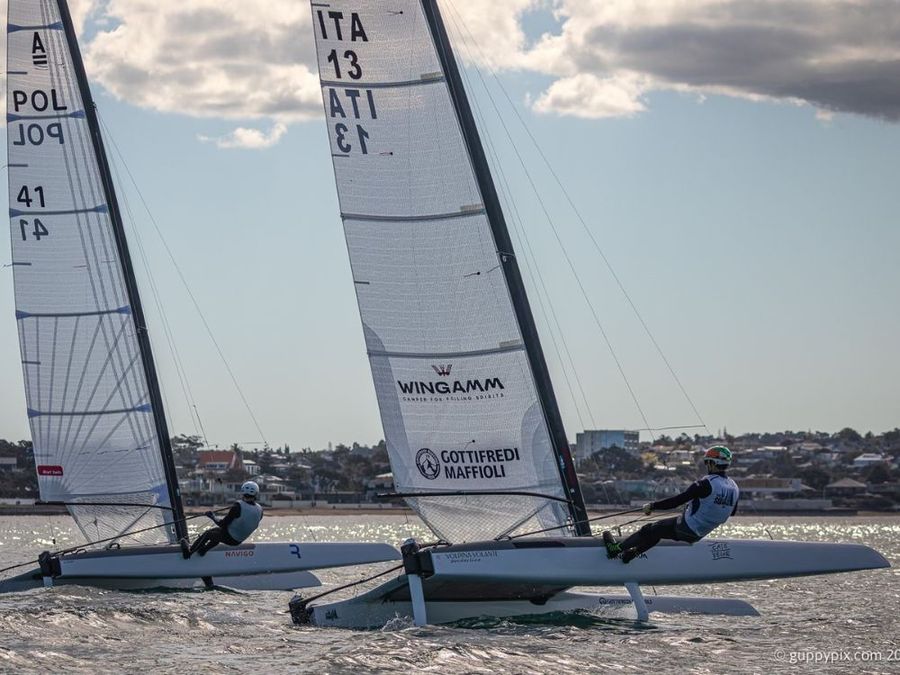
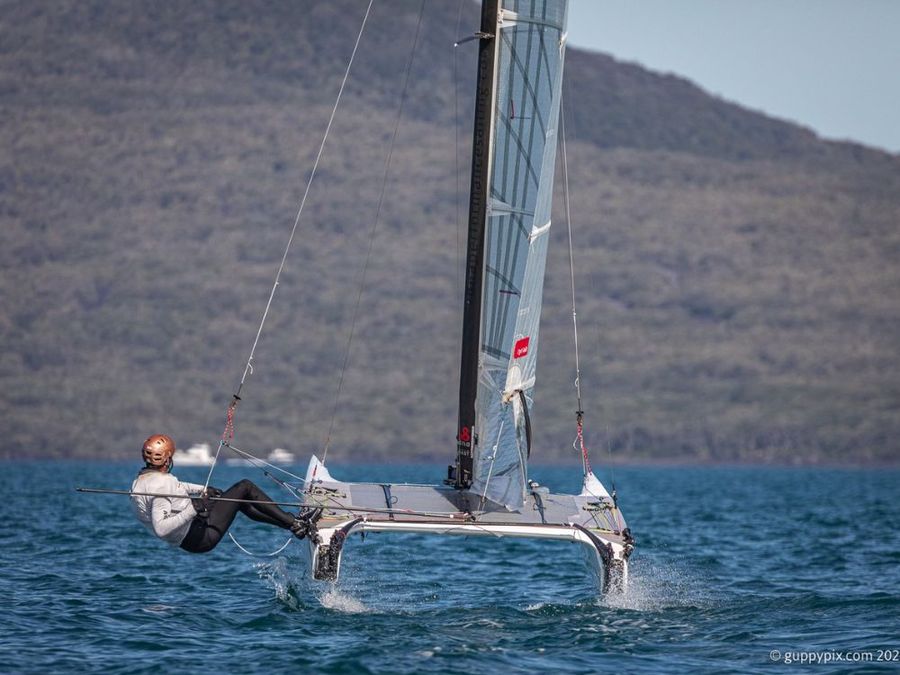
Since 2018, the class has operated across two distinct divisions. The Open fleet runs full foiling platforms, using curved daggerboards and T-foiled rudders to lift both hulls completely clear of the water. Keeping a boat in that state of flight demands constant, intuitive adjustment, with tiny changes to foil rake and sail trim working together to maintain height and stability. The Classic fleet works differently. Its straight or constant-curve foils allow only one hull to lift at a time, so sailors depend on clean hydrodynamics, minimal weight, and precise rig management rather than full airborne flight. In lighter conditions, Classics frequently have the edge, their reduced drag keeping them ahead of early foilers.
Despite those differences, both fleets share the same hull dimensions and rig profiles. One rewards the ability to hold a boat at the very limit of stability. The other demands tactical sharpness across a tightly contested pack.
{{MEDIA_1}}
Innovation has always been central to the A-Class identity, and this year's Worlds is no exception. Several competitors will campaign the Scheurer G8, a new Swiss-built Classic attracting considerable attention in the paddock. The design features a wider stern to generate additional downwind power, a recessed traveller track, and a raised rear beam that keeps sheets free of spray. Underwater, redesigned C-boards and thinner-chord T-rudders aim to improve efficiency and cut drag.
In the Open division, Exploder and DNA F1x platforms continue to set the standard. Both make extensive use of pre-preg carbon fibre laminates and precision moulding, producing ultra-light foils and aerodynamic beams that deliver what amounts to fighter-jet efficiency on water. Skippers work rake angles to within millimetres, hunting the precise point where lift, drag, and control come into equilibrium.
Above the waterline, aerodynamics have undergone their own quiet transformation. Sail designers now work with curved booms and refined luff profiles to smooth airflow over the sail surface, reducing turbulence, increasing lift, and sharpening the boat's response whenever the breeze shifts direction or strength.
The PredictWind partnership brings a further dimension to competition. Live forecasting and tide data fed directly to teams means sailors can identify micro-changes in wind angle and pressure before those shifts even reach the course. In a class where a single knot of difference can determine whether a boat is flying or floundering, that kind of advance information carries serious weight.
Even so, data can only take a sailor so far. On an A-Class, the margin between a winning adjustment and a capsize is measured in half a degree of foil rake or a centimetre of mainsheet travel. These boats sit at the intersection of science and instinct, and that combination, engineering knowledge working alongside human feel, separates the front of the fleet from the rest.
Auckland has long served as fertile ground for performance sailing development, and the Hauraki Gulf's mix of shifting breezes and rolling chop makes Milford Cruising Club's home waters a demanding and revealing venue. Local builder and America's Cup designer Mike Drummond adds his own layer of credibility to the Classic fleet, racing his own Exploder Ad3 while contributing design thinking that spreads through the broader group.
The A-Class has always been about balance: power against control, design against intuition, data against feel. Whether their hulls are cutting through Gulf chop or riding silently above it, the boats competing at the 2025 Worlds represent the furthest edge of what is achievable on wind alone. As the fleets prepare to race, the sailors who succeed will be those who can make all of that refined science work in harmony, and hold their flight together when conditions demand the most.