
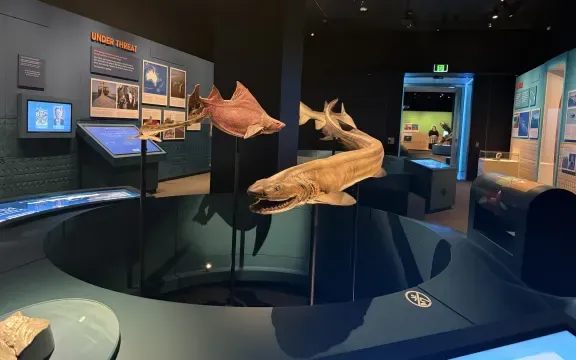
From cigar-sized curiosities to creatures heavier than an elephant, the range of shark species on display at Auckland Museum's latest exhibition is genuinely staggering. Simply titled Sharks, the show gives visitors an immersive look at the hundreds of species that inhabit New Zealand waters, and it challenges more than a few long-held assumptions along the way.
Clinton Duffy, Auckland Museum's curator of marine biology, has spent years arguing that sharks are among the most misunderstood animals on the planet. Even species with fearsome reputations, such as great whites, tiger sharks, and bull sharks, are not the relentless hunters popular culture has made them out to be.
"We're not part of their normal diet and most sharks are naturally cautious ... particularly of things that they don't know," he says.
Walking into the first room of the exhibition, though, it is easy to see how those fears took hold. Four life-sized models dominate the space, including a great white and a reconstruction of the 270-million-year-old Helicoprion, an extinct creature whose very classification remains a point of contention among scientists.
"It's a very, very early relative of a shark," Duffy says.

The Helicoprion's most arresting feature is a spiral of teeth running lengthwise along the middle of its tongue, an arrangement so unusual it earned the animal the nickname "Buzzsaw Shark". Since the first fossils came to light, researchers have argued over exactly how that structure worked in life.
"There's been a lot of debate, ever since the first fossils were found, about how [the toothed tongue] functions and what its purpose was," Duffy says.
"It's now thought that those teeth rotated backwards ... into the mouth as the jaw closed ... it's thought that they impaled prey on the tips of those teeth and when they closed the mouth the teeth rotated back in and pulled the prey in," he says.
Teeth are, of course, central to the shark's popular image, but the exhibition is equally interested in telling a less familiar story: that of sharks as a species under pressure. Their slow growth rates and limited reproductive capacity leave them unusually exposed to the effects of overfishing.
"Over-fishing is the biggest threat to sharks and rays globally.
[gallery td_select_gallery_slide="slide" ids="161925,161926"]
"In New Zealand most of our shark populations seem to be in pretty good shape [but] there are not anywhere near as many of them as there used to be," he says.
Duffy estimates that around 3,000 tonnes of shark are taken from New Zealand waters each year, frequently as unintended bycatch in commercial nets. Once a shark is in a net, the outcome is rarely good. Many larger species must keep moving simply to breathe, forcing water across their gills, and entanglement quickly becomes fatal.
"Many of the large species of shark have to keep swimming to stay alive, they have to keep swimming to breath and ventilate their gills and as soon as they get caught ... they start drowning," he says.
The fishermen who haul them up are left with a pragmatic calculation. "If a fisherman catches it, they may as well use it," Duffy says.
The consequences of depleting shark populations ripple far beyond the animals themselves. Sharks sit near the top of marine food webs, and their removal can trigger unexpected cascades elsewhere in the ecosystem. In the Atlantic, Duffy points to what happened when shark numbers fell and populations of the cownose ray went unchecked.
"They feed heavily on scallops and the result of that has been that there have been some pretty large and important scallop fisheries completely devastated by the cownose ray.
"You would think if we get rid of the sharks everything's going to be good, but you can get these big population explosions of species that never caused anybody any trouble before ... because their numbers were being kept under control by sharks," Duffy says.
"Just removing one component of [the ecosystem] means you can really tip the balance."
The Sharks exhibition opens 10 December and runs until 27 April, 2026.