Juan Kouyoumdjian, currently an unattached America's Cup designer explains the rule keeping AC75s human-controlled, and the wearable tech he thinks could be the next edge.
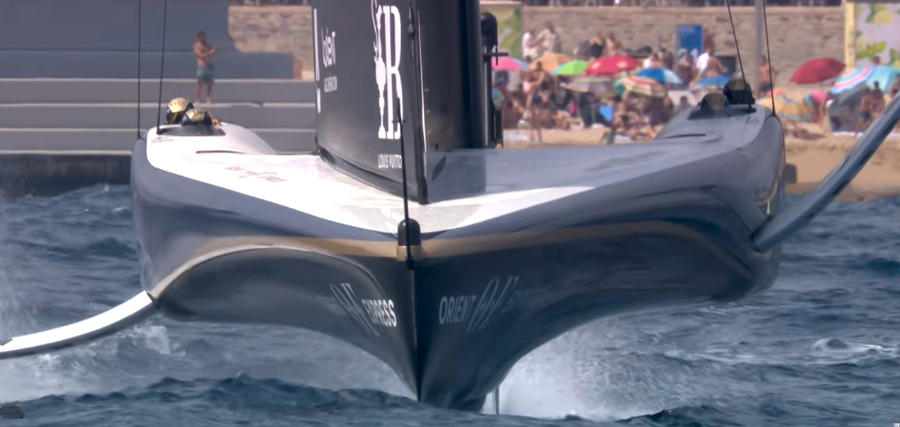
Here's something most fans watching the AC75s fly around Auckland, Cagliari and Lorient this month don't clock: an America's Cup yacht isn't allowed to use its own sense of wind angle, heel and boat speed to close an autonomous loop and adjust its own sails. A sailor still has to make the call.
That's the principle naval architect Juan Kouyoumdjian, an America's Cup veteran with six design involvements behind him and currently unattached to any team, unpacks in the latest episode of Inside America's Cup with host Niall Myant-Best.
Watch the full interview below, but here's what stood out.
The workaround is simple in theory. A sailor feeds in boat speed and wind speed, the system calculates an apparent wind target, and the crew steers toward it. Where it gets interesting is what happens after that human input hits the boat. Kouyoumdjian describes a chain of roughly 11 or 12 actuators that can sit downstream of that command, and says the real design battle this cycle isn't refining that logic for straight-line speed. It's manoeuvre logic. Races are barely won on pure VMG, he points out, they're won and lost in tacks and gybes.
His go-to example is the high-exit tack, which he says needs a completely different sail trim for roughly the first five to seven seconds out of the turn before snapping back to normal. Get it wrong and you bleed metres. Get it right, consistently, tack after tack, and that's what actually separates the fleet in his view. Not a single clever idea. Repeatable precision.
Which sets up his big call, the piece of tech he reckons is still sitting on the table. Kouyoumdjian sees another possible area to explore, rather than building the sensing system into the yacht itself, whether technology carried by a sailor could interpret what that sailor sees and feed it back better than the naked eye. Whether a given version of that idea would actually clear the class rule is a separate question, but as a concept, he calls it a genuine "winning device". As far as he knows, nobody's built it yet.
Asked about the AC75's five-sailor crew structure, Kouyoumdjian says he rates the trimmer-forward, helm-aft setup New Zealand and France ran last cycle. He argues it works because sailors ultimately fly the AC75 on visual references, particularly the relationship to the leeward foil, rather than by following numbers on a screen.
Bottom line from a guy who's spent decades designing these things: no silver bullet decides Naples. Just very, very small margins, mastered relentlessly. Catch the whole conversation below.