One hundred years ago, seven yachts left Cowes on what must have seemed like a reckless dream: to round a lonely rock off the Irish coast and come back. That vision became the Rolex Fastnet Race, and its centenary edition is shaping up to be the most extraordinary yet. With 451 boats confirmed to start on Saturday 26 July, the fleet has already surpassed the 2023 record of 430 entries, and the race itself feels less like a commemorative occasion than a demonstration of just how far offshore sailing has travelled in a century.
Spread across 57 nations and almost every conceivable class, the entry list is as democratic as any start line in world sailing. Teenagers racing double-handed in sub-10m cruisers will share the Royal Yacht Squadron start with veterans of the Vendée Globe, America's Cup tacticians, Olympic medallists, and sailors completing their first offshore passage. Every boat is bound for Cherbourg-en-Cotentin by way of Fastnet Rock and Bishop Rock. The ambition on display is immense.
At the absolute sharp end, four 32-metre foiling Ultim trimarans will race both the clock and each other. SVR-Lazartigue, skippered by François Gabart and Tom Laperche and carrying New Zealand sailing star Peter Burling, set the outright race record in 2023 and arrives again as the boat to beat. Maxi Banque Populaire XI, Sodebo Ultim 3 and Actual Ultim complete the class, each capable of a sub-24-hour finish and each representing the furthest edge of what a sailing vessel can currently do. These are not merely the fastest boats in this race. They are among the fastest sailing craft ever constructed.
Corrected-time glory is most likely to emerge from IRC Zero, where the overall contenders are concentrated. Eric de Turckheim's Teasing Machine, a NMYD 54, arrives in formidable form after victories in the RORC Transatlantic, Caribbean 600 and Myth of Malham. The chasers are no less serious: Warrior Won, Ino Noir, Albator and Rán all carry genuine podium ambitions. Mark Emerson's Phosphorus II, originally campaigned as Teasing Machine, is another boat widely tipped for a strong result.
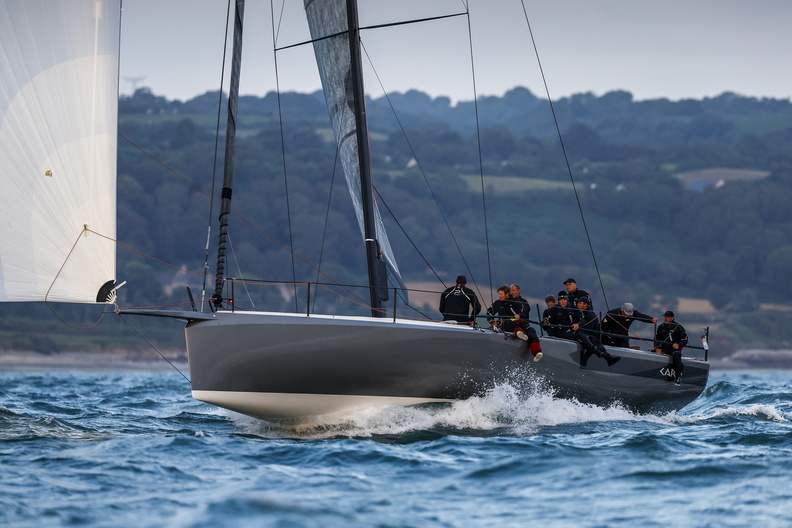
Monohull line honours could go one of three ways. Hong Kong's SHK Scallywag 100, Australia's Black Jack 100 and US-flagged Rambler 88 are all capable of blistering pace, and any one of them might pursue the unofficial Fastnet "triple": line honours, IRC overall and the race record in a single passage.
Stepping down through the fleet, IRC One features French legend Géry Trentesaux contesting his 18th Fastnet race. IRC Two is particularly well stocked with JPK-built designs, the JPK 11.80s prominent among them. IRC Three mixes owner-driver campaigns with seasoned Fastnet hands, while IRC Four, with 97 entries ranging from family cruisers to well-worn classics, is the beating heart of the whole event.
The double-handed division has grown into a genuine force, with more than 80 boats competing two-up. Many are modern, fast platforms sailed by specialists who thrive on the particular demands of short-handed offshore racing. Alongside them, the IMOCA 60s bring Vendée Globe pedigree to the grand prix ranks, while the Ocean Fifty class of 50-foot trimarans promises sustained high-speed racing through some of the most demanding water on the course. The Class40 fleet has expanded in both numbers and ambition, with several foiling Musa 40s expected to press hard against the established French campaigns. Multihull interest reaches its peak in MOCRA, where more than 20 entries will contest the Crystal Trophy, a record field drawing in performance cats and tris crewed by everyone from full professionals to accomplished cruising sailors.
Beyond the individual classes, one of the most compelling storylines of this edition is the return of the Admiral's Cup. Absent from the Fastnet since 1993 and not contested at all since 2003, the Cup is back with fifteen two-boat teams racing under national or club colours. Three inshore races have already been completed, and Yacht Club de Monaco leads the standings on 27 points, a single point clear of Royal Hong Kong Yacht Club. Royal New Zealand Yacht Squadron and Italy's Yacht Club Costa Smeralda are level on 34 points, with Sweden's Rán-led team close behind.
Monaco's position at the top of the table reflects the quality of its pair of TP52s. Jolt 3 and Jolt 6 carry a roster of Cup-level talent, with Ed Baird and Will Harris among those aboard. Hong Kong has Karl Kwok's Beau Geste, a boat always associated with pace and precision. New Zealand's campaign pairs Caro, a Botin 52 and the 2023 Fastnet IRC overall winner, with the lively GP42 Callisto, a combination that brings genuine offshore depth. Sweden's entry, Rán 8, is skippered by Niklas Zennström and crewed by a roster heavy with Volvo Ocean Race experience.
The Fastnet leg counts for triple points in the Admiral's Cup standings, which means the lead built inshore could unravel quickly. A mistimed tack at the Rock, a poor gybe angle approaching the Scillies, a single bad decision on the return leg across the Channel: any of these could swing the Cup. For the national teams, everything that has gone before is essentially a warm-up.
What binds this whole sprawling fleet together is the course itself. The tide gate at Hurst, the long haul past Portland, the grinding passage around Land's End, and the grey solitude of Fastnet Rock at the far end of it all. Then the return across the Celtic Sea, the Channel crossing, and the tactical puzzle of the Raz Blanchard at Cherbourg. Every boat in this fleet will face those same pressures, the Ultims for perhaps a day, the smallest cruisers for potentially a week and a half.