A decade of work and six new hulls on Wellington Harbour have produced something fresh for New Zealand sailing: a performance-capable vessel designed from the start for disabled sailors, beginners, and anyone whose mobility has changed over time.
The first production ParAble, built by MacKay Boats, entered the water under conditions that were, for a Wellington winter, surprisingly kind. The launch marked the end of a ten-year effort to create a sailing pathway for people who have historically found the sport difficult to access.

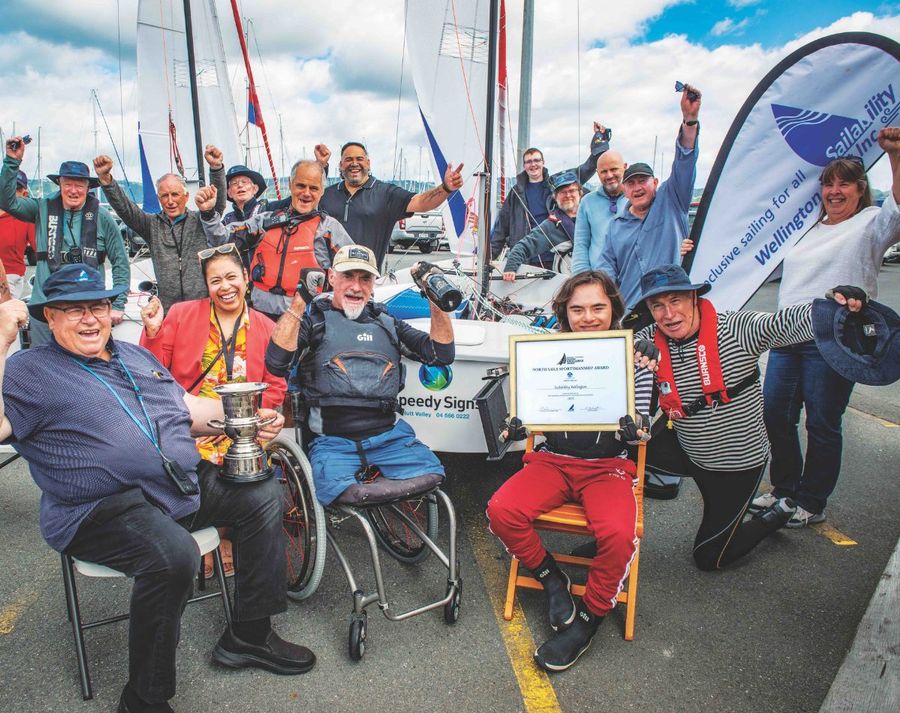
The project grew from conversations among the Support Crew of the Sailability Wellington Trust Inc (SWTI), based at Seaview. SWTI is New Zealand's leading sailing programme for people with disabilities, with more than 200 members and 70 volunteers spread across bases at Evans Bay, Seaview, and Onepoto in Porirua. Through years of working with their existing fleet, the crew reached a clear conclusion: the Hansa 303 boats they relied upon, while useful, fell short in several ways. Greater weight capacity was needed, along with stronger performance potential, self-righting and self-bailing capability, and the straightforward practicality of beach trolley launching. That recognition set a project in motion that took a full decade to complete, finishing in September 2025 with six production boats taking to Wellington Harbour.
[gallery td_select_gallery_slide="slide" ids="175406,175398,175399,175401,175403"]
The road from idea to production began in a Naenae garage, where designer Bruce Askew, supported by Kevin Cudby, shaped a wooden prototype. When that first model launched in 2019, it proved the concept was sound. Two further prototypes followed, named Prodigal Son and Jeff Dixon, with Carboglass and Tory Channel Contractors both contributing to the development process. MacKay Boats then partnered with the team to refine the final design and went on to construct all six production vessels.
The ParAble measures 4.1 metres in length with a beam of 1.5 metres and a draft of 1.4 metres. Stability comes from a 75-kilogram bulbed keel, and the cockpit accommodates two to three crew with a combined maximum weight of 240 kilograms. Adaptive seating and steering options are integrated into the design from the outset rather than retrofitted. The sail plan is deliberately versatile: an 8.1 square metre mainsail works alongside a 3.29 square metre jib and a 10.58 square metre furling gennaker, giving the boat a range that stretches from relaxed introductory sailing through to competitive racing. The hull is both self-bailing and self-righting, and the design has been conceived with a broad audience in mind. Those behind the ParAble see it as equally well suited to Scouts, Sea Cadets, yacht club learn-to-sail programmes, and sailors whose mobility has diminished with age.
The ParAble Class Association of New Zealand Inc is registered with Yachting New Zealand and is working through the development of class rules intended to support global racing under World Sailing rules. The class operates on a one-design basis, with MacKay Boats as the sole authorised builder and Doyle Sails as the designated sail maker. Safety provisions are built into the class rules: crew are required to remain within the cockpit at all times, with gunnel sitting and trapezes both prohibited. Work on finalising those rules continues, alongside the production of training materials and the planning of the first class regatta. Fundraising and volunteer recruitment remain active priorities, supporting both the ParAble programme and the broader work of Sailability Wellington.