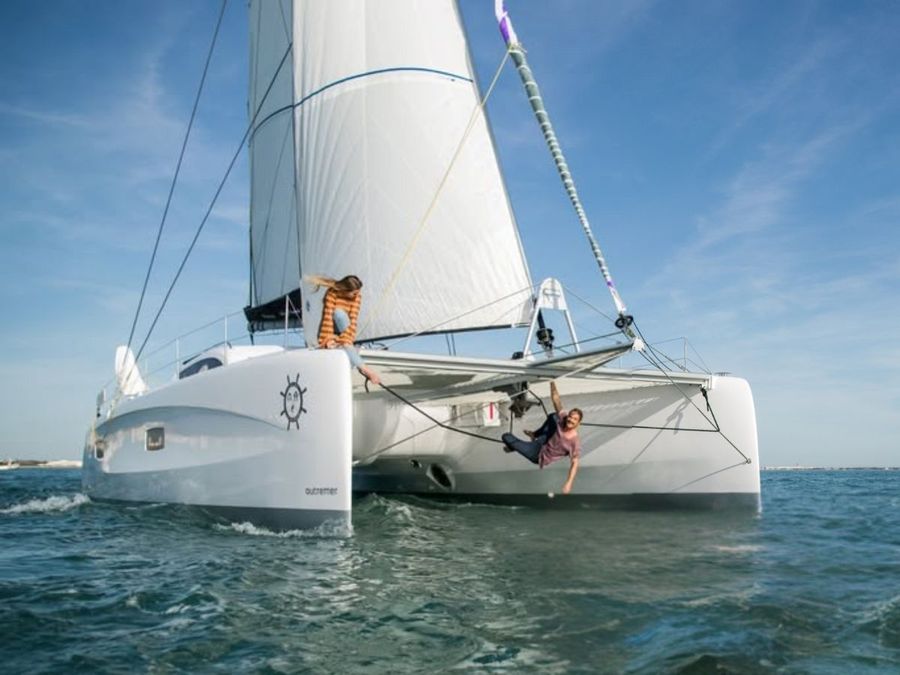
The Outremer 45 has built a genuine following among multihull sailors since its launch in 2014, and the reasons are not hard to find. At 48 feet, this catamaran strikes a balance between offshore capability and ease of handling that appeals equally to solo sailors, couples, and small families intent on long-distance cruising.
Central to that appeal is the helm station, where mainsheet, solent sheet, engine controls, and windlass are all positioned within arm's reach of whoever is at the tiller. Tacking, reefing, and trimming can each be handled from a single location, a layout that proves its worth when sailing shorthanded, navigating confined waters, or dealing with rapidly changing conditions. The autopilot engages quickly and reliably, adding another layer of confidence for those passages when an extra set of hands would otherwise be welcome.
Under sail, the Outremer 45 rewards its helmsperson with immediate, responsive steering. Narrow hulls and relatively light displacement produce a lively sailing feel even in moderate wind, with the boat accelerating cleanly rather than flopping onto its ear as a heavier design might. A fixed helm seat paired with a tiller gives a clear, unobstructed view of the sailplan, making efficient trim straightforward and physically undemanding. Performance has always been a strong point, and the range has been extended over time with variants including the 4X and the electrically powered 4.Zero. A 2.5-tonne payload means the boat can be outfitted properly for ocean passages without surrendering its characteristic handling.
The design has not stood still since its introduction. Hull extensions fitted as standard from 2017 pushed the length overall out to 48 feet. In 2018, a weight reduction of close to 500 kilograms sharpened performance further. Gennaker fittings and davits became standard equipment by 2019, and in 2020 the electrical system was upgraded with digital management through the CZone multiplexer. Each change has been incremental rather than radical, reinforcing the sense that the Outremer 45 has been refined steadily rather than reinvented.
Sail-handling safety runs through the entire deck layout. A low boom improves access to the mainsail and eases the load on the rig, while wide, flat side decks and step access positioned close to the mast make moving forward a straightforward business in most conditions. These details matter on a long passage, particularly at night or in a seaway.
Below decks, the emphasis is on practicality for extended use. The saloon and cockpit are arranged to provide 360-degree visibility, which benefits watchkeeping and anchoring alike. Whether at the navigation station or working in the galley, sightlines ahead and to each side remain largely unobstructed. The low boom also reduces the mainsail's centre of effort, contributing to both performance and easier reefing. Storage and access points are laid out logically, and while the interior is generous for a vessel of this size, nothing has been sacrificed in terms of sailing efficiency.
Cabin space accommodates four or five people for comfortable cruising, with up to seven aboard possible when provisioning is kept lean. The Outremer 45 is the smallest model in the Outremer range, yet it carries enough volume to support genuine liveaboard use without feeling cramped on passage.
With more than 100 hulls now launched, the Outremer 45 has moved well beyond the early-adopter stage into proven ocean cruiser territory. A decade on the water has shown that its appeal rests on a consistent combination of performance, control, and simplicity, qualities that continue to resonate with long-distance sailors.