Sunshine over the Solent greeted seven IMOCA crews on Sunday as Gunwharf Quays buzzed with anticipation ahead of the Leg 2 start. The dock-out ceremony, the parade of sailors, and the roar of the crowds carried an unmistakeable resonance: Portsmouth is the city where the first Whitbread Round the World Race was launched in 1973, and the weight of that history was felt throughout the afternoon.
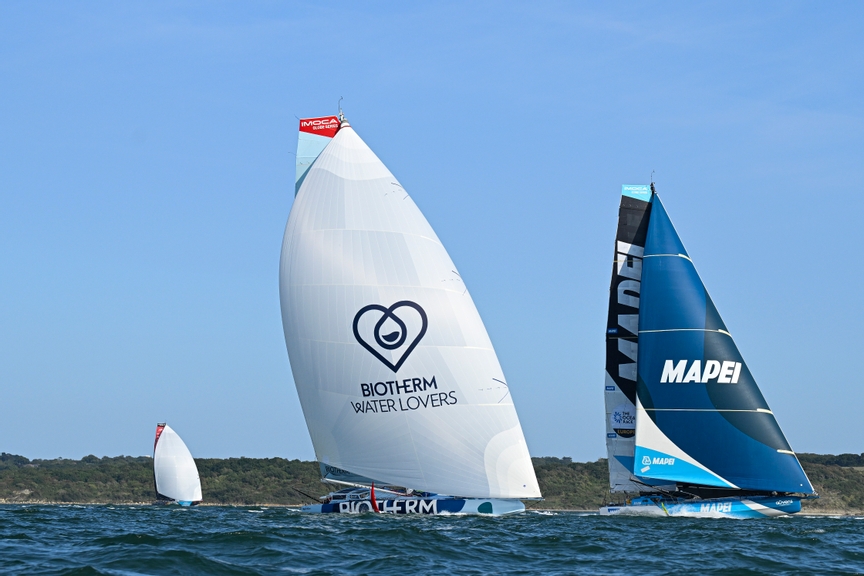
By 1700 the fleet had crossed to Cowes and lined up behind the Royal Yacht Squadron's storied start line. The Solent offered close to ideal racing conditions, with 10 to 14 knots of breeze, a helpful ebb tide, spinnakers aloft, and the first scoring gate at The Needles sitting just 12 miles ahead. For Portsmouth, this was something more than spectacle. It was a living connection to the origins of offshore racing, played out aboard the most advanced sailing machines the sport has ever produced.
The stories heading into the start, though, belonged to two boats that had barely seemed likely to make it to the dock at all.
Just one week earlier, Holcim-PRB and Allagrande Mapei Racing had been in serious doubt after a high-speed collision in the opening moments of the Leg 1 start in Kiel forced both boats out of the race with significant structural damage. The repairs that followed were considerable. Holcim-PRB, skippered by Rosalin Kuiper, had sustained a sizeable hole in her carbon hull along with rigging failure. Working in shifts around the clock, the shore team, supported by Knierim Yachtbau shipyard, designed, moulded, and fitted a new hull section in a matter of days.
Crew member Alan Roberts captured the mood: "Adversity either splits or unites you. In this case it united us. The shore team thrived on it. When we go offshore, we're in a really focused, nothing-else-matters mindset, and that's what they gave us."
Allagrande Mapei's skipper Ambrogio Beccaria was candid about how close things had come to ending altogether: "We really thought it was over. Now that it's behind us, it's going to push us to give our very best."
Both boats were alongside at Gunwharf Quays by Saturday, repairs complete, their presence at the start line already a victory in itself.
When racing got under way, it was Yoann Richomme's Paprec Arkéa that nailed the start, the blue and red IMOCA crossing the Royal Yacht Squadron line with a full spinnaker in a picture-perfect moment.
Control at the front shifted by the time the fleet reached The Needles scoring gate. Biotherm, led by France's Paul Meilhat, collected maximum points there, with Paprec Arkéa second and a determined Holcim-PRB crossing third, keen to show their comeback was genuine. Malizia and Canada Ocean Racing followed, while Allagrande Mapei and Amaala trailed. The result extended Biotherm's unbroken run of scoring gate victories across Leg 1 and the early stages of Leg 2, putting them clear at the top of the provisional standings.
Back on the Portsmouth dock before the start, the significance of what lay ahead had been etched across the sailors' faces. At over 1,000 nautical miles, Leg 2 is the longest and most complex stage of the 2025 edition, threading through the English Channel, across the Bay of Biscay, down the Portuguese coast, and into the Mediterranean.
Franck Cammas, sailing aboard Holcim-PRB, spoke with the focus of someone who had studied the routing closely: "We're arriving fairly fresh and obviously very focused. It's the longest leg and we're going to face many different conditions. There will be a windy first night, then tough transitions. The result could be decided in the last 100 miles."
Morgan Lagravière, a newcomer stepping onto Allagrande Mapei for his first Ocean Race leg, was eager to put the frustrations of Kiel behind him: "We were all frustrated with Kiel, so now we're really happy to be heading back to sea, measuring ourselves against the others."
Richomme, smiling easily before the start gun, described the route with undisguised enthusiasm: "A spinnaker start down the Solent, a fast run down the Channel, beautiful. Then a tactical crossing of the Bay of Biscay, Portuguese trades, and into Porto. It's what I like for my boat."
The tactical complexity of the course ran through nearly every pre-race conversation. Winds were forecast to build beyond 30 knots as the fleet pushed west toward Brittany, but the more decisive challenge was expected at the transition zone near Ushant, where easterly winds would give way to patchy light air before the northwesterlies filled back in.
Holcim-PRB navigator Nicolas Lunven was measured about what lay ahead: "Versatility will be key. The forecast isn't clear, so we'll need to be very opportunistic. Big differences could open up in the transitions."
Further along the course, the Matosinhos–Porto fly-by presented its own wildcard. The three-hour neutralisation is an unusual feature that could either bunch the fleet or amplify the gaps. Paprec Arkéa's Corentin Horeau was direct about it: "It could be a jackpot, or it could be a handicap."
Beyond Porto, the fleet would face Gibraltar's notoriously unpredictable, funnelled winds before pushing into the Mediterranean for the finish. Cammas was similarly frank: "It should be very inconsistent. The result could be decided right at the end."
The leg's first twist arrived before Monday morning was out. After a fast opening night in which the fleet exceeded routing predictions, the wind dropped below 10 knots off Ushant and the pack compressed sharply. Canada Ocean Racing grabbed the lead briefly before Biotherm reasserted themselves as pressure returned. Teams that had gambled on the southern route, among them Holcim-PRB and Allagrande Mapei, found themselves on the wrong side of the calm.
Lagravière was honest about the setback: "It's a bit of a disappointment. We thought we could sneak through, but it wasn't the case. Still, we're working hard to pick up the new wind."
Aboard Biotherm, Sam Goodchild described the conditions plainly: "The conditions are struggling to stabilise, it's not super pleasant, but we're doing everything to optimise speed."
After the Needles scoring gate the provisional standings showed Biotherm on 11 points, Paprec Arkéa on 7, Team Malizia on 6, Canada Ocean Racing – Be Water Positive on 4, Team Amaala on 3, and both Holcim-PRB and Allagrande Mapei Racing yet to open their accounts. For those last two boats, raw points matter less at this stage than demonstrating they are back at full strength. Roberts left no doubt about the intention aboard Holcim-PRB: "We're not just back, we're 100% ready, more ambitious than before."
What lies ahead demands patience, adaptability, and the capacity to handle whatever the Atlantic and the Mediterranean choose to deliver. Light-wind compressions, the explosive potential of the Bay of Biscay, shifting Portuguese trades, the chaos of Gibraltar, and a finish that could come down to the final miles before Cartagena — it amounts to the most complete test the 2025 edition has offered so far.
Lagravière, reflecting on the field around him, offered a thought that perhaps framed the entire leg: "You don't need to fear anyone — we all know each other well — but you do need to be wary of everyone."