A festival atmosphere set the scene along Kiel's Kiellinie promenade, where flags fluttered, brass bands filled the air, and the harbour bristled with spectator boats packed close enough for crews to pick out individual voices in the crowd. After a week of sailor parades, speed runs, and warm summer days, seven IMOCA 60s assembled for the opening leg of The Ocean Race Europe 2025, an 850-nautical-mile passage to Portsmouth threading through wind farms, rocky coastlines, and the tight channels of the Danish straits.
Nobody anticipated that the race's defining moment would arrive before the fleet had covered even a mile.
In the final seconds before the gun, Team Holcim PRB, under skipper Rosalin Kuiper, came storming in on starboard with right of way. Above them, Ambrogio Beccaria's Allagrande Mapei Racing bore away beneath a large masthead sail. As the breeze strengthened, Holcim PRB broached and Mapei heeled hard, and the two boats came together with a crunch. Mapei's headsail was torn to ribbons; a gash opened in Holcim PRB's port topsides. Both crews immediately turned back toward the harbour. The remaining five boats sailed on.
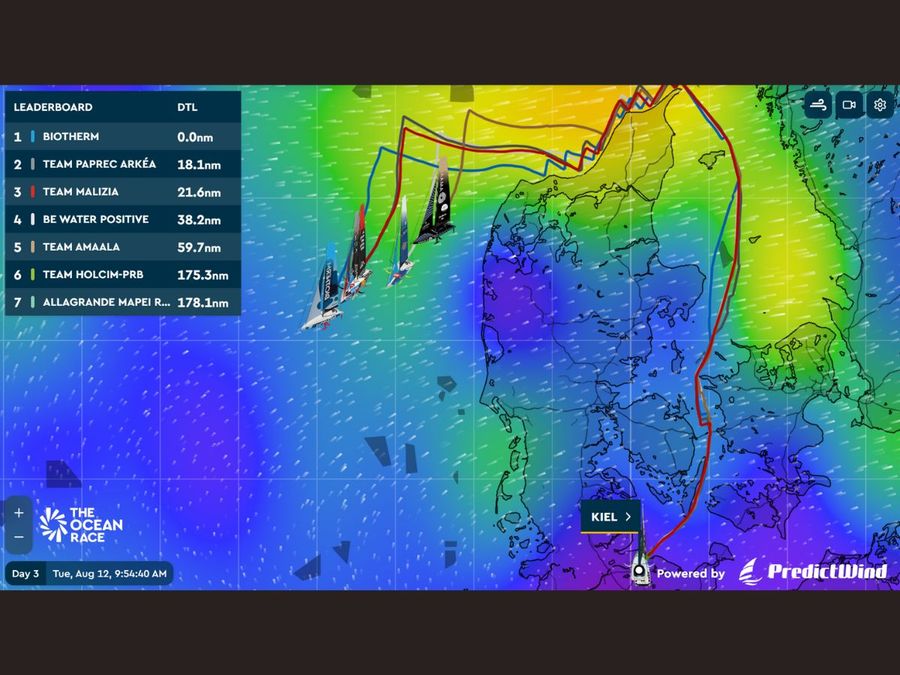
Biotherm, skippered by Paul Meilhat, led the charge through the Kiel Lighthouse scoring gate, banking the first two bonus points of the race. Paprec Arkéa crossed second and Canada Ocean Racing – Be Water Positive third. Meilhat's crew maintained their advantage through that first night, racing in close company with Yoann Richomme's Paprec Arkéa across the tricky early miles.
"The start was super intense, and we definitely burned a lot of energy," Richomme admitted.
Biotherm's Amélie Grassi described the opening hours as "relentless," with shifting, unstable winds, heavy boat traffic, and constant trim changes demanding full crew concentration. "For a long time, all four of us were in the cockpit working," she said. "We had a clear plan for onboard organisation and sail trim, so far, it's gone without a hitch."
That discipline kept Biotherm at the front through to dawn. Reaching Skagen at Denmark's northern tip, the character of the race changed entirely. The fast, flat reaching gave way to a punishing upwind slog into 15 to 20 knots of breeze, short-tacking through a steep, choppy sea. Spray, noise, and relentless boat motion made meaningful rest all but impossible for every crew on the water.
Back in Kiel, the two crews who had turned back were already deep into damage assessment and repair. For Beccaria, taking the helm of Allagrande Mapei Racing for the first time, the experience carried conflicting emotions. He described it as "a mix of disappointment and pride… disappointment at having to withdraw so early, but immense pride in the way the team reacted."
The scale of the damage made recovery far from straightforward. Mapei's starboard shroud system had been severely compromised, requiring a replacement D0 outrigger stay, donated by rival team Paprec Arkéa, and a complete replacement outrigger sourced from TR Racing's other IMOCA, Advens 1. Those carbon components were dispatched from Lorient the morning after the collision, expected to reach Kiel within 24 hours.
Engineers turned particular attention to the D0 chainplate, an attachment point that routinely bears loads exceeding 30 tonnes. Ultrasound scanning and consultations with the boat's designers were under way to determine whether repairs could restore Mapei to race-ready condition. The J0 headsail was written off entirely, though the mainsail's significant tear had already been patched by the time the full extent of the work became clear.
Holcim PRB faced a similarly intense repair programme. Both teams also lodged formal protests arising from the collision, with those matters set to be decided by an international jury.
At sea, Biotherm and the front-runners found no let-up as the first full day unfolded: hard upwind miles, minimal sleep, and racing conducted at close quarters. On the dock, Allagrande Mapei Racing and Holcim PRB were fighting a different kind of contest, measured in sourced components, repaired structures, and the slim possibility of rejoining the fleet for Leg 2, from Portsmouth to Cartagena, scheduled to depart on 17 August.
Grassi, already well ahead on the water, had not forgotten the two boats left behind. "We all hope they'll find a way to get back in the race," she said. In The Ocean Race Europe, a single mile can rewrite the entire story, and the ability to recover is every bit as much a part of the competition as the sailing itself.