Nearly a year on from Emirates Team New Zealand's victory in Barcelona, the defenders have returned to the water in Auckland. The mood inside the base is one of deliberate reconstruction. The team is deep in what it calls recalibration, reordering crew dynamics and sharpening priorities as the focus locks onto Naples 2027. There is a great deal of ground to cover before the Cup itself comes around again.
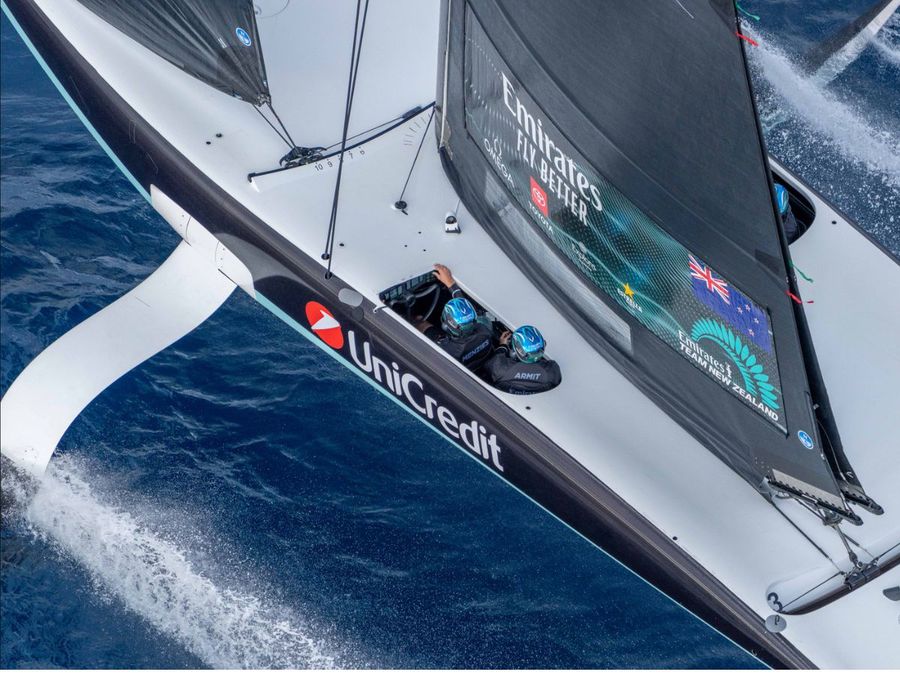
Training has resumed aboard the AC40, the nimble foiling boat that bridges the gap between everyday sailing and the full demands of the AC75. Anyone who has spent time on the Waitematā in a cruising yacht will have some sense of just how startling the AC40 is in motion, a machine that appears and vanishes before you have quite registered it. Time on the water has been matched by long sessions in the simulator inside the team's base, the two environments working together to sharpen timing, voice commands, and data management into something approaching instinct.
The central question hanging over the programme is how skipper Nathan Outteridge will fill the space left by Peter Burling, who has departed for Luna Rossa. Burling and Blair Tuke were the axis around which the team's modern success turned, their composure and precision underpinning back-to-back Cup victories. Tuke remains, providing continuity, while Outteridge carries the task of binding experience and youth into a cohesive unit. The old guard of Andy Maloney, Chris Draper, Sam Meech, and Tuke will be essential to that process, holding the line while a newer generation finds its footing. Distractions, potentially including SailGP commitments, may well need to be set aside, though how that plays out remains to be seen. Naples will require complete focus.
Four new sailors have come into the squad. Josh Armit finished fourth in the IQ Foil class at the 2024 Olympics. Seb Menzies claimed the 2025 European Championship in the 49er and brings experience from the Youth America's Cup. Jake Pye, the youngest of the group at 20, has twice reached the Moth Worlds podium. Alongside these three young Kiwis comes Jo Aleh, 39, a double Olympic medallist, former Female World Sailor of the Year, and someone who helmed during the Women's America's Cup. Her inclusion also satisfies the new rule requiring a female sailor within the five-person crew. She is the only woman named in the line-up so far. One woman among five is progress, though it is not parity. It is, at minimum, a beginning.
Progress on the water has been swift. The simulator and AC40 sessions are built to develop synchronisation across timing, foil control, and communication, and the results have been visible. Flight controller Maloney has described watching the new sailors develop as "impressive," and those inside the base report a team room that now carries the energy of youthful ambition tempered by experienced steadiness. That combination is exactly what Team New Zealand is aiming for when it talks about recalibration.
That process of rebuilding runs alongside some of the most significant rule changes the America's Cup has seen in years. Cyclors are gone. The leg-powered grinding systems that became a signature of the Kiwis' 2017 Bermuda campaign are now history, replaced by stored battery energy to drive foils and control surfaces. Raw physical power no longer carries the weight it once did. Crews have been reduced to five, each sailor operating across multiple roles simultaneously, closer in some ways to a Formula One engineer than a traditional deckhand. As strength becomes less decisive, the door may open wider for more women at the top level of Cup racing.
The shift has reshaped what training looks like. Endurance remains important, but the emphasis has moved firmly toward precision and communication. The simulator has taken on the role once filled by the gymnasium, a place where split-second coordination is repeated until it becomes automatic. Outteridge and chief operating officer Kevin Shoebridge have spoken of building depth, though what they are really describing is the cultivation of a new collective mindset. These sailors are as much technicians and pilots as they are athletes. The AC75, still the fastest monohull on water, will now reward awareness and nerve above all else.
Cost controls add another dimension to the environment. Teams are required to reuse hulls from either the Auckland 2021 or Barcelona 2024 campaigns, redirecting ingenuity toward systems and foils rather than an unconstrained carbon-fibre build programme. That kind of constraint tends to suit Emirates Team New Zealand. The team's competitive edge has consistently come from design efficiency and system intelligence rather than brute spending. Where others pursue breakthroughs through expenditure, the Auckland base looks for speed in software refinement and technical precision.
For Aleh, Armit, Menzies, and Pye, stepping into that environment means embracing constant scrutiny and expectation with very little ceremony in between. Aleh contributes tactical composure and hard-won experience. Menzies brings an analytical approach to problem-solving. Armit offers explosive physical agility. Pye carries the unguarded hunger of someone with everything to prove. As a group they represent a concentrated wave of renewal, operating under the direct oversight of Outteridge and the veterans around him.
The broader America's Cup landscape is itself in transition. Governance has moved away from the old tension between defender and challenger toward a structure shared across the competing syndicates. The expectation is that the next event will be more stable and less exposed to the political friction that has at times overshadowed previous cycles. Inside the teams, however, the practical effect is immediate and personal. With budgets constrained, hulls reused, and sustainability commitments part of the framework, there is no longer room to absorb poor decisions or unnecessary waste. Crew selection, energy strategy, and technical choices all carry real consequences. Every call counts.