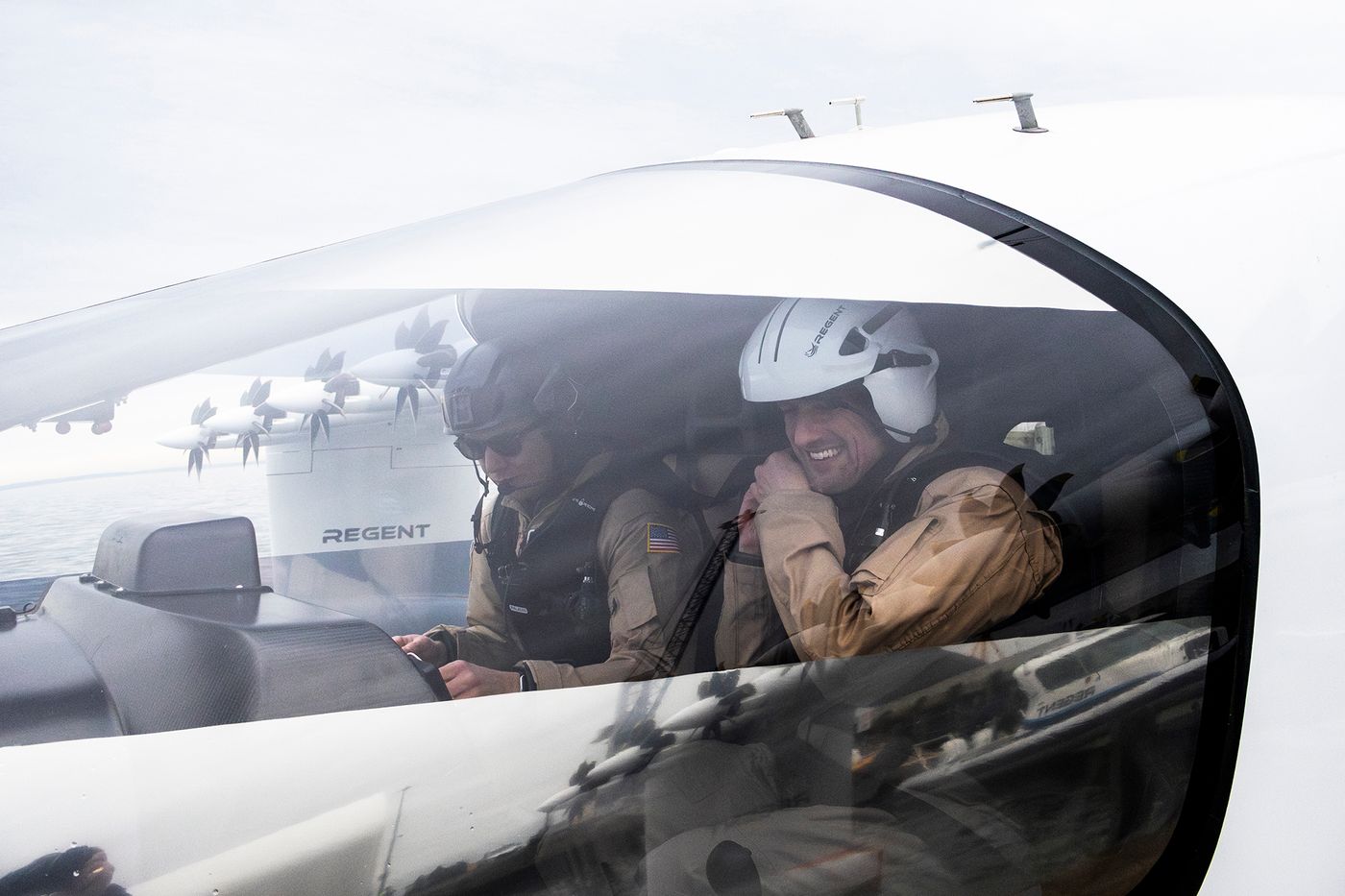
Something notable is taking shape on the waters of Rhode Island, and New Zealand already has a stake in it. The Viceroy, a 55-foot full-scale prototype built by REGENT (Range Extending Ground Effect Naval Transport), belongs to a category of craft that resists easy description. Equal parts boat, hydrofoil, and aircraft, it travels at high speed just above the water's surface, staying within a wingspan of it at all times. By 2026, the technology has moved decisively past the concept phase and into rigorous, full-scale prototype testing.
What sets the Viceroy apart is its ability to operate across three entirely distinct modes. At rest or low speed it behaves as a conventional vessel. Apply power to its twelve 120kW electric motors and the hull rises clear of the water on retractable hydrofoils. Push the throttle further and the craft transitions into ground-effect flight, the foils retract, and the Viceroy skims above the surface at up to 156 knots. REGENT is currently putting the full-scale prototype through its paces across all three modes, with a crewed first flight targeted for this year.
Configured to carry 12 passengers and two crew, the Viceroy has a payload capacity of 3,000 pounds. Current battery technology supports roughly an hour at cruise speed on a single charge, equating to around 156 nautical miles. REGENT expects that figure to grow considerably as next-generation aviation-specific battery packs come online, with projections pointing toward 400 nautical miles.
New Zealand is not waiting to see how this plays out. In April 2022, Ocean Flyer signed a landmark NZ$700 million agreement with REGENT to bring 25 Seagliders to New Zealand, becoming the first Seaglider-only company established anywhere in the world. The vision underpinning that commitment is ambitious: sustainable, fully electric, fast, and affordable public transport connecting communities the length and breadth of the motu.
"REGENT's first full-size seaglider entering human sea trials is a defining milestone in the evolution of sustainable maritime movement," says Shah Aslam, Ocean Flyer CEO.
New Zealand's geography suits the Seaglider about as well as any place on earth. Long coastlines, island-dotted harbour networks, and coastal communities separated by stretches of open water are precisely the conditions this craft was designed to serve. One of the longstanding obstacles to coastal air-water transport has been the requirement for dedicated seaplane infrastructure, but the Viceroy can operate from standard marina facilities, removing that barrier entirely. At a cruise speed more than triple that of a fast ferry, routes such as Auckland to Wellington or across Cook Strait become a very different proposition.
Aslam has spoken about what the technology means beyond the journey time itself. "This technology represents more than just a new mode of travel. It's a bold step toward a future where efficiency, sustainability, and innovation redefine how we connect our communities. With seagliders, we are not only reducing emissions but also unlocking unprecedented economic and social opportunities across our coastal regions."
For REGENT, 2026 marks a significant step change. After a winter period focused on design refinements, data analysis, and simulation work, the company launched a comprehensive testing campaign covering both on-water operations and simulation-based development. The goals are to sharpen vehicle performance, reduce operational risk, and accelerate readiness for both commercial service and defence applications.
"2026 is a defining year for REGENT as we continue advancing from prototype testing toward scaled production," said Billy Thalheimer, co-founder and CEO. "Demand for Seagliders is growing quickly across both commercial and defence markets."
The test campaign also covers the Squire, a smaller autonomous Seaglider drone built around the same hydrofoiling and ground-effect principles. The Squire carries a 50-pound payload at 70 knots across a range of 100 nautical miles, and is being evaluated for defence roles including contested logistics and search and rescue operations.
On the production side, REGENT is preparing to open a 255,000-square-foot manufacturing facility in Rhode Island this summer, where commercial Seaglider vessels will be built and first customer deliveries are expected in 2027. The commercial order book already speaks to the scale of interest, with orders exceeding US$10 billion. Recent additions include The XXV in the United States and Synerjet in Brazil, while on the defence side an expanded contract with the US Marine Corps Warfighting Laboratory signals growing military appetite for the technology. The company has also raised more than US$100 million from investors including Japan Airlines, Lockheed Martin, and Founders Fund.
As the programme scales toward production, quality assurance is being built into every stage of the process. Senior Quality Technician John Still applies advanced measurement and inspection technology to verify that every component is documented and validated before it is integrated into the vehicle. Those same standards will carry through as the programme transitions from prototype to production, and they will matter enormously once passenger-carrying commercial services begin.
For Ocean Flyer and the New Zealand communities it hopes to serve, that moment is the one worth watching. Aslam has said Ocean Flyer is proud to be leading this charge, shaping the future of transportation in New Zealand and beyond. The Viceroy is no longer a digital render. It is on the water in Rhode Island, rising onto its foils, and edging closer to flight.